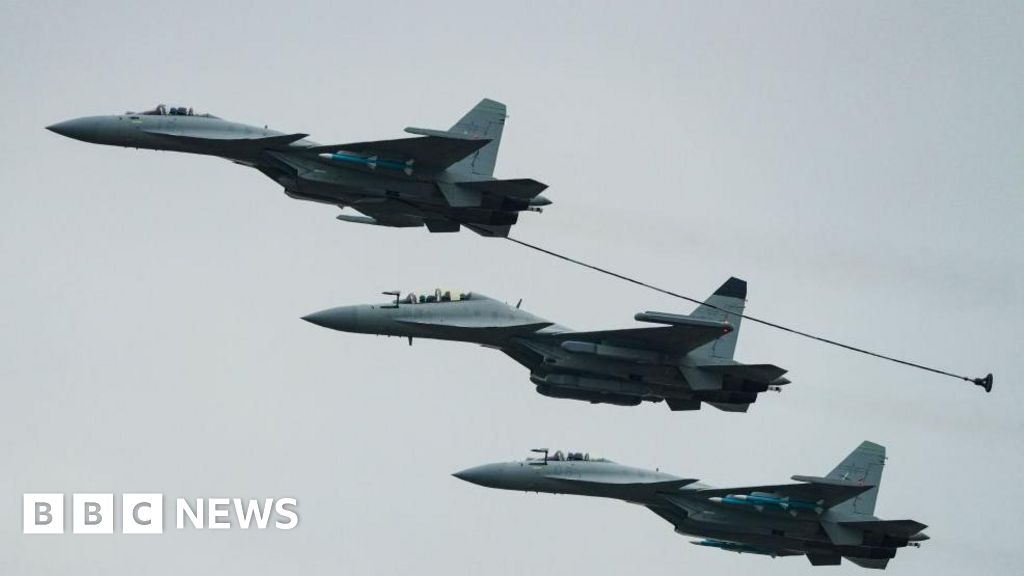
Japan lodged a formal protest after Chinese J-15 fighter jets launched from the carrier Liaoning locked fire-control radar on Japanese aircraft twice off Okinawa on Saturday (at 16:32 and ~18:37 local time), prompting Japan to scramble jets; no damage or injuries were reported. The episode follows a month of escalating rhetoric after Prime Minister Sanae Takaichi signalled Japan might use force if China attacked Taiwan, and Beijing has responded with measures affecting travel and trade (travel advisories, a seafood import ban and suspension of Japanese film screenings), raising near-term geopolitical risk that could pressure regional tourism, seafood exports and elevate defense-sector attention.
Market structure: Immediate winners are defense primes (US: LMT, RTX, NOC; Japan: 7011.T Mitsubishi Heavy, 7012.T Kawasaki Heavy) as government procurement probability rises; losers are Japan/China tourism, film distributors and consumer-facing exporters reliant on cross‑border flows (airlines 9201.T/9202.T, hospitality). Pricing power shifts toward large defense OEMs and logistics providers; Japanese consumer discretionary faces demand compression with potential margin pressure of 5–15% over several quarters if inbound tourism declines persist.
Risk assessment: Tail risks include escalation around Taiwan (low probability but >$1tn global GDP shock scenario) and sanctions that could sever tech supply chains; immediate horizon (days) sees FX and volatility spikes, weeks–months sees revenue hits to tourism and media, long-term (1–3 years) sees sustained defense capex. Hidden dependencies: Taiwan semiconductor continuity, potential BOJ/FX intervention if USD/JPY moves >3%, and China’s use of non-tariff trade retaliation as a lever. Key catalysts: repeated military incidents, formal Japanese procurement announcements, or Chinese broad consumer boycotts (30–90 day windows).
Trade implications: Tactical longs: defense primes and select Japanese OEMs with 6–18 month holding periods; tactical shorts: Japan airlines and leisure names for 1–3 months or until China reopens travel. Cross-asset: expect JPY appreciation in risk‑off (USD/JPY down 1–3%), JGB yields compressing, Treasuries rallying, gold rising +3–8% on escalation. Options: buy 1–3 month VXX call spreads and 3–6 month gold calls as asymmetric hedges.
Contrarian angles: Consensus overstresses immediate kinetic conflict probability while underpricing multi-year Japanese rearmament (procurement cycles + supply contracts take 6–36 months to flow to OEM revenues). Historical parallel: 2014 Crimea saw defense primes outperform by ~20% within 12 months. Unintended consequence: stronger defense demand could lift industrial and semiconductor capex, benefiting certain suppliers but also stoking inflation and policy tightening if sustained.
AI-powered research, real-time alerts, and portfolio analytics for institutional investors.
Request DemoOverall Sentiment
moderately negative
Sentiment Score
-0.50
