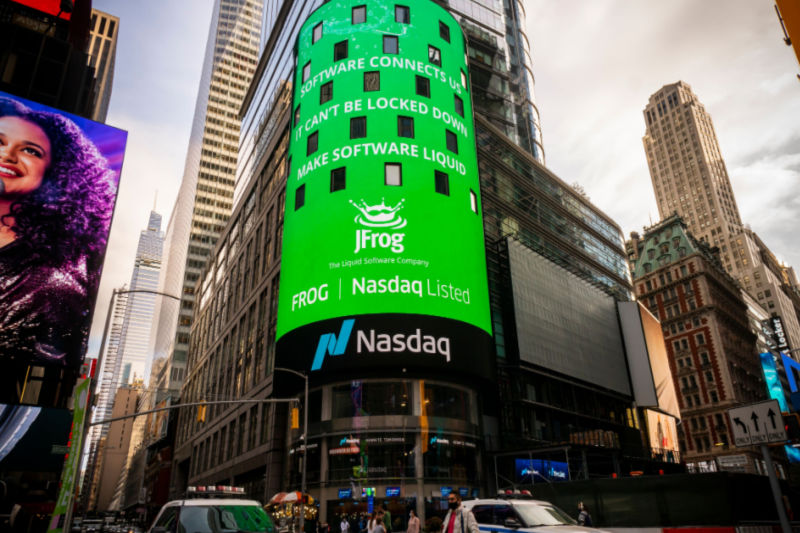
UBS upgraded JFrog to Buy from Neutral with a $60 price target (TD Cowen and Guggenheim reiterated Buy with $80 and $60 PTs), signaling analyst optimism driven by AI tailwinds. JFrog launched its Agent Skills Registry integrated with NVIDIA to scale enterprise AI agents, while addressing security after a supply-chain attack on the litellm Python package. Director Sela Yossi sold 25,000 shares for $1.13M under a 10b5-1 plan and now directly holds 103,922 shares; the stock trades at $43.34 with a $5.22B market cap. Fundamentals show 76.79% gross margin and 24.12% revenue growth but the company was unprofitable over the last twelve months.
JFrog’s move to bundle AI agent governance into its platform is strategically sensible but should be viewed as a multi-quarter TAM expansion rather than an immediate EBITDA lever. High gross margins give pricing flexibility, but monetizing enterprise AI governance requires new sales motions, SOC integration, and compliance certifications that typically lengthen sales cycles by 6–12 months and raise near-term S&M intensity.
The most important second-order winners are AI-infrastructure and systems vendors (GPU vendors, server OEMs, and cloud providers) because enterprise adoption of managed AI agents will drive incremental spend on secure deployment and monitoring stacks. Conversely, lightweight open-source packages and unauthenticated supply chains become more fragile as enterprises shift to paid, verifiable toolchains — expect consolidation pressure on small OSS maintainers and niche security tooling vendors.
Key risks: a successful supply-chain compromise or an operational failure in an AI-agent marketplace could reset trust and stall enterprise adoption for 3–9 months, while rising competition from specialists (CI/CD security, SBOM providers) could force feature bundling and margin erosion. Short-term price action will be headline-driven; meaningful fundamental re-rating requires visible ARR acceleration and proof points of cross-sell into AI governance within 4–12 quarters.
The market narrative is leaning toward an ‘AI tailwind’ shortcut — that upside is real but front-loaded in expectations. If you believe adoption is gradual, there’s an asymmetry: patient, structured exposure captures upside from platform wins while limiting downside from headline volatility and attack-driven resets.
AI-powered research, real-time alerts, and portfolio analytics for institutional investors.
Request DemoOverall Sentiment
mildly positive
Sentiment Score
0.20
Ticker Sentiment
