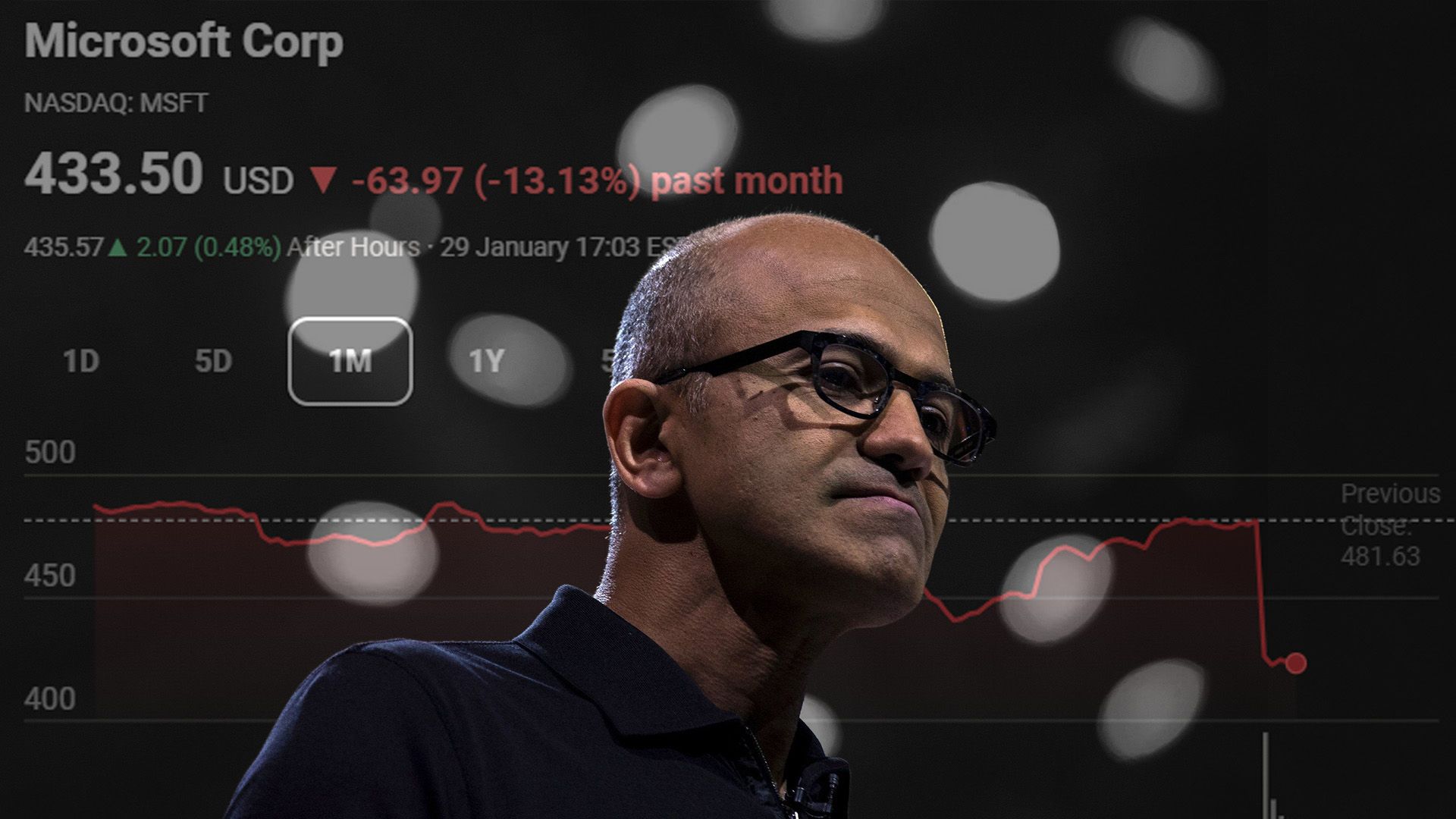
Microsoft shares plunged 5.37% in a single session, wiping about $440 billion of market value and leaving the stock down ~14% in January and ~2% year-to-date, as investors questioned the firm's AI strategy and heavy infrastructure spending. The company reported Azure growth of 39% with a 37% forward growth guide, cloud revenue surpassing $50 billion and FY revenue of $81.3 billion (+17% YoY), operating income up 21% YoY with net $38.5 billion, and strong product metrics (Microsoft 365 Copilot +160% YoY; GitHub Copilot +75% YoY), but capex jumped to nearly $40 billion for the quarter (≈+70% YoY). Markets reacted to concerns that aggressive GPU and data‑center investments — and reliance on OpenAI — may not generate timely returns and could pressure margins, prompting a sizable risk‑off repricing.
Market structure: The immediate winners are disciplined cloud owners (GOOGL) and GPU suppliers (NVDA on continued demand) while aggressive capex spenders—MSFT and data‑center dependent suppliers—face near‑term pain. A 5.4% one‑day MSFT drop (~$440bn) re-prices growth premium and increases funding costs for AI partnerships (OpenAI); Azure growth of ~39% Y/Y vs capex ~ $40bn/Q suggests expectations now price slower margin leverage over 6–18 months. GPU demand remains tight but investor focus has shifted from revenue growth to ROIC and depreciation schedules, pressuring pricing power for firms with heavy silicon rollovers.
Risk assessment: Tail risks include (a) an OpenAI funding shortfall forcing MSFT equity raises or asset sales, (b) rapid GPU obsolescence triggering multi‑billion write‑downs, and (c) regulatory action limiting cloud bundling—each could cut MSFT EPS >15% over 12 months. Near term (days–weeks) expect elevated IV and stop‑runs; medium term (3–12 months) margin compression and guidance downgrades; long term (2–5 years) optionality remains if AGI captures >10% incremental TAM. Hidden dependency: MSFT’s capital return program and buybacks may be constrained if capex to sales stays >20% for successive quarters.
Trade implications: Implement relative value: long GOOGL vs short MSFT over 3–9 months (GOOGL capex discipline vs MSFT execution risk). Use defined‑risk options: buy 3‑month MSFT 5% OTM put spreads (limit loss) sized to 1–2% portfolio; buy 6–12 month GOOGL call spreads (1–2% allocation) or outright 2–3% long GOOGL equity. Reduce discretionary mega‑cap exposure by 3–5% and rotate into defensive Sectors (Healthcare, Staples) and 5–10yr Treasuries until post‑earnings volatility subsides.
Contrarian view: The market may be over‑penalising MSFT’s capex because heavy infrastructure creates a durable moat if AI demand scales; historical parallel: early AWS capital intensity (2012–15) pressured Amazon’s margins before capturing cloud market share. If GPU amortization schedules normalize or OpenAI finds strategic funding, a sharp mean reversion is plausible — a >20% rebound in MSFT within 6–12 months is a non‑trivial scenario to hedge into rather than outright sellout.
AI-powered research, real-time alerts, and portfolio analytics for institutional investors.
Request DemoOverall Sentiment
strongly negative
Sentiment Score
-0.70
Ticker Sentiment
