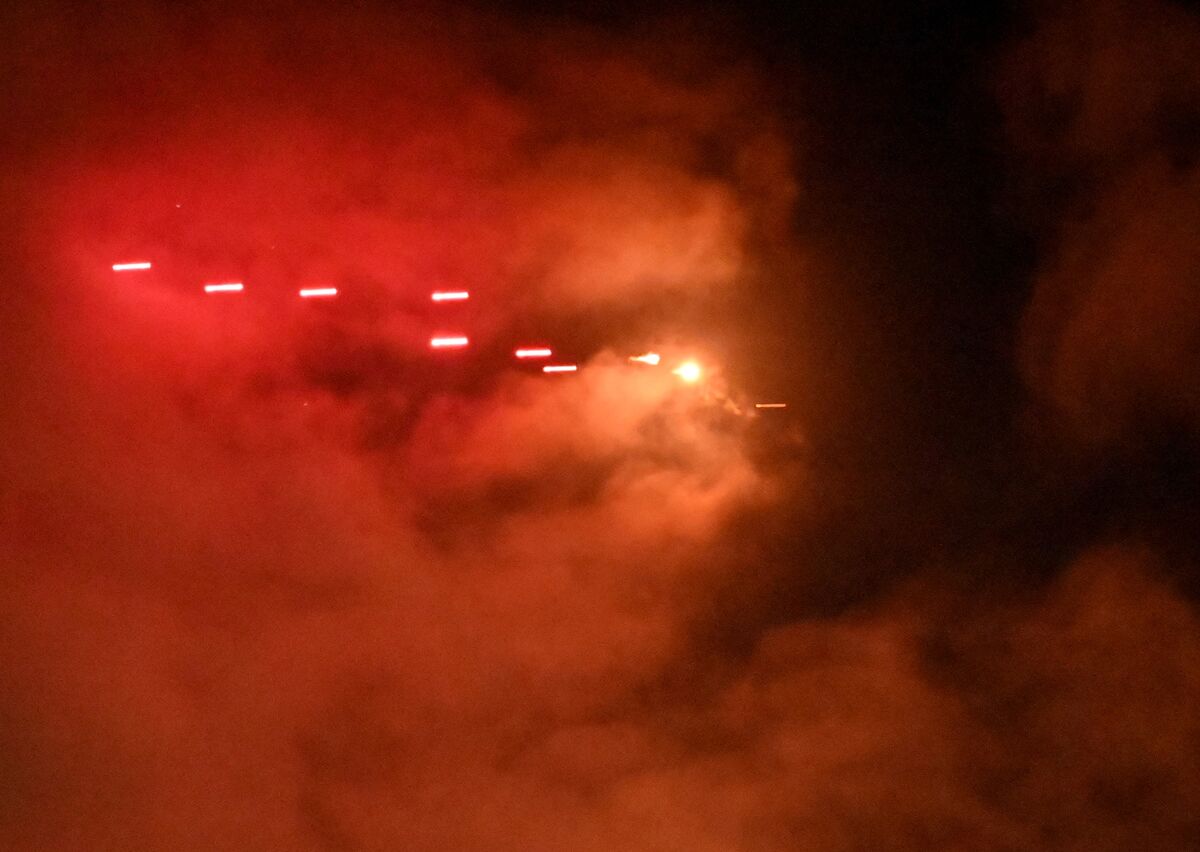
Russian forces launched heavy air raids on Kyiv and attacks on southern Russian areas early Tuesday, prompting Kyiv’s air defenses to respond, widespread explosions, and authorities ordering residents to shelter; Kyiv Mayor Vitali Klitschko reported severe damage to a residential apartment building and fires in commercial properties. The strikes occurred hours after President Donald Trump expressed optimism about a potential ceasefire deal, undercutting near-term diplomatic hopes and increasing geopolitical risk that could weigh on risk assets and regional stability.
Market structure: Defense contractors, energy producers, and global safe-haven assets are the mechanical beneficiaries as geopolitical risk premium re-prices; expect 6–12% relative outperformance in US large-cap defense names vs S&P over 1–3 months if tensions persist. European cyclical sectors (banks, travel, real estate) face near-term funding and demand pressure; CEEMEA sovereign and corporate credit spreads are likely to widen 25–75 bps in the next 2–8 weeks, compressing regional equity valuations. Commodity demand shock is asymmetric: oil/gas forward curves likely to steepen by $2–6/bbl in 1–3 months while grain/fertilizer logistics risk keeps upside skewed for 3–6 months.
Risk assessment: Tail risks include rapid escalation to energy supply disruption (probability 5–15%) which would push Brent > $100/bbl and trigger stagflation dynamics, or a diplomatic ceasefire that reverses risk premia within 7–21 days. Immediate (days) risk is volatility spikes; short-term (weeks/months) risk is credit repricing and capex deferral; long-term (quarters/years) is persistent defense spending and diversification of energy suppliers. Hidden dependencies: winter heating demand, LNG cargo availability, and upcoming elections in major markets can amplify or mute moves.
Trade implications: Favor long-defense equity exposure sized 2–4% of portfolio via LMT/RTX/NOC with 1–3 month call spreads to cap premium; hedge with 1–2% long TLT or UUP for duration/FX protection. Short European cyclical beta via -1.0x exposure to VGK or short financials (STOXX Banks) sized 1–2% for 4–8 weeks; consider buying 3–6 month Brent call spreads (e.g., BZ=F) for commodity upside with defined risk. Use options to express skew: buy puts on STOXX600 (1–3 month) and buy calls on GLD or IEF as convex hedges.
Contrarian angles: Consensus may overpay defense outperformance if markets price an ephemeral flare-up; a 2–4 week diplomatic de-escalation could compress defense multiples 10–15% from peak. Energy moves are spotty—if winter inventories hold, a fast retreat in oil is plausible; avoid indiscriminate energy longs and prefer integrated majors (XOM, CVX) over pure midstream. Historical parallels show post-spike mean reversion in equities within 30–90 days unless supply fundamentals change, so size and use defined-risk instruments.
AI-powered research, real-time alerts, and portfolio analytics for institutional investors.
Request DemoOverall Sentiment
strongly negative
Sentiment Score
-0.60
