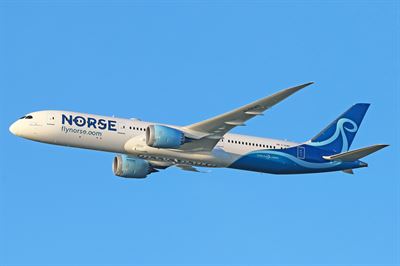
Norse Atlantic has completed a strategic shift to a blended business model by delivering the sixth and final Boeing 787-9 under a long-term ACMI deal with IndiGo (delivered 29 Jan), securing long-term contracts for 50% of its 12-aircraft 787 fleet and receiving guaranteed payment for 350 block hours per aircraft per month plus excess utilization pay. The move reduces exposure to fuel-price volatility and short-term demand swings while the remaining fleet operates a high-graded route network; Norse reported roughly USD 680 million in revenue for the 12 months ended 30 Sept 2025 and has carried about 5 million passengers to date, improving predictability of cash flows and lowering the company’s overall risk profile.
Market structure: Norse’s 50% fleet shift into long‑term ACMI with IndiGo transfers a large chunk of long‑haul supply from spot to contracted capacity, benefiting ACMI specialists, lessors (AER) and OEMs (BA) via utilization stability while pressuring margin‑thin, spot‑dependent leisure carriers. Price discovery for transatlantic leisure fares will be less volatile on routes served by ACMI, lowering downside for contract counterparties but ceding upside capture to operators retaining their own network capacity.
Risk assessment: Key tail risks are counterparty concentration (IndiGo payment/default), a sudden >20% spike in jet fuel prices within 3 months, or regulatory constraints on cross‑border ACMI rules. Immediate market moves should be muted; expect credit spread compression for firms with ACMI floors over next 1–3 quarters and structural earnings volatility reduction over 3–18 months. Hidden dependency: residual values and 787 maintenance reserves - if secondary values drop 10–20%, lessor/OEM earnings face erosion.
Trade implications: Favor equities and credit exposed to stable cash flows — BA (supply/aftermarket), AER (lessors), and selective aircraft credit — while underweight pure-play leisure carriers and broad airline beta (JETS ETF). Use relative value: long lessors/OEMs vs short spot‑exposed airlines, and layered options to express event risks (ACMI renewals, fuel moves) over 3–12 month horizons.
Contrarian angle: Consensus prizes headline stability but underprices counterparty and residual‑value risk; markets may underreact to the concentration risk of large ACMI blocks (single‑counterparty failure could wipe ~30–40% of secured hours). Historical parallel: post‑2010 capacity contracts insulated some carriers but left them exposed to concentrated lessee defaults — don’t conflate contracted revenue with risk‑free cash flow.
AI-powered research, real-time alerts, and portfolio analytics for institutional investors.
Request DemoOverall Sentiment
moderately positive
Sentiment Score
0.55
Ticker Sentiment
