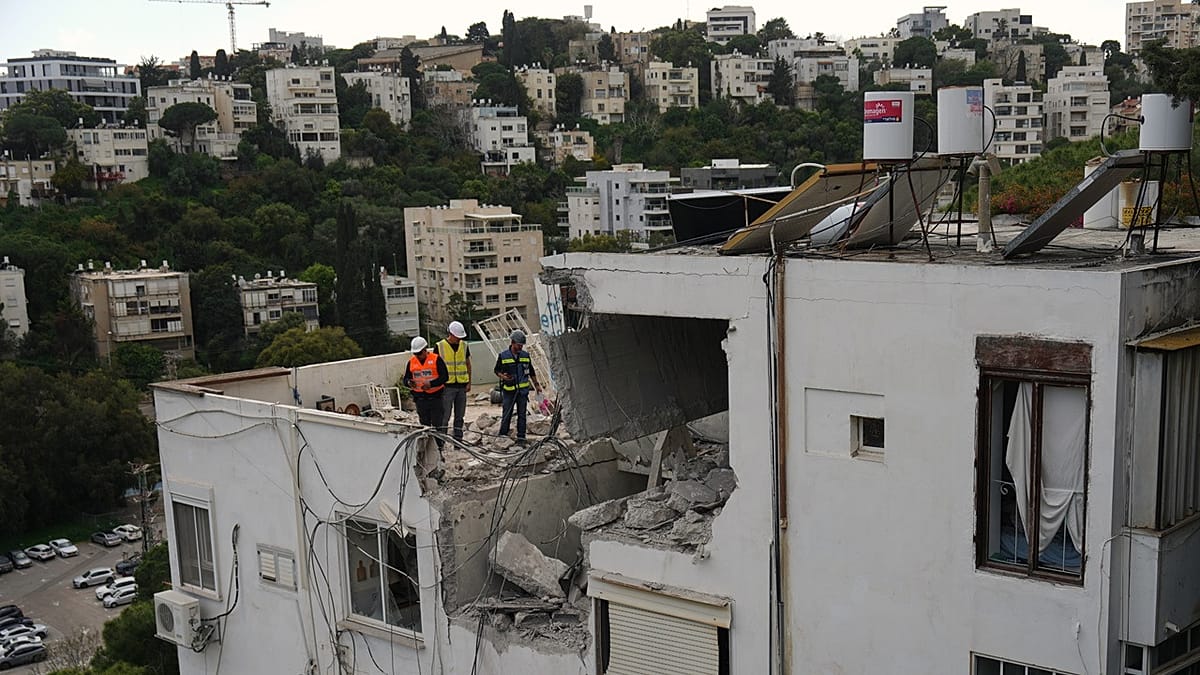
Iran launched missiles across the Middle East in response to fresh Israeli strikes, escalating a month-long regional war that has jolted global markets; Israel says it has achieved "more than half" of its military aims. Falling debris wounded four in Dubai and a Kuwaiti oil tanker caught fire, Saudi Arabia intercepted eight ballistic missiles, and Iranian media reported strikes on military sites in central Iran. The US is moving forces to the region (approximately 2,500 Marines already aboard ship, ~1,000 82nd Airborne expected, plus another 2,500 Marines deploying), while Trump threatened strikes on Iranian energy infrastructure including Kharg Island. Implication: elevated oil-price risk and broad risk-off market moves with heightened volatility and potential supply disruption.
Market mechanics are already pricing a sizable geopolitical insurance premium into energy, defense, and insurance-related instruments; that premium will magnify non-linearly if shipping disruption or insurance market dislocation broadens beyond Gulf choke points. Expect an initial 2–6 week window where Brent/WTI volatility spikes and tanker insurance (war-risk) rates rise; this will reroute cargoes, lengthen voyages by 10–20%, and effectively tighten global crude and refined product availability even without a sustained supply cut. US shale remains the marginal producer but responds on a 3–9 month cadence, so near-term price moves will be dominated by risk premia rather than physical incremental barrels.
Defense and defense-supply chains are first-order beneficiaries of sustained risk; however, delivery timelines (missiles, munitions, specialized alloys and avionics) create second-order supply bottlenecks that lift smaller suppliers and specialty material names more than the large primes in the first 6–12 months. Insurance brokers and reinsurers will see accelerated revenue recognition through elevated premiums and retentions — this is an earnings catalyst that manifests faster than new government procurement programs. Conversely, Gulf sovereign credit spreads and local-currency assets will face outsized re-pricing if capital outflows persist beyond 30 days, pressuring regional banks and EM liquidity-sensitive equities.
Reversal scenarios are discrete and short-dated: a credible back-channel de-escalation within 2–6 weeks could erase 40–60% of the energy and defense risk premia, whereas a protracted ground escalation materially increases the probability of oil trading above $100–120/bbl and causes sustained spikes in shipping rates and insurance costs. Position sizing should reflect this bimodal payoff — trade for event-driven gamma in the near term while keeping convex hedges for the high-impact, low-probability ground-escalation tail over the next 3–12 months.
AI-powered research, real-time alerts, and portfolio analytics for institutional investors.
Request DemoOverall Sentiment
strongly negative
Sentiment Score
-0.80
Ticker Sentiment
