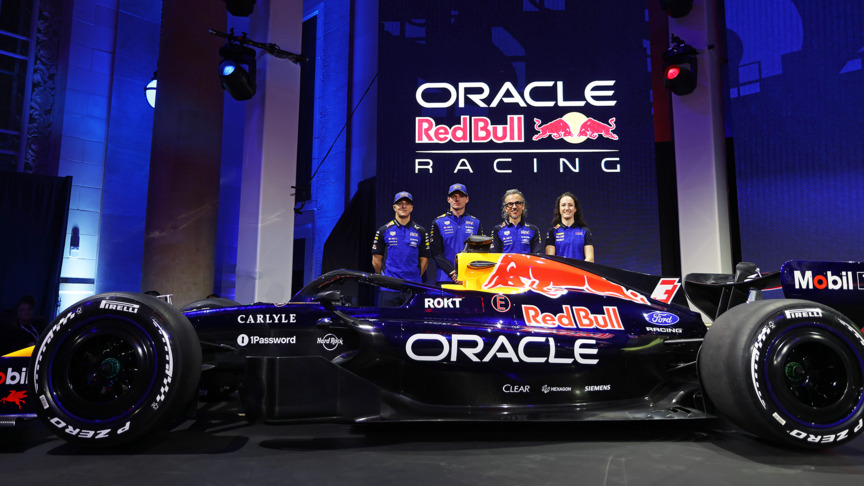
Red Bull and Ford unveiled their new Red Bull Ford Powertrains partnership and the DM01 power unit ahead of the 2026 season, coinciding with major F1 technical regulation changes. Team principal Laurent Mekies warned of expected early operational challenges and a period of 'struggles' as the new manufacturer ramps up, but expressed confidence in the Ford partnership and the team's ability to improve over the season; drivers noted uncertainty but high motivation. The announcement signals Red Bull's vertical integration into power unit manufacturing and establishes expectations for short-term execution risk with potential long-term performance upside.
Market structure: Ford’s (F) visible partnership with Red Bull creates a niche marketing and technology win for Ford and select tier-1 auto suppliers (Aptiv APTV, BorgWarner BWA) through elevated demand for high-performance powertrain components and calibration services. Near-term market share shifts in consumer auto sales will be negligible, but branding/tech premium could support a 3–8% re-rating of Ford’s midsize valuation multiple over 12–24 months if on-track reliability and public milestones succeed. Commodities/semiconductor demand impacts are incremental (low single-digit demand lift for specialty alloys/MCUs) and bond spreads may tighten by 10–25bp on positive sentiment for Ford credit over 6–12 months.
Risk assessment: Tail risks include a high-profile engine failure or reliability crisis in the first 3–6 races that could knock 10–20% off Ford’s stock temporarily and damage brand equity; regulatory shifts or FIA disputes could force redesigns and capex overruns. Hidden dependencies: reliance on niche suppliers, semiconductor availability, and integration of F1 power unit tech into corporate R&D pipelines; second-order financial strain could emerge if development costs exceed internal budgets, pressuring margins in 2026–2027.
Trade implications: Near-term (days–weeks) expect elevated equity and options volatility around pre-season testing (next 2–6 weeks) and first 3 races (0–3 months). Direct plays: small, hedged long in F, tactical call spreads ahead of testing, selective 9–12 month longs in APTV/BWA to capture supplier upside; buy short-dated straddles to capture IV spikes around test/race windows. Exit or re-evaluate after 3rd race (approx 3 months) when reliability signal crystallizes.
Contrarian angles: Consensus bullish PR value may underappreciate early operational pain — the market likely underprices option-like asymmetric upside if Red Bull Ford Powertrains proves superior by H2 2026; conversely, downside is crowded into sentiment and could be overstated in the first 2 months. Historical parallel: manufacturer entries (e.g., Honda re-entry episodes) show ~6–12 month volatility then crystallization; mispricings exist in short-dated options and small-cap suppliers whose forward revenue exposure is not yet reflected.
AI-powered research, real-time alerts, and portfolio analytics for institutional investors.
Request DemoOverall Sentiment
mildly positive
Sentiment Score
0.22
Ticker Sentiment
