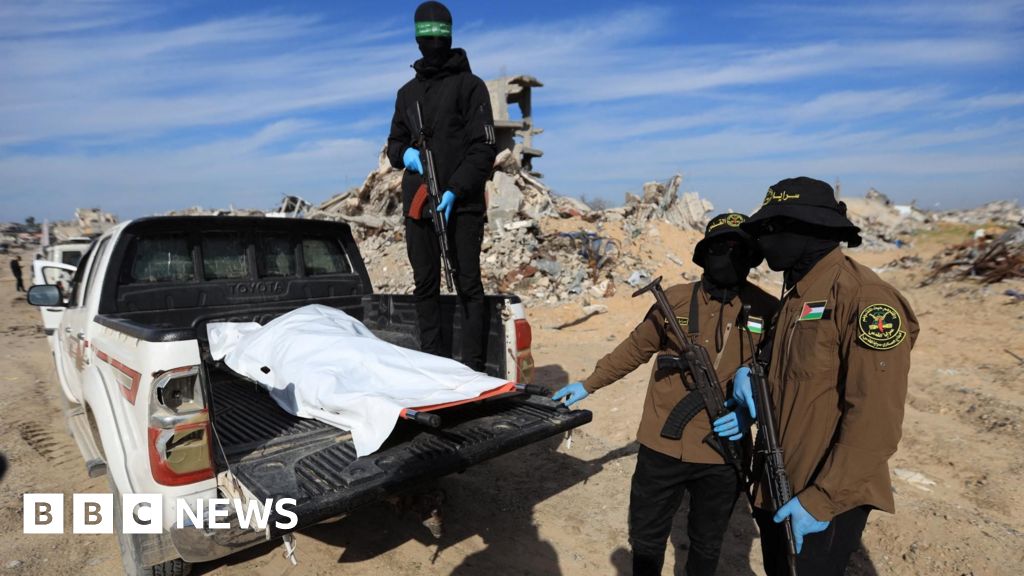
Israel received via the Red Cross a coffin that Hamas and PIJ say contains the body of one of the last two deceased hostages still in Gaza; remains will be transferred to Israel's National Institute of Forensic Medicine for identification. The two remaining dead hostages are identified by Israeli and Thai authorities as 24-year-old police officer Ran Gvili and 43-year-old Thai agricultural worker Suthisak Rintalak, abducted in the 7 October 2023 attack. Under the first phase of a U.S.-brokered ceasefire that began on 10 October, Hamas agreed to return 20 living hostages and 28 dead within 72 hours; to date 23 Israeli and three foreign remains have been handed over while Israel returned 345 Palestinian bodies. Continued disputes and slow recovery of remains have stalled the second phase of the peace plan (governance, Israeli troop withdrawal, disarmament and reconstruction), prolonging regional instability and associated risk premia for assets sensitive to Middle East tensions.
Market structure: Near-term winners are defense and security suppliers (US majors RTX, LMT, NOC and Israeli Elbit/ESLT) and safe-haven commodities (gold GLD, oil XLE/USO) as risk premia rise; losers are regional equities (iShares MSCI Israel EIS), travel/leisure (AAL, LUV, MAR) and EM carry/ILS which should see depreciation. Cross-asset mechanics: expect a 10–30bp compression in core yields (flight-to-quality) and a stronger USD; oil could reprice +5–15% on renewed supply-risk pricing while gold could outswing +3–8%.
Risk assessment: Tail scenarios include wider regional escalation (Iran/Lebanon) producing an oil shock of +$15–$40/barrel and a global equity drawdown of 10–25%; probability low but impact extreme — plan for 1–3 month volatility spikes and portfolio drawdowns. Hidden dependency: hostage recoveries directly affect ceasefire durability and reconstruction flows; if returns stall >2–4 weeks, expect prolonged military operations and higher defence/heavy industry spend.
Trade implications: Tactical plays should favor 1–2% long positions in large defense primes (RTX, LMT) and 1–2% gold (GLD) for 3–6 months, with paired shorts in airlines/travel (AAL, MAR) to capture relative weakness. Use options to control risk: buy 3–6 month call spreads on XLE or XOM (15% OTM) as an oil-insurance and 3-month put protection on regional equity exposure (EIS) if oil >$95 or ILS down >3% vs USD.
Contrarian angles: Consensus underestimates reconstruction demand 6–24 months out — consider selective exposure to heavy equipment and materials (CAT, VMC) for 6–18 month cyclical upside once security stabilizes. Beware procurement risk: rapid defense rearmament can pressure margins and raise political oversight — validate order-book visibility before sizing positions. Historical parallels (short-lived oil spikes after regional wars) argue for scaled, time-boxed positions with clear triggers (oil >$95 / ceasefire failure at 30 days) to add or unwind.
AI-powered research, real-time alerts, and portfolio analytics for institutional investors.
Request DemoOverall Sentiment
strongly negative
Sentiment Score
-0.60
