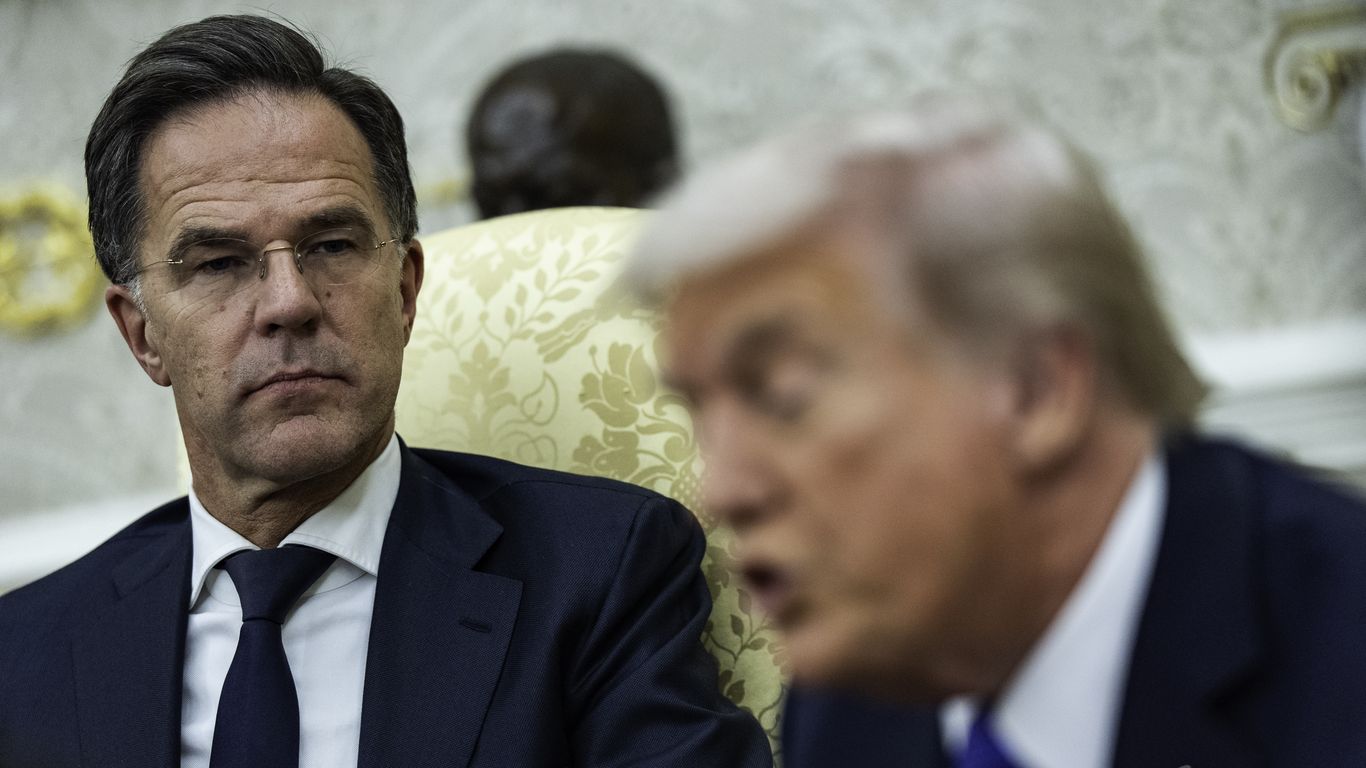
Rutte returns to Washington to meet President Trump days after Trump labelled allies 'cowards' and NATO a 'paper tiger', testing the transatlantic bond and heightening political risk. Rutte has called for a fourfold increase in air-and-missile defense spending, signaling material upside for European defense budgets and companies, while the U.S.-Europe rift could boost gas-price volatility and spur supply-chain and rearmament policy shifts.
A credible near-term increase in Western air-and-missile defense budgets will disproportionately lift midsize system integrators, missile and sensor suppliers, and specialty electronics vendors over broad industrials. Expect procurement to favor modular, off-the-shelf radars, C2 systems, and attritable munitions—products with 6–24 month lead times—creating an earnings acceleration window for suppliers that can scale production quickly rather than large platform manufacturers that have multi-year delivery cycles.
Supply-chain realignment pressures will create asymmetric winners: onshore semiconductor and RF-component producers as well as Western logistics/shipping specialists will be bid up, while firms deeply integrated into adversary-dominated ecosystems face contract and certification frictions. Energy-market spillovers are a realistic transmission mechanism; even short-lived chokepoint headlines can reprice shipping insurance and LNG freight, creating 1–3 month windows of outsized volatility in European gas and US LNG stocks.
Market catalysts cluster by horizon: immediate (days–weeks) headline-driven dispersion and option-driven volatility; medium (3–12 months) budget approvals and contract awards that re-rate suppliers; long (12–36 months) structural reshoring and industrial consolidation that compress margins for laggards. Tail risks—an actual alliance rupture or a major transit-disruption—would simultaneously lift defense and energy risk premia and compress European financial assets; conversely, a rapid diplomatic de-escalation would sharply re-rate defensive positioning lower over the same horizons.
AI-powered research, real-time alerts, and portfolio analytics for institutional investors.
Overall Sentiment
mildly negative
Sentiment Score
-0.20
