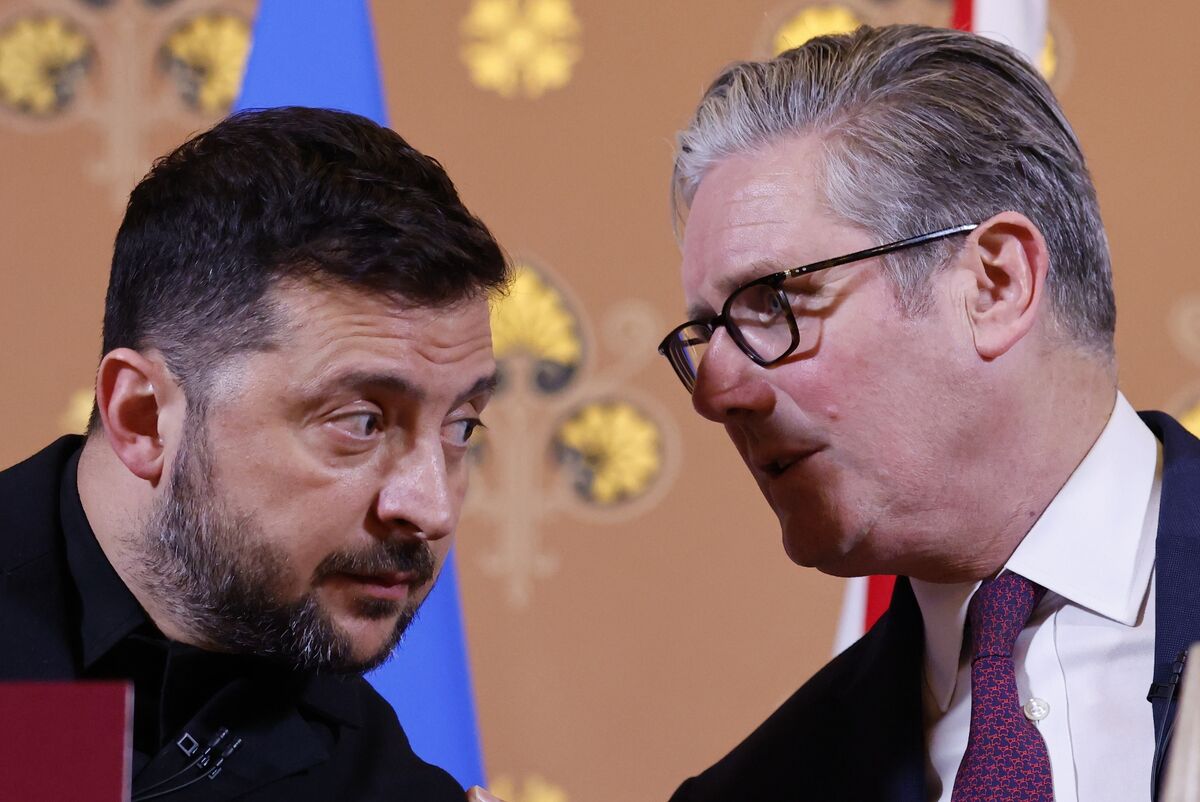
UK Prime Minister Keir Starmer will host Ukrainian President Volodymyr Zelenskiy in London with French President Emmanuel Macron and German Chancellor Friedrich Merz to try to nudge US-led peace talks toward a settlement intended to protect Ukraine from future Russian aggression. UK Foreign Secretary Yvette Cooper will travel to Washington to meet with US officials, including Secretary of State Marco Rubio, signaling coordinated diplomatic engagement among major Western powers on the Ukraine negotiating track.
Market-structure: European diplomatic coordination around Ukraine (Starmer + Macron + Merz + Zelenskiy) signals continued Western alignment on defense and security policy; expect sustained procurement budgets, boosting European and US defense OEM revenue by ~5-15% incremental over 12–36 months if talks produce a guarantee rather than immediate ceasefire. Energy and commodity risk premia remain asymmetric: successful security guarantees that de‑escalate active conflict could compress Brent by 5–15% within 3 months; conversely failed talks or sanctions escalation would lift oil/gas +15–30% and keep European gas spreads wide.
Risk assessment: Tail risks include sudden negotiation breakdown or targeted strikes that spike insurance/premia (oil, shipping, crop prices) within days; low-probability systemic outcomes include expanded sanctions causing supply-chain decoupling across semiconductors/defense over 6–24 months. Hidden dependencies: defense spending depends on domestic politics (UK/France/Germany budgets) and election cycles—monitor fiscal announcements within 30–90 days. Key catalysts: public security guarantees (reduces risk premium) or fresh tranche approvals for weapons (increases revenue visibility); either can move sector multiples by ±10–20%.
Trade implications: Tactical longs: European defense (RHM.DE, BAES.L) and US defense (LMT, RTX) for 3–12 months, targeting 10–25% upside if procurement clarifies; pair: long Rheinmetall (RHM.DE) 2–3% vs short European airlines (IAG.L) 1–2% for idiosyncratic travel weakness. Options: buy 3–6 month call spreads on LMT/RTX sized 1–2% notional and a 3‑month Brent straddle to capture oil volatility. Rotate: overweight defense and energy, underweight European travel/consumer discretionary until peace signal is explicit (90 days).
Contrarian angles: Consensus assumes diplomatic progress will quickly reduce risk—this is underdone; even a political framework often increases multi-year defense budgets (2014–22 precedent) so market may be underpricing sustained capex. Conversely, if a binding multilateral security guarantee is signed within 90 days, defense equities could reprice down 15–25% rapidly; hedge with short-dated calls or tighten stop-loss at 12–15% gains. Monitor UK/EU formal treaty text, US funding bills, and German procurement approvals as binary triggers.
AI-powered research, real-time alerts, and portfolio analytics for institutional investors.
Request DemoOverall Sentiment
neutral
Sentiment Score
0.05
