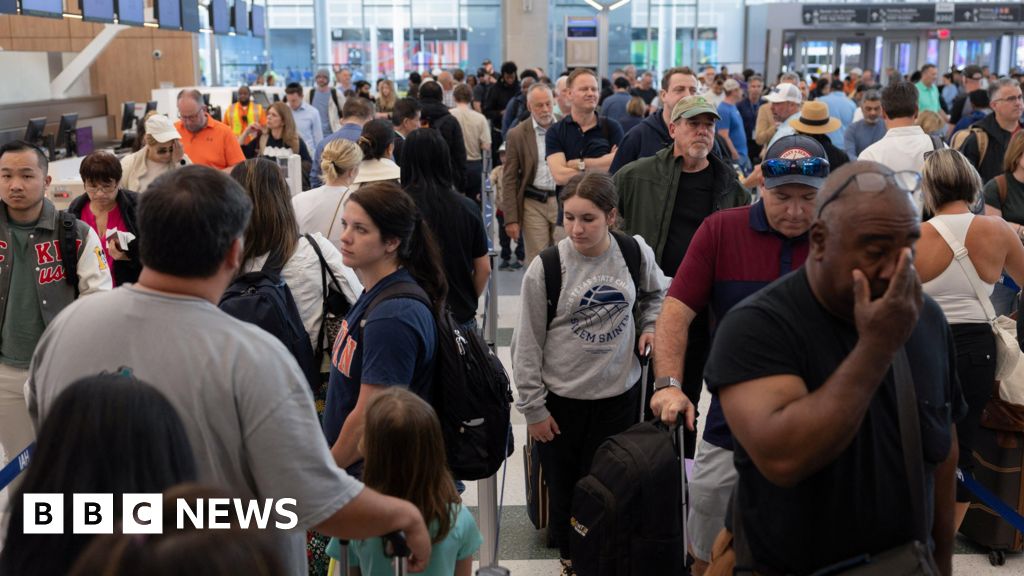
Security wait times at Houston's George Bush Intercontinental Airport have exceeded four hours as nearly 40% of TSA security staff failed to show and the airport is operating at roughly 33–50% of checkpoints. More than 450 TSA workers have quit since the partial government shutdown and thousands of absences are lengthening queues ahead of spring-break travel and multiple major sporting events; federal deployments (ICE, National Deployment Office) are being used as temporary mitigation. The shutdown funding standoff in Congress remains unresolved, creating ongoing operational and reputational downside risk for US airports, particularly ahead of the FIFA World Cup this summer.
Operational friction at checkpoints acts like a temporary reduction in airport throughput; the direct consequence is lower aircraft utilization and higher irregularity costs for carriers (crew/rest, repositioning, compensation) which show up as a discrete margin hit over the spring quarter. A 1–3% drop in utilization concentrated over high-yield travel weeks can compress quarterly EBIT by low single-digits for the largest US carriers, and the disruption disproportionately damages carriers with tight turn times and minimal schedule slack.
Second-order winners and losers diverge from the headline. Rideshare and curb-to-terminal services capture incremental revenue per stranded passenger (higher average trip length, surge pricing), while concession revenues and duty-free capture rates fall as throughput slows; rental-car companies and adjacent hotels see mixed effects—higher transient demand but operational strain on pick-up/drop-off. Persistent attrition in specialized screening staff creates a multi-month supply-side constraint in checkpoint capacity that cannot be reversed by short deployments alone because training and certification lag measured in weeks-to-months.
Catalysts to watch are political (a funding resolution passed in days would snap a quick reversal) versus structural (attrition and reputational flight to alternative travel modes that can persist for quarters). The highest-probability worsening scenario is a prolonged negotiation stretching into the next 60–120 days, which would materially raise costs for airlines, boost short-term modal-shift risk for short-haul leisure travel, and increase the optionality value of asset-light services that monetize passenger inconvenience.
AI-powered research, real-time alerts, and portfolio analytics for institutional investors.
Request DemoOverall Sentiment
mildly negative
Sentiment Score
-0.35
