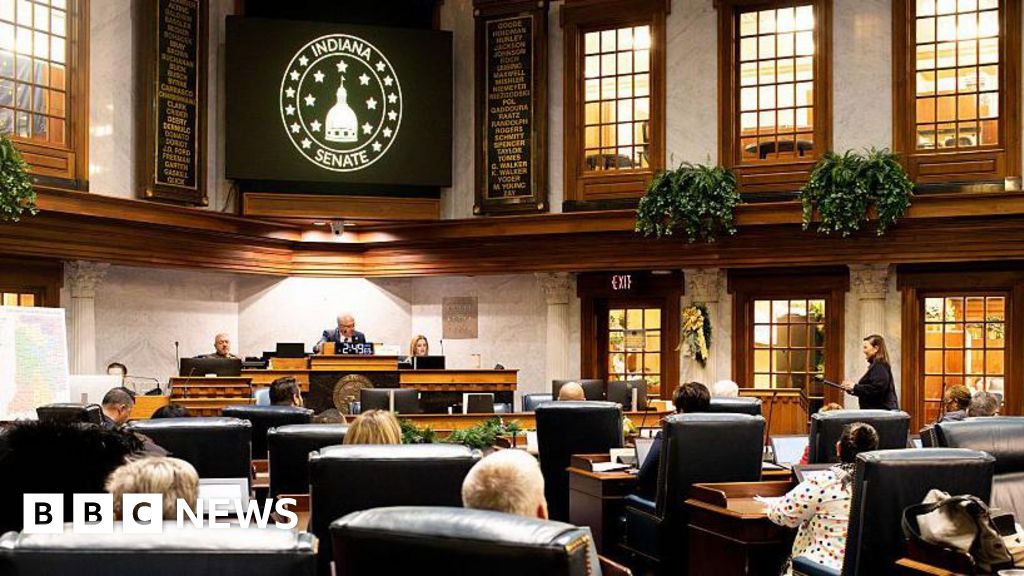
The Indiana Senate rejected a proposed mid‑cycle redistricting plan that would have given Republicans a net gain of two U.S. House seats for the 2026 midterms, voting it down 19–31 after a group of Republican senators joined all Democrats in opposition. The defeat is a direct rebuke to a months‑long pressure campaign from President Trump — including White House meetings, Truth Social warnings and visits from Vice‑President JD Vance — to secure partisan map changes, and underscores intra‑party resistance to mid‑decade gerrymandering. The outcome weakens Trump’s effort to engineer GOP gains through state legislatures and signals a potential check on similar redistricting pushes nationwide.
The Indiana Senate rejected a proposed mid‑cycle redistricting plan intended to give Republicans a net gain of two U.S. House seats for the 2026 midterms, voting it down by a 19‑31 margin after a cohort of Republican senators joined all Democrats in opposition. The Indiana House had approved the map the prior week, but the Senate vote prevented the mid‑decade change that would have altered seat competitiveness ahead of 2026.
The outcome is a direct rebuke to a months‑long pressure campaign from former President Trump that included White House meetings, warnings on Truth Social and two visits by Vice‑President JD Vance; Trump singled out Senate leader Ryan Bray as a holdout. Republican Senator Spencer Deery framed his opposition as a principled resistance to mid‑cycle gerrymandering, highlighting intra‑party institutional and ideological resistance within the GOP.
This vote narrows one tactical pathway for Republicans to secure structural House gains via state legislatures in Indiana and signals a potential check on analogous mid‑decade efforts elsewhere even as other states pursue redistricting (Texas, California, Utah, Ohio, New Hampshire, Illinois). Market signals indicate minimal immediate market impact (market_impact_score 0.1), but politically sensitive forecasts for 2026 should be adjusted downward for partisan map changes in Indiana and used to recalibrate campaign and policy‑outcome scenario analyses.
AI-powered research, real-time alerts, and portfolio analytics for institutional investors.
Request DemoOverall Sentiment
neutral
Sentiment Score
0.00
