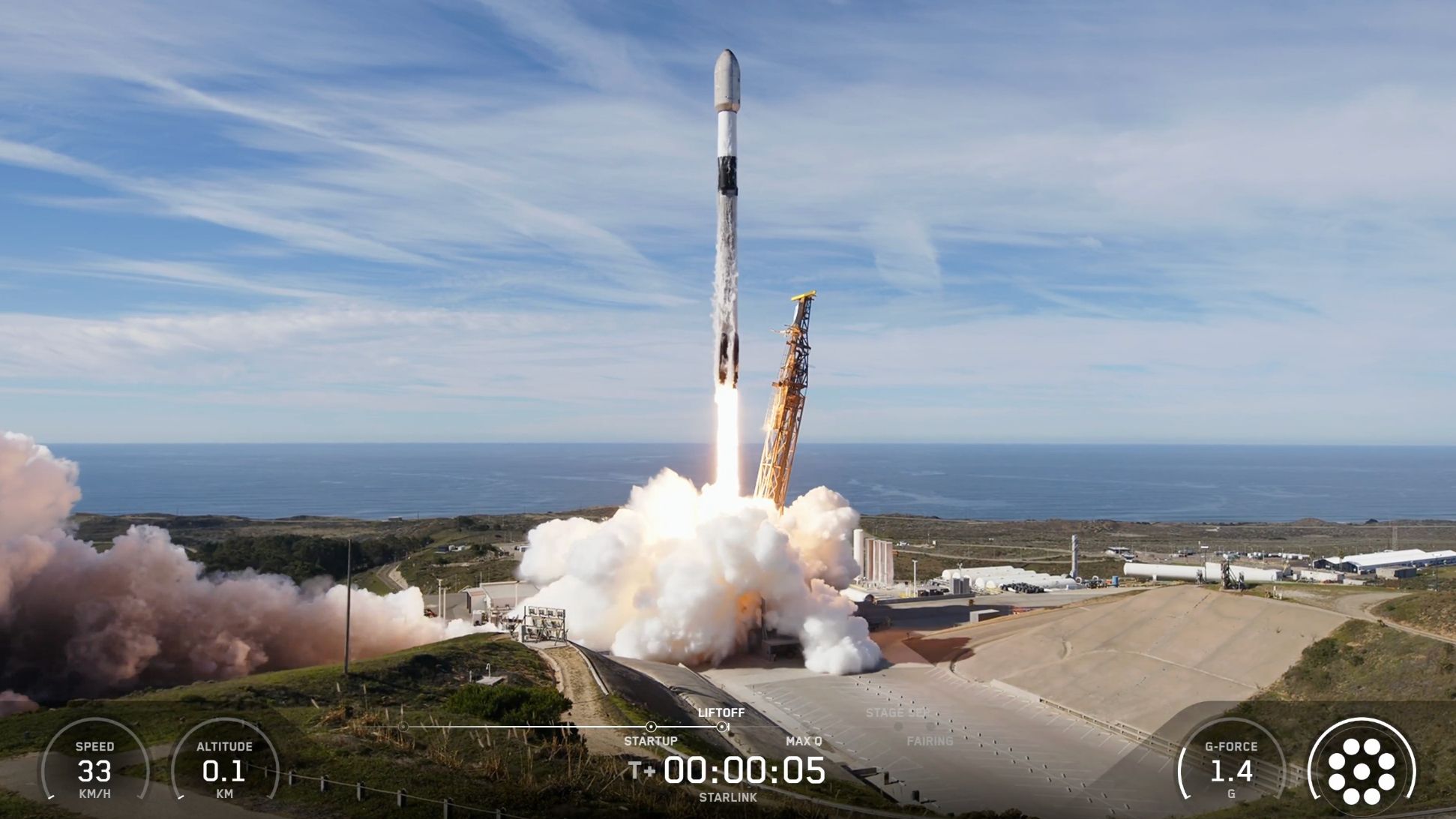
SpaceX launched 28 Starlink satellites from Vandenberg Space Force Base on Dec. 4 aboard a Falcon 9 whose first stage (booster B1097) returned and landed on the drone ship 'Of Course I Still Love You.' The upper stage will deploy the satellites about an hour after liftoff; the flight was the 156th Falcon 9 launch of 2025 and contributes to a constellation now operating more than 9,000 Starlink satellites (over 10,000 launched in 6.5 years), underscoring SpaceX's high-cadence, reusable-launch economics and continued capacity expansion for satellite broadband — an operational positive for long-term competitive positioning, though unlikely to be an immediate market-moving event.
Market structure: Repeated Falcon 9 Starlink launches strengthen SpaceX's vertical moat—launch cost (~$50–70M per Falcon 9), reusability (4+ flights per booster) and >9,000 satellites deployed translate into sustained pricing power vs. incumbents (Viasat VSAT, Eutelsat ETSY/ETL equivalents). Winners are equipment suppliers scaling with mass-market terminals (Qualcomm QCOM, STMicro STM) and defense primes buying resilient low-latency links (LHX, NOC); losers are niche launchers (RKLB) and legacy GEO broadband providers facing ARPU compression. Expect incremental downward price pressure on LEO launch revenues: >70% of 2025 Falcon activity was Starlink, signaling saturated dedicated-launch demand and margin squeeze for third-party launch services.
Risk assessment: Tail risks include a major on-orbit collision or a regulatory moratorium on new launches (6–18 months) that could reprice valuation multiples across the sector; spectrum disputes or national security export controls could restrict military adoption. Immediate (days) market impact is muted; short-term (weeks–months) could see re-rating of public competitors; long-term (3–5 years) structural winner-take-most dynamics for vertically integrated players. Hidden dependency: SpaceX’s user-terminal manufacturing scale and supply-chain leverage can compress component suppliers’ margins even as volumes rise. Catalysts to watch: FCC/KDB rulings, Amazon Kuiper tranche approvals, any Starlink major outage within 30–90 days.
Trade implications: Favor semiconductor and defense primes that supply mass-market terminals and military gateways (QCOM, LHX) and underweight pure-play GEO broadband vendors (VSAT) and small launchers (RKLB, MAXR exposure in near-term launch revenue). Use defined-risk options to short thesis: buy 3–6 month put spreads on VSAT sized 1% NAV, and consider 9–18 month call exposure to QCOM/LHX sized 1–2% with 25–35% profit targets. Cross-asset: lower-term Treasury yields could bear if large-cap private capex (SpaceX) crowds bank financing; watch credit spreads on smallspace EM issuers widening >200bp as a sell signal.
Contrarian angles: Consensus underrates operational risks—debris or coordinated regulatory pushback could cause a >30% drawdown in public satellite/launch small-caps; conversely, markets may underprice revenue upside to suppliers (QCOM) if SpaceX monetizes Starlink enterprise/military contracts. Historical parallel: satellite consolidation post-2008 saw incumbents (GEO) lose >40% over three years; but winners emerged in adjacent chipsets and ground infrastructure. Unintended consequence: rapid Starlink scale could spur government subsidies for competitors (Kuiper) or impose spectrum fees, which would re-open TAM and relieve pressure on incumbents within 12–24 months.
AI-powered research, real-time alerts, and portfolio analytics for institutional investors.
Request DemoOverall Sentiment
mildly positive
Sentiment Score
0.25
