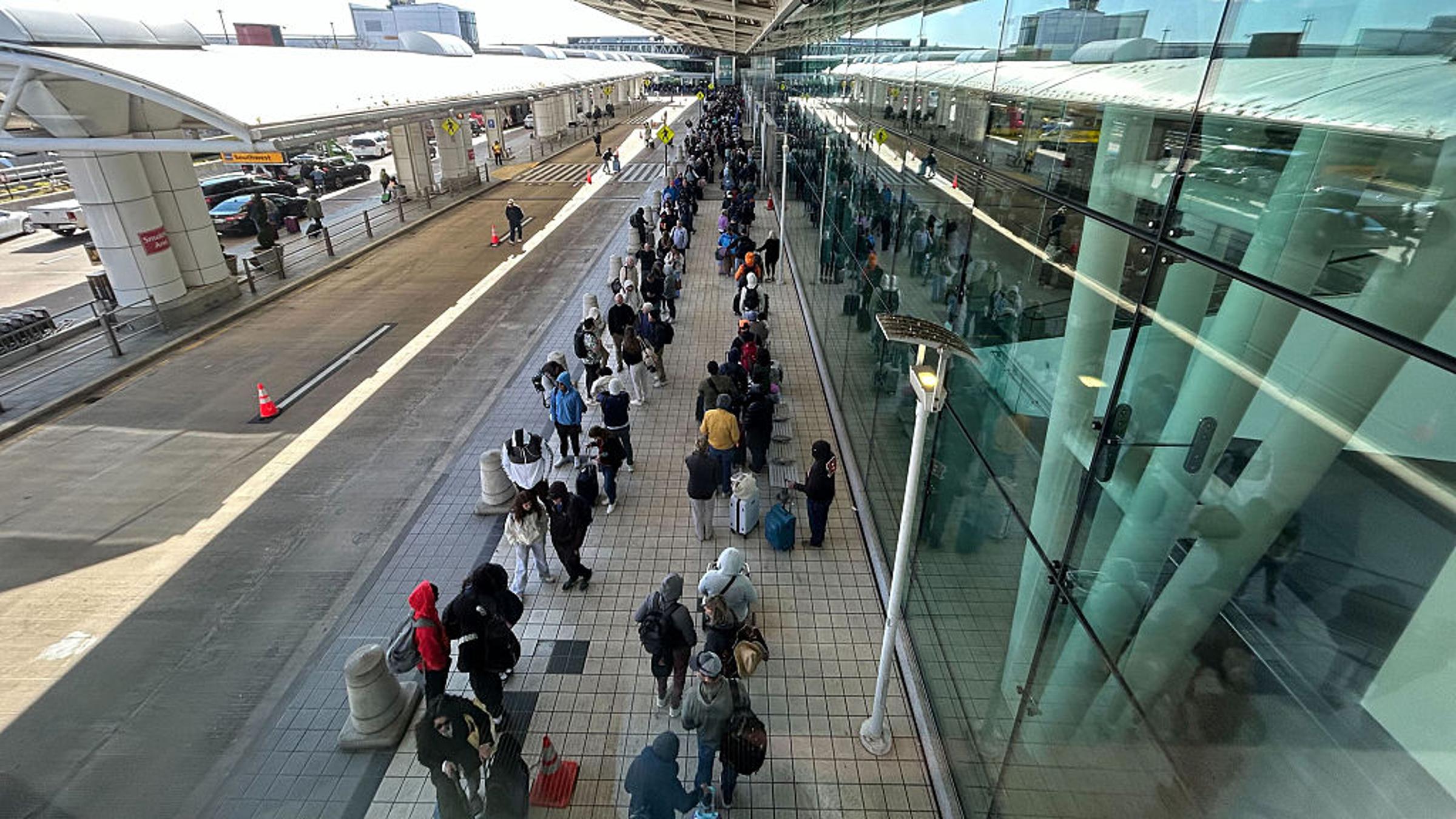
ICE agents remain deployed at U.S. airports pending how many TSA agents return after President Trump agreed to fund TSA; more than 500 TSA employees have quit and thousands called out since the partial DHS shutdown. Reports of ICE effectiveness are mixed—some airports saw queue reductions while data and multiple reports indicate wait times in some locations reached four or more hours despite the deployment. Operational uncertainty and political controversy increase downside risk to travel reliability but are unlikely to move broad markets materially.
Operational fragility at U.S. airport security is now a market-level amplifier: staffing uncertainty produces nonlinear queuing risk where a small shortfall (single-digit % of screeners) can produce outsized delays and cascading missed connections over weeks. That nonlinearity means airline unit revenues and ancillary yields are exposed to operational shocks in the near term (days–months) even if underlying demand remains intact, since schedule integrity and customer goodwill are hard to re-create quickly.
Second-order winners are vendors that substitute labor with capital — biometric ID, CT-body scanners, and outsourced screening contractors — because airports will look to replace an unstable labor model with capex and contracted services over the next 3–12 months. Conversely, legacy labor-heavy airport services and any operators with concentrated peak-hour throughput are the losers: they face both revenue loss from delayed passengers and higher short-term opex if premium staffing or overtime is used to plug holes.
Key catalysts that will move markets are: (1) congressional DHS funding language tied to operational reforms (weeks–months), (2) labor-return metrics reported by ports and carriers (daily–weekly), and (3) any high-profile security incident or PR backlash that forces rapid reallocation of resources. Tail risks skew negative: a security incident or prolonged staffing shortfall could depress air travel volumes for multiple quarters and spur outsized regulatory procurement or contract re-sourcing.
The consensus trade is to worry airline equities; the contrarian angle is that procurement and tech re-platforming create a multi-quarter procurement cycle that lifts select defense/IT contractors more than the market expects. That sets up asymmetric pair trades where you hedge cyclical exposure to travel softness while owning secular beneficiaries of airport modernization.
AI-powered research, real-time alerts, and portfolio analytics for institutional investors.
Request DemoOverall Sentiment
mixed
Sentiment Score
0.00
