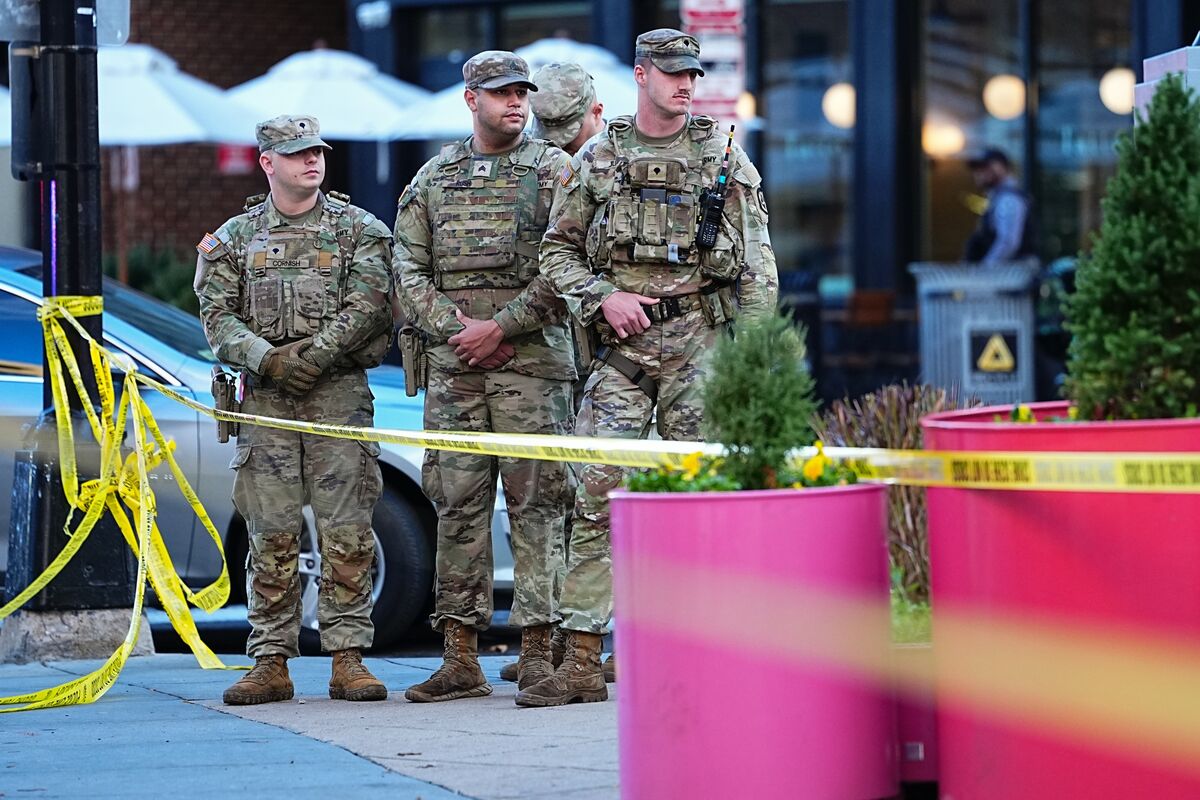
President Donald Trump said one West Virginia National Guard member, US Army Specialist Sarah Beckstrom, 20, who was shot in an attack near the White House in Washington, DC, died after being in critical condition; US Air Force Staff Sergeant Andrew Wolfe, 24, remains in critical condition. The shooting involving on-duty service members at a high-profile location elevates short-term domestic security and political risk, though it is unlikely to have material economic or market effects.
Market structure: The fatal shooting of a National Guard member near the White House is a localized shock that pushes short-term risk-off pricing: expect modest safe-haven flows into U.S. Treasuries and gold and a 1–3% reweight toward defense/security equities (RTX, GD, LHX) over 1–12 weeks if rhetoric escalates. Direct winners are homeland-security contractors, cybersecurity names (PANW, FTNT) and airport/security equipment suppliers; losers are high-beta consumer discretionary and travel (XLY, JETS) for days-to-weeks if visible threats persist.
Risk assessment: Tail risks include a sequence of attacks or significant civil unrest that forces multi-month travel/commerce friction or emergency federal spending re-allocations; probability low (<5%) but impact high on markets and fiscal deficits. Immediate horizon (days): higher VIX, lower yields; short-term (weeks–months): policy/appropriations noise that can lift defense budget expectations ~2–5% versus baseline; long-term (quarters+): any sustained pivot in federal spending or tariffs could reprice industrial suppliers.
Trade implications: Implement small, tactical positions: long defense/cyber equities and short consumer cyclicals; favor defined-cost option structures (3–6 month call spreads) on ITA/RTX to express upside while hedging with short-dated VIX call spreads (30–60 days). Use bond exposure (IEF/TLT) as hedge if 10y yield drops >10bp in 72 hours; consider pair trades (long ITA vs short XLY) to capture relative strength while neutralizing beta.
Contrarian angles: Consensus may overstate permanent defense upside — much depends on legislative follow-through; defense stocks already trade on long-cycle assumptions, so upside may be 3–8% not 20%. Watch two underpriced risks: (1) tighter domestic surveillance/regulation hitting tech/privacy stocks, (2) political backlash that constrains fiscal flexibility; both can flip winners into losers within 3–6 months.
AI-powered research, real-time alerts, and portfolio analytics for institutional investors.
Request DemoOverall Sentiment
mildly negative
Sentiment Score
-0.25
