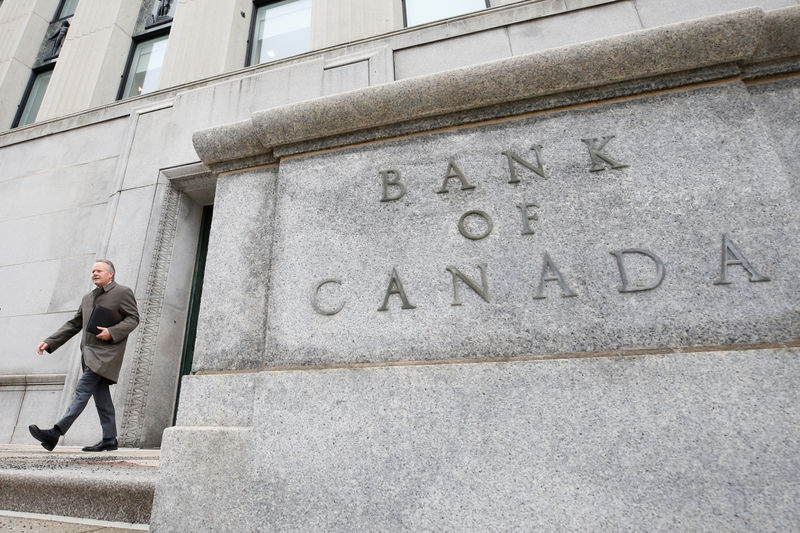
Bank of America economists expect the Bank of Canada to hold the policy rate at 2.25% for the year, noting market pricing implies nearly 50 bps of tightening driven by geopolitical risk rather than Canadian fundamentals. They highlight negative job creation since 2025, decelerating wage growth, a negative output gap and inflation anchored around ~2% prior to the Iran shock; only a persistent shock pushing inflation above 3% or Fed hikes would force a BoC hike. Higher oil prices help Canada as a net exporter but trade uncertainty and U.S. tariffs continue to weigh on investment.
Market pricing currently embeds a geopolitically-driven inflation tail that is poorly correlated with Canada’s underlying demand slump. That creates two distinct scenarios: a short-lived oil spike (weeks) that mainly reprices FX and front-end volatility, and a persistent shock (>3 months, +$10–15/bbl sustained) that mechanically lifts headline CPI by roughly 0.5–1.0 percentage point and materially reroutes real cash flows to energy exporters and provinces.
Second-order winners from a persistent shock are not just upstream producers but provincial balance sheets, pipeline contractors and equipment suppliers whose capex re-accelerates; losers include import-intensive manufacturing, cross-border retailers and any corporates with US-dollar cost bases. CAD strength in the first 1–3 months would compress US-reported revenue for TSX exporters translated back to USD, creating an earnings-per-share dispersion that is currently underpriced by consensus.
From a flow and volatility standpoint, the market is overstating the probability of monetary tightening as the marginal inflation impulse is supply-driven and thus easier for a central bank to “look through” if demand remains weak. That disconnect opens opportunities: short-dated volatility and FX carry trades if the shock looks transitory, but convex protection (long-dated puts or corridor hedges) if oil markets show structural dislocation. Liquidity in CDS and provincial paper should tighten quickly on a persistent shock — those moves can be front-run with option-backed credit positions within a 3–12 month window.
AI-powered research, real-time alerts, and portfolio analytics for institutional investors.
Overall Sentiment
neutral
Sentiment Score
0.00
Ticker Sentiment
