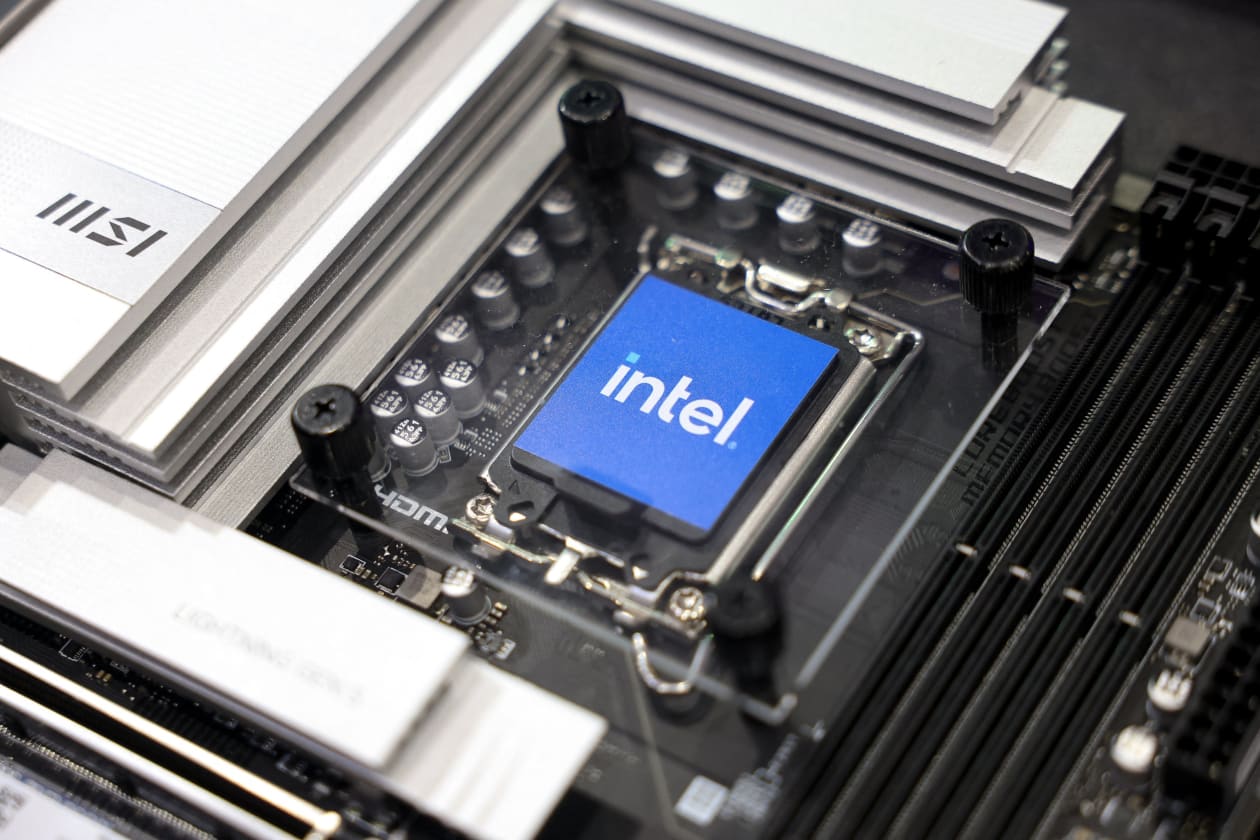
Intel shares closed up 11.4% on Wednesday, hitting a five-year high and ranking as the second-best performer in the S&P 500. The rally was driven by broad market momentum after a cease-fire agreement with Iran and a rotation into AI-hardware names amid optimism over recent business developments. Expect continued sector-level strength in AI/hardware stocks and elevated volatility as investors reassess risk positioning.
The price action looks driven more by a cross-asset rotation into AI-capex exposures than by a discrete change in Intel's competitive moat. That rotation creates a near-term feedback loop: flows lift the equity, which eases funding for large-scale capital projects, which in turn supports orders for equipment vendors and memory suppliers. Expect this loop to amplify over days-to-weeks but dissipate without concrete share gains in cloud/server CPU or accelerator win announcements over the next 3–12 months.
Second-order beneficiaries are the semiconductor equipment and memory chains (photolithography, deposition/etch, DRAM) because incremental Fab spend has long lead times and high operating leverage; a modest 5–10% step-up in fab booking translates to 15–25% revenue upside for tools vendors across the following 6–18 months. Conversely, the move increases the risk of crowding into lower-quality cyclical exposure: if Intel’s node roadmap or foundry customer wins slip by 6–12 months, that same capital-market enthusiasm can reverse quickly as analysts reset throughput assumptions and capex guidance.
The clearest tail-risks are execution (node delays), reallocation back to cloud-native accelerators (software and ecosystem lock-in), and macro-driven flow reversals. Days-to-weeks: momentum-driven unwind if option gamma flips; months: guidance/earnings could re-price the re-rating; 12–36 months: secular competitive outcomes (market share vs. TSMC/NVIDIA/AMD) determine realized returns. Hedged/optioned exposure is preferred over naked equity given the asymmetric short-term flow risk.
AI-powered research, real-time alerts, and portfolio analytics for institutional investors.
Overall Sentiment
strongly positive
Sentiment Score
0.60
Ticker Sentiment
