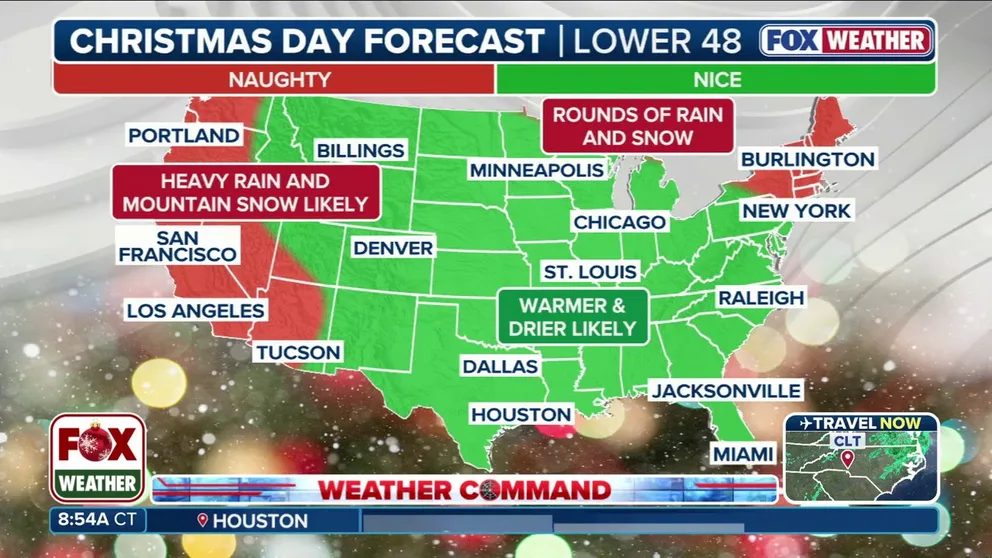
A fast-moving post-Christmas storm is forecast to impact the U.S. Northeast Friday into mid‑Saturday, with widespread 3–5 inches of snow from central New Jersey through New York City into southern Connecticut and localized 5–8 inch totals possible; the Catskills and Poconos are also at risk. A strong high over Quebec increases the threat of ice accretion (0.1–0.25 inch, with isolated amounts >0.25 inch) across central Pennsylvania into parts of Maryland, raising short-term risks of treacherous roads and scattered power outages and prompting likely winter advisories and warnings. Planners should also note a subsequent fast-moving system may bring mixed rain and snow by the end of the weekend into early New Year’s Eve week, creating additional operational risk for travel and local infrastructure.
Market structure: The near-term winners are utilities and heating/fuel suppliers (natural gas distributors, diesel generators), road-crew contractors, and home-improvement retailers (HD, LOW) that see 1–5% sales bumps in the 7–14 day window; losers are airlines (AAL, DAL, UAL), ground-transport logistics and regional airports facing 1–4% revenue hit from cancellations and delays. Pricing power shifts to localized services (salt, plowing, emergency fuel) where capacity is fixed short-term; regulated utilities can pass incremental restoration costs to ratepayers over quarters, limiting credit stress but increasing capex narratives.
Risk assessment: Tail risks include >0.25" ice causing multi-day outages impacting 100k+ customers, spiking insurance and contingent business-interruption claims and forcing emergency power purchase spikes; regulatory inquiries into grid resilience could follow in 3–12 months. Immediate impacts (days) are cancellations and fuel/heat demand; short-term (weeks) are insurance claims and repair revenue; long-term (quarters) are capex and potential higher utility ROEs. Hidden dependencies include road-salt inventories, diesel logistics for crews, and labor availability — constraints that amplify localized price moves.
Trade implications: Expect short-dated volatility: airline and airport IV to rerate up 20–40% into Friday–Saturday; natural gas and local diesel to spike 5–15% in 3–7 days. Favor short-week put structures on airlines, short-dated call spreads on UNG/NG futures, and small tactical long positions in regional utilities/HD/LOW sized to 1–3% each with 1–8 week horizons. Watch correlations: equities sensitive to travel (airlines, hotels) will underperform staples/utility defensives during storm windows.
Contrarian angles: Markets may overprice systemic risk from a single fast-moving storm — widespread insured losses are unlikely unless ice >0.5" occurs; thus deep long-dated shorts on airlines are risky. Conversely, the market may underappreciate the boost to local materials/contractors and to natural-gas winter demand; those short-term winners can outperform for 2–6 weeks. Historical parallels (post-Christmas NE storms) show 3–10% directional moves that mean-revert within 2–4 weeks once service is restored.
AI-powered research, real-time alerts, and portfolio analytics for institutional investors.
Request DemoOverall Sentiment
neutral
Sentiment Score
-0.15
