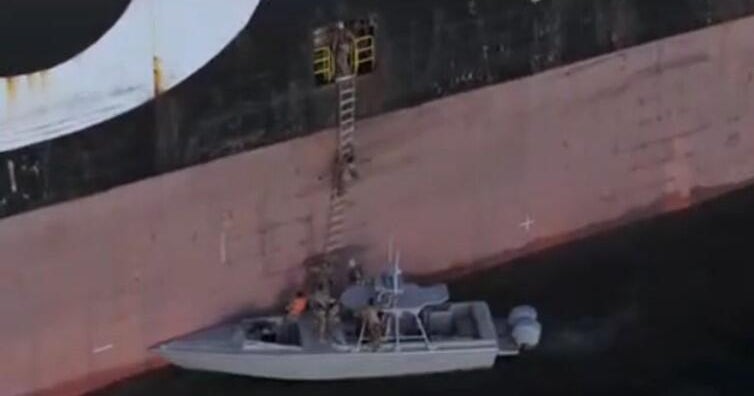
Iran's Revolutionary Guard said it seized two cargo ships in the Strait of Hormuz, while the Philippines confirmed 15 seafarers aboard the vessels were safe and unharmed. The article also highlights continued U.S. naval enforcement in the region, with CENTCOM saying 31 vessels have been directed to turn around under the blockade. The escalation raises risks to global shipping and energy flows through a critical chokepoint, with Israel-Lebanon ceasefire talks and the broader Iran conflict adding to geopolitical तनाव.
The market is underpricing how quickly a Hormuz disruption propagates from headline risk into actual basis and freight dislocations. Even a small number of boarded vessels is enough to force shipowners into rerouting, higher war-risk premiums, and slower turnaround times, which tightens effective tanker supply long before physical barrels are lost. That tends to matter first in refined products and LNG shipping, not just crude, because charterers immediately start paying for optionality and delay.
The bigger second-order effect is on import-dependent Asian economies and the retail fuel complex. If insurers start treating the waterway as intermittently untradable, refiners with alternative Atlantic Basin access gain pricing power while Asian refiners and carrier-heavy industrials take the hit through wider delivered-cost spreads. In that setup, the equities that look most vulnerable are transporters, chemicals, and airlines with limited fuel hedges; the losers are broader than energy itself.
Near term, the risk is binary and event-driven: one additional seizure, a tanker hit, or a U.S. escalation on escort policy can gap freight and crude vol higher within 1-5 sessions. Over the next few weeks, the more interesting tell is whether the market starts pricing a persistent security surcharge rather than a one-off spike. If talks de-escalate and vessel traffic normalizes, the move reverses quickly because the physical supply shock is still mostly psychological rather than volumetric.
Consensus is likely too focused on spot crude and not enough on volatility as the real tradeable asset. A contained geopolitical standoff with repeated but non-catastrophic incidents often compresses realized operating performance for shippers and airlines while leaving energy producers only modestly better off. That argues for expressing the view through relative value and optionality rather than outright directional beta.
AI-powered research, real-time alerts, and portfolio analytics for institutional investors.
Request TrialOverall Sentiment
moderately negative
Sentiment Score
-0.45
