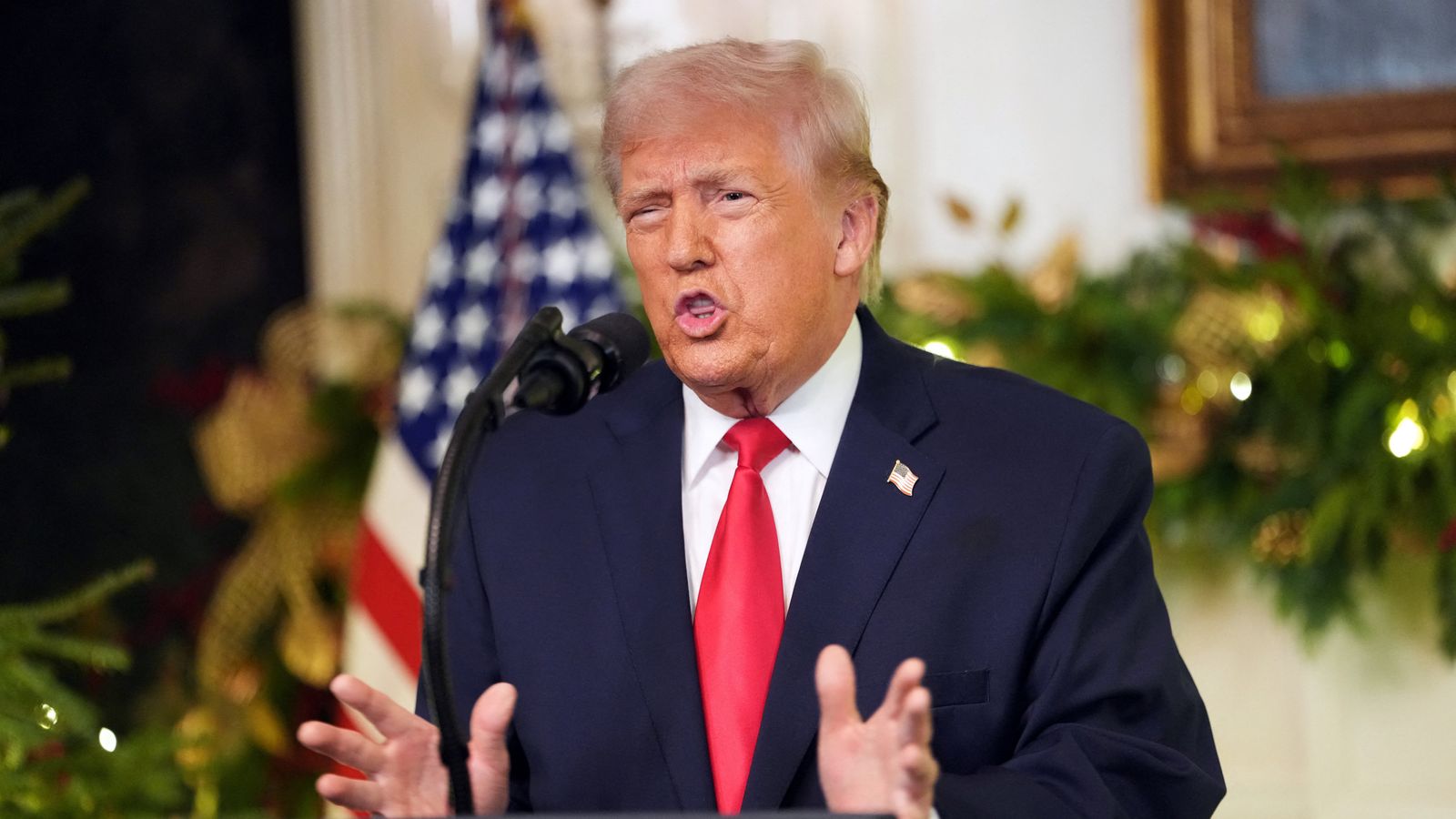
President Trump used a primetime address to defend his domestic record rather than announce any action on Venezuela, delivering a combative, campaign-style speech as polls and economic indicators weaken. Key datapoints: unemployment rose to 4.6% in November, petrol prices have fallen while broad cost of living remains elevated, and the administration announced one-off $1,776 checks to all service members. The address is unlikely to move markets materially but underscores rising political risk, persistent inflationary pressures and a modest fiscal giveaway that could have limited microeconomic impact.
Market structure: The speech is a political signal more than policy; immediate winners are defense names and short-term consumer staples (flight-to-safety), losers are consumer discretionary and regional banks sensitive to slowing consumer activity. Petrol downhelps refiners/retail margins (short-lived), but talk of Venezuela and a pro-military posture increases idiosyncratic upside for LMT/RTX/GD by ~5–10% on conviction trades ahead of any concrete action. Cross-assets: expect a modest rise in equity implied volatility (VIX +10–30% intraday risk), bid for 10y Treasuries (TLT) if growth fears deepen, and mixed FX flows — USD up on global risk-off, down if fiscal expansion risks surge.
Risk assessment: Tail risks include unexpected military action in Venezuela (low prob, high impact for oil: Brent +15–30%), sudden large fiscal giveaways (bigger deficits -> term premium +20–40bps), or a political shock (resignation/health) that spikes volatility. Immediate (days): headline-driven VIX/energy swings; short-term (weeks–months): consumer demand deterioration if unemployment continues higher than 4.6%; long-term (quarters): higher structural deficit risk driving real yields and inflation expectations. Hidden dependencies: market reaction depends on the timing/scale of any fiscal measure and Fed tolerance — a pre-election fiscal push could force earlier Fed tightening.
Trade implications: Tactical plays: buy protection and rotate into defensives. Specifics: establish a 2–3% long position in TLT (or 3–6 month ladder in IEF) if 10y yield drops >10bps intraday, and a 2–3% long basket in LMT/RTX/GD (equal-weighted) on any concrete Venezuela escalation within 30 days. Pair trade: go long XLP (2%) and short XLY (2%) to express consumer weakness vs. staples; implement 1–3 month XLY 5–7% OTM put spreads (sell-to-open) sized to cap max loss to 1% of portfolio. Add a cheap VIX 1–2 month call spread as insurance if polls/politics worsen.
Contrarian angles: Consensus assumes mild political noise only; that underestimates the probability of pre-election micro-stimulus (veteran/military bonuses as a template) — if fiscal impulse >0.2% of GDP, cyclical equities could outperform and bond yields reprice higher (term premium +25–50bps). Conversely, defence names may be priced for action; if no geopolitical follow-through, rotate out in 2–6 weeks. Historical parallel: incumbents often deliver targeted transfers pre-election (1992, 2008 patterns) — trade with tight stops and event-driven time decay limits.
AI-powered research, real-time alerts, and portfolio analytics for institutional investors.
Request DemoOverall Sentiment
moderately negative
Sentiment Score
-0.35
