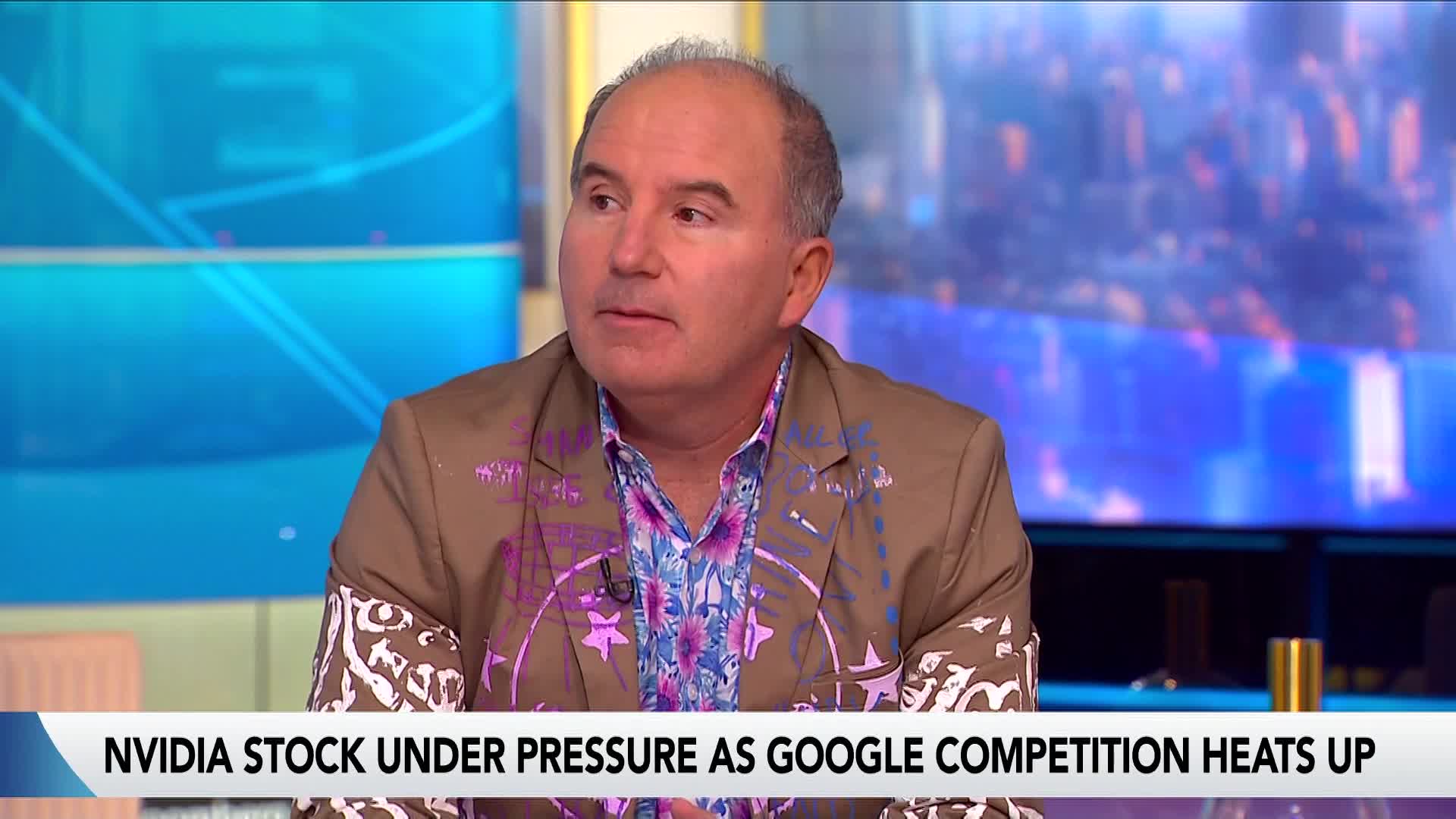
Wedbush analyst Dan Ives reiterated a strongly bullish view on NVIDIA, arguing the company is roughly four years ahead of rivals and faces a 12:1 demand-to-supply imbalance for its chips. Ives forecasts massive secondary waves of AI spending (he cites $3–4 trillion) and suggests NVIDIA could reach a $5–6 trillion valuation as Jensen Huang remains the industry leader, while acknowledging competition from Google, AMD, Meta and potential vertical integration by big tech. The interview also flagged funding questions around AI services (noting OpenAI’s cited $14 billion revenue vs. a $1.4 trillion opportunity) but maintains the view that enterprise adoption is early and will drive significant revenue upside for chip suppliers.
Market structure: NVIDIA (NVDA) is the primary beneficiary — outsized pricing power on accelerator GPUs and a ~12:1 demand/supply imbalance implies customers will pay a premium; hyperscalers (MSFT, GOOGL) and chip-suppliers (AVGO, AMZN via AWS) are secondary beneficiaries. Losers: ID-centric fabs/legacy CPU vendors (INTC) face pricing/market-share pressure as vertical integration is slow and capacity-constrained, and smaller GPU rivals (AMD) lack short-term volume to displace NVDA. Cross-asset: equity risk appetite favors tech cyclicals (steepen curve, risk-on), implied vol in NVDA options will remain elevated around product/earnings dates, and energy/metal demand for datacenter expansion supports industrial commodity complex over 12–36 months.
Risk assessment: Tail risks include US/China export controls or antitrust actions that could remove >20% of TAM for NVDA in 12–24 months, or a macro slowdown that delays enterprise AI spend by 6–12 months. Short-term (days–weeks): headline-driven volatility around earnings and new chip disclosures; medium (3–12 months): supply chain ramps and hyperscaler orders; long-term (2–5 years): vertical integration by AWS/Google/Meta could capture 20–30% of workloads if foundry access and software stack align. Hidden dependencies: NVDA’s moat is as much software (CUDA/SDKs) and ecosystem momentum as silicon scarcity; foundry capacity (TSMC) and ASML supply are implicit constraints.
Trade implications: Direct plays: overweight NVDA and cloud-native winners (MSFT, GOOGL) with 6–12 month horizons; tactical shorts or underweights in INTC and cyclic margins-exposed OEMs. Options: favor defined-risk bullish spreads on NVDA (6–9 month 15–30% OTM call spreads) to capture upside while limiting theta; sell short-dated puts only if funding to accumulate on >15% pullback. Sector rotation: reduce exposure to legacy semis (INTC) and raise allocation to AI software, cloud, and select networking/interop (AVGO) over next 3–12 months.
Contrarian angles: Consensus underestimates the software/ecosystem lock-in — not just silicon — so NVDA’s decline on any macro pullback is likely a buying window rather than permanent share loss. Conversely, the market may be underpricing regulatory/export risk; a 20%+ drawdown is plausible if China access tightens. Historical parallel: Intel’s earlier dominance eroded only after multi-year supply/architecture missteps — NVDA’s risk is concentrated execution and geopolitical shocks, not immediate competitive substitution.
AI-powered research, real-time alerts, and portfolio analytics for institutional investors.
Request DemoOverall Sentiment
strongly positive
Sentiment Score
0.60
Ticker Sentiment
