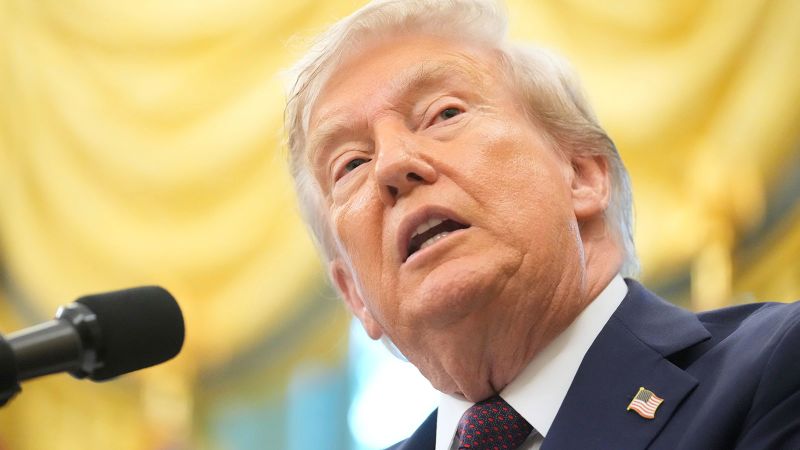
Former President Trump has appealed to the Supreme Court to reverse lower court rulings that deemed his administration's emergency tariffs, imposed via the International Emergency Economic Powers Act (IEEPA), unlawful due to overstepping presidential authority, which courts argue resides with Congress. This case holds significant financial and strategic implications, as a ruling against the administration could invalidate over $210 billion in FY2025 IEEPA-related tariff revenue, potentially leading to importer refunds and weakening the U.S.'s trade negotiation leverage. The outcome will also set a critical precedent on the scope of presidential executive power, particularly under the 'major questions doctrine,' despite the existence of other, more limited tariff authorities like Section 232.
The Trump administration's appeal to the Supreme Court introduces significant legal and fiscal uncertainty surrounding tariffs imposed under the International Emergency Economic Powers Act (IEEPA). Lower federal courts have ruled that the IEEPA does not grant the president unilateral tariff authority, framing it as a 'core congressional power,' a position which may be evaluated under the 'major questions doctrine.' The financial stakes are substantial, as over $210 billion in IEEPA-related tariff revenue for fiscal year 2025 is at risk; a Supreme Court decision upholding the lower court rulings could trigger large-scale refunds to American importers and materially impact the U.S. fiscal balance. Strategically, an adverse ruling would weaken a key lever in trade negotiations, potentially jeopardizing recent agreements and constraining future foreign policy options. While the administration possesses alternative tariff mechanisms like Section 232 of the Trade Expansion Act, these are more restrictive and less flexible, suggesting a negative IEEPA ruling would significantly curtail, though not entirely eliminate, the administration's tariff-heavy agenda. The request for an expedited review, targeting arguments for early November, positions this legal challenge as a near-term catalyst for market volatility.
AI-powered research, real-time alerts, and portfolio analytics for institutional investors.
Overall Sentiment
moderately negative
Sentiment Score
-0.50
