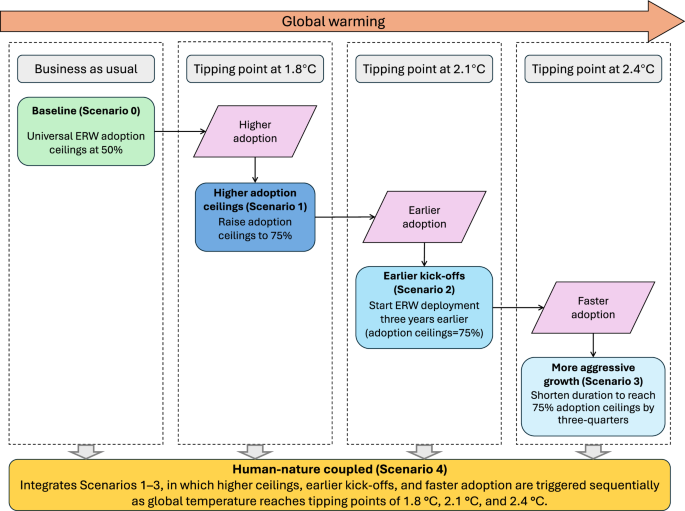
A diffusion-based study projects enhanced rock weathering (ERW) could remove 0.35–0.76 GtCO2/yr by 2050 and 0.7–1.1 GtCO2/yr by ~2080–2100, yielding cumulative sequestration of roughly 34–55 GtCO2 by 2100 under 50–75% adoption ceilings (baseline/upper scenarios). Early deployment is concentrated in high‑income regions but shifts toward India, Brazil and lower‑income countries mid‑century, with low and lower‑middle income shares rising from ~20–29% in 2040 to ~60% by 2100; a climate‑responsive scenario shows rapid acceleration after global temperature thresholds (1.8, 2.1, 2.4°C). Significant commercialization risks remain—adoption ceilings, cropland dynamics, mining/grinding/transport costs and M&V uncertainties—so ERW is a meaningful long‑term CDR exposure for ESG portfolios but currently a high‑uncertainty, low near‑term market mover.
Market structure: ERW creates direct winners in bulk-aggregates, bulk-mining and freight logistics (capacity-constrained crushed-rock suppliers and rail) while producing long-term downside for parts of synthetic-fertilizer demand and localized water/permit-constrained agriculture. Expect incremental pricing power for regional aggregate producers (spot spreads could expand 10–30% in constrained corridors) as scale-up needs thousands of tonnes/km of rock and new grinding capacity over 3–10 years.
Risk assessment: Tail risks include regulatory moratoria on quarrying or restrictive permitting, a failure of verification standards that collapses carbon-credit demand, or energy-price shocks that make grinding uneconomic—each can wipe out projected IRRs and occur within 12–36 months. Key hidden dependencies are logistics (rail/truck bottlenecks), local rock quality, and a carbon-price threshold (likely in the $50–$150/tCO2 range) necessary to underwrite deployment; policy signals (GCF funding, standards) are primary catalysts.
Trade implications: Near-term (6–18 months) alpha will come from select US/EM materials and freight plays, not tech buyers; mid/long-term (2–10 years) winners are suppliers in India/Brazil where biophysical sequestration is highest and adoption could accelerate. Options can asymmetrically capture optionality around policy/certification milestones within 9–18 months.
Contrarian angles: Consensus underestimates logistics and verification as bottle-necks — the market may underprice VMC/MLM/UNP exposure while overpricing fertilizer damage in the short term. Historical parallels: bulk-commodity surges (e.g., frac sand 2010–15) show multi-year capex cycles and outsized returns for early-capacity owners, but late entrants face margin compression when grinding technology commoditizes.
AI-powered research, real-time alerts, and portfolio analytics for institutional investors.
Request DemoOverall Sentiment
mixed
Sentiment Score
0.12
Ticker Sentiment
