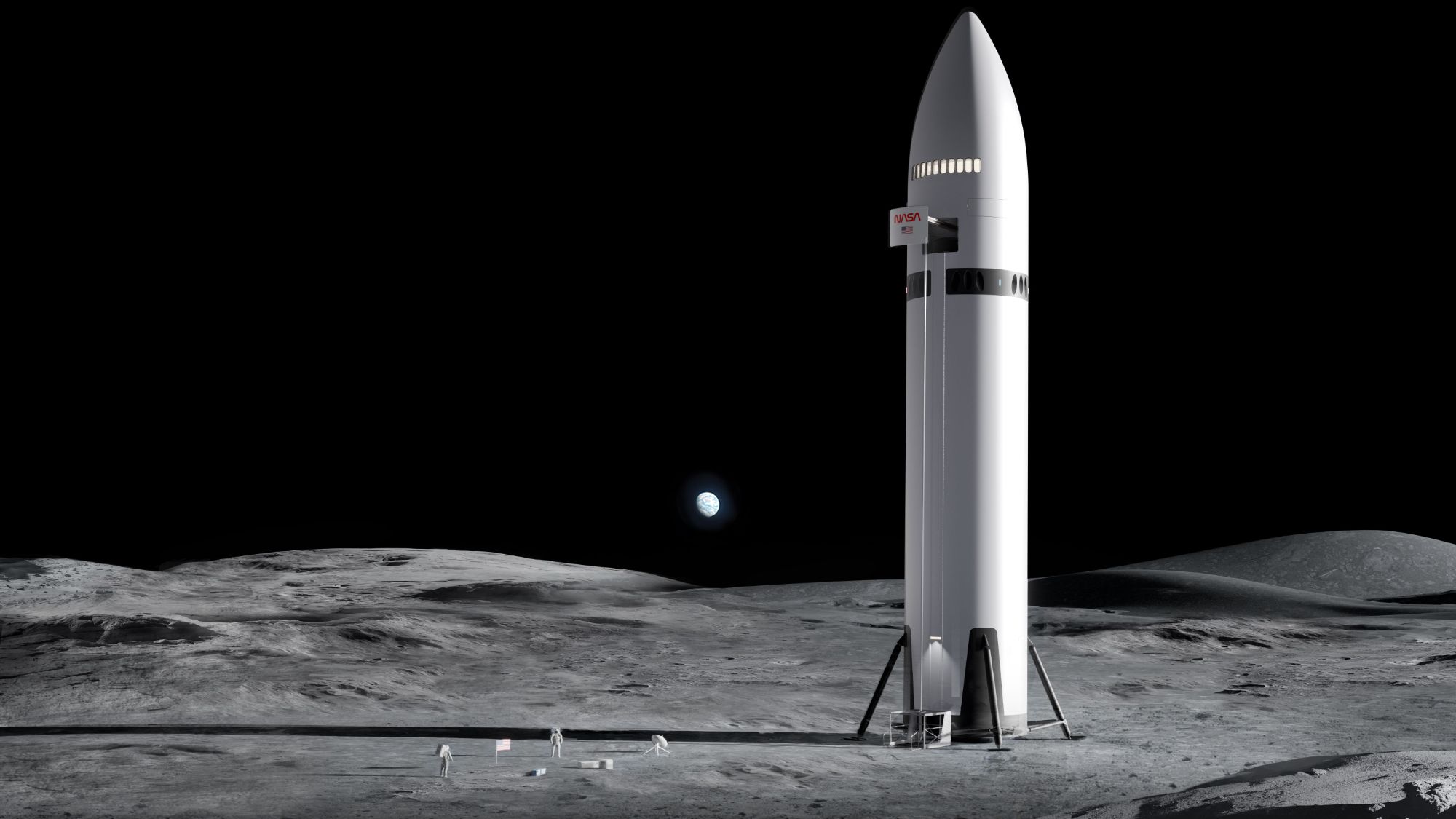
Elon Musk announced SpaceX is prioritizing a self-growing lunar city that he says could be achieved in under 10 years, citing a launch cadence to the Moon every ~10 days (2-day transit) versus Mars' 26-month alignment cycle and 6-month transit which he argues makes Martian settlement take 20+ years. The plan centers on Starship — already selected by NASA as the Artemis crewed lander — and leverages in-space refueling, multiple tanker flights (perhaps 10–12 per lunar mission), and lunar manufacturing to support large satellite deployments; however Starship still must complete orbital flights and demonstrate refueling, and NASA competition and development risks remain material to timelines and program economics.
Market structure: A SpaceX pivot to a moon-first settlement raises near-term demand for heavy‑lift launches, lunar lander cargo, and in‑space refueling infrastructure. Public beneficiaries are large aerospace primes and satellite/robotics suppliers that can scale manufacturing quickly (think NOC, LHX, LMT, MAXR); pure consumer tech (AMZN) sees neutral direct impact but could face competitive pressure in orbital data services. Pricing power will concentrate with firms that secure NASA/modular manufacturing contracts and cryogenic propellant supply chains, creating multi-year backlog visibility if Starship proves reliable.
Risk assessment: Key tail risks are Starship orbital/refueling failures, FAA/NASA regulatory pushback, or a policy reversal reopening Artemis contracts (probability medium, impact high). Short horizon catalysts include Artemis 2 (weeks) and upcoming Starship orbital tests (months); long horizon (3–10 years) depends on tanker cadence and in‑space propellant production. Hidden dependencies: SpaceX’s timeline hinges on orbital refueling capacity and tanker cadence (need ~10–12 tankers per lunar mission) and on supply of cryogenic methane/oxygen — a potential bottleneck.
Trade implications: Favor defense/aerospace primes and satellite infrastructure names with 12–36 month horizons: accumulate NOC/LHX/LMT/MAXR selectively; use 12–24 month call spreads to limit capital while capturing upside if NASA/SpaceX cadence accelerates. Pair trade: long NOC or LHX vs short speculative space/tourism weak-cash names (SPCE) to isolate industrial exposure. Options: buy 9–18 month call spreads on MAXR and LHX sized 1–3% NAV; buy outright puts on SPCE 6–12 month expiries as hedge.
Contrarian angles: Consensus assumes Musk’s tweets equal immediate program change — that underestimates technical bottlenecks (refueling, orbital qualification) so market may underprice delay risk; conversely, success in next 6–12 months would re‑rate suppliers by >20% given multiyear contracts. Historical parallel: shuttle-to‑ISS cadence showed government contracting can shift rapidly after single technical success/failure. Unintended consequence: rapid lunar focus could crowd out small commercial LEO satellite launches (pressure on small launchers and suppliers), creating short opportunities among undercapitalized launch vendors.
AI-powered research, real-time alerts, and portfolio analytics for institutional investors.
Request DemoOverall Sentiment
neutral
Sentiment Score
0.12
Ticker Sentiment
