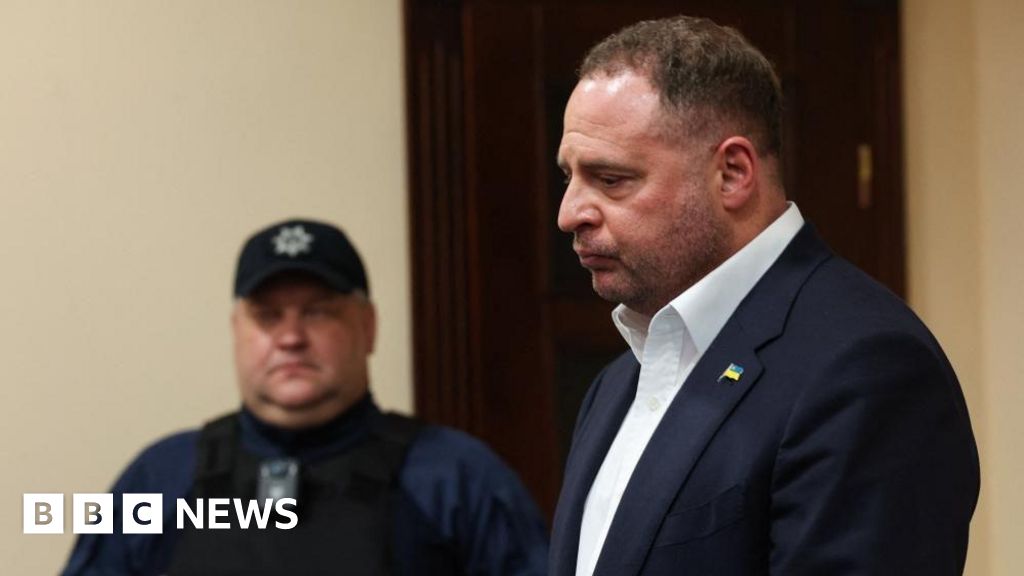
Ukraine's anti-corruption probe has escalated, with former presidential chief of staff Andriy Yermak appearing in Kyiv court after being named a suspect in an alleged money-laundering case tied to a $10.5m luxury construction project and a broader $100m embezzlement inquiry. Prosecutors are seeking either preventive detention or about $4m bail, while the case has already implicated other senior figures and further strained Ukraine's EU accession narrative. The developments come amid intensified Russian attacks and renewed Kremlin nuclear messaging, adding to geopolitical risk.
This is less a single corruption headline than a governance stress test for Ukraine's entire reform premium. The immediate market impact is not on one issuer but on the financing stack: donor disbursements, IMF conditionality, EU accession pacing, and the willingness of Western contractors to sign long-dated work in a jurisdiction where political protection can evaporate overnight. That raises the effective cost of capital for any Ukraine-exposed project, especially in power, housing, logistics, and reconstruction-linked names where procurement opacity is already a discount factor.
The second-order winner is the anti-corruption infrastructure itself. If the probe survives political pushback, Nabu/Sapo credibility increases and future selective enforcement risk falls, which is bullish for institutions but bearish for the oligarchic and politically connected ecosystem. In the near term, though, the bigger trade is headline-duration risk: every additional arrest, wiretap leak, or court action extends the window in which Brussels and Washington can slow-walk support on compliance grounds, and that matters more than the specific defendant.
There is also a defense and sanctions angle. A governance shock in Kyiv makes Western capitals less tolerant of leakage in aid flows and more likely to tighten monitoring on military procurement and reconstruction funds, which can delay project awards but improve pricing discipline for incumbents with cleaner compliance records. Meanwhile, Russia benefits at the margin from any internal distraction in Ukraine, but the missile signaling is mostly escalation theater; the more investable implication is that geopolitical risk premia in Eastern Europe stay elevated even if front-line dynamics do not change materially.
Contrarian view: the selloff in Ukraine-adjacent assets may be overdone if the market is assuming institutional unraveling rather than institutional hardening. A credible, public, and politically costly investigation can actually improve the medium-term investment case by reducing the hidden tax on capital allocation. The key is whether the case widens into the presidential circle; if it stops at visible arrests and process, the long-term governance signal could be cleaner than consensus expects.
AI-powered research, real-time alerts, and portfolio analytics for institutional investors.
Request DemoOverall Sentiment
strongly negative
Sentiment Score
-0.65
