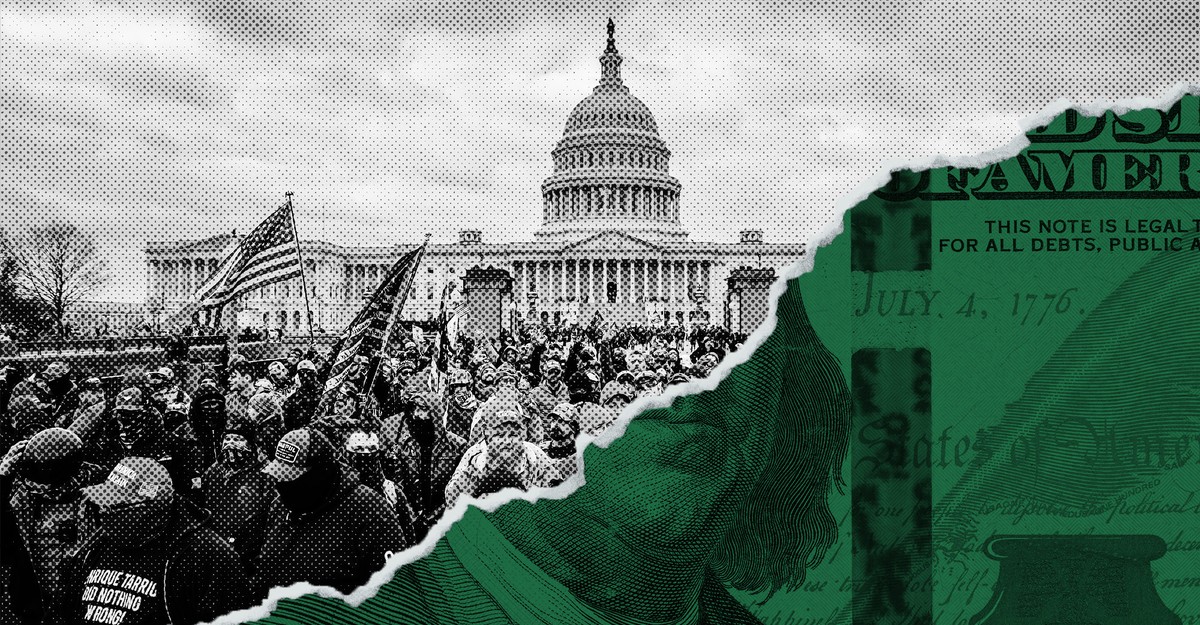
Trump is reportedly setting up a $1.8 billion Treasury-funded compensation program aimed at alleged victims of government weaponization, with the article arguing it is designed to reward political allies and January 6 participants rather than legitimate claimants. The fund would run through December 15, 2028 and be controlled by a Trump-selected committee, raising major governance and legal concerns. Market impact is likely limited, but the policy underscores heightened political risk and institutional erosion.
The core market implication is not the headline “slush fund” itself but the further degradation of institutional checks around IRS discretion and Treasury payment governance. That raises a small but persistent sovereign-risk premium: not default risk, but process-risk, where future outlays become more contingent on political loyalty than statutory discipline. The direct equity read-through is limited, but any business model exposed to federal tax administration, audit outcomes, or regulatory adjudication should trade with a higher legal-variance discount.
Second-order winners are political-consulting, investigations, and defense-adjacent firms with exposure to internal-security budgets, while losers are entities whose value depends on clean administrative process: large-cap financials, insurance, and any regulated issuer with tax disputes in the pipeline. The more important effect is behavioral: once market participants believe enforcement can be selectively redirected, settlement expectations rise and the cost of contesting the government falls for allies, but rises for everyone else. That asymmetry tends to widen dispersion inside sectors rather than move index-level multiples immediately.
The catalyst path is months, not days. Near term, headlines can fade; the real risk is a cascade of copycat claims, litigation over fund administration, and new executive attempts to bypass normal appropriations. The tail risk is reputational spillover into Treasury auctions or FX if foreign investors start pricing governance slippage, but that is a low-probability, slow-burn outcome unless the fund expands materially or becomes a template for other agencies.
Consensus is likely underestimating how investable the negative is for event-driven and defense-of-process trades. This is less about ideology and more about optionality: a regime that rewards loyalty over process increases black-swan probability for anyone short legal uncertainty. The move is probably underpriced in broad indices, but overdone if expressed as a direct macro-short; the cleaner expression is relative-value and hedged downside convexity.
AI-powered research, real-time alerts, and portfolio analytics for institutional investors.
Request DemoOverall Sentiment
strongly negative
Sentiment Score
-0.75
Ticker Sentiment
