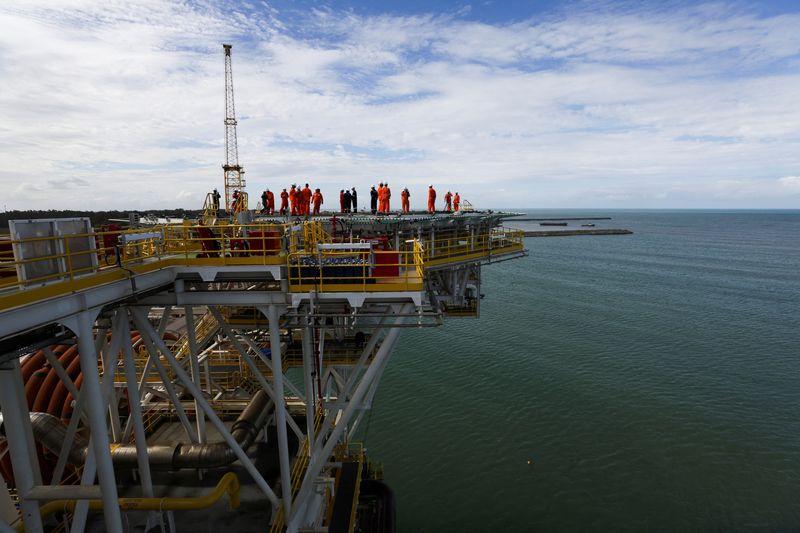
Bank of America downgraded Petroleo Brasileiro (PETR3) to "Neutral" from "Buy," citing a more challenging macro outlook and rising regulatory risks, leading to reduced price targets of R$34 for preferred shares and $12.50 for ADRs. The downgrade reflects concerns over OPEC+’s increased oil production, potential impacts from US import tariffs, and the Brazilian government's possible implementation of an "oil package" to meet fiscal targets, which could negatively impact Petrobras' free cash flow and dividend policy. While BofA projects double-digit dividends through 2026, they caution that sustained low oil prices could force a review of the dividend policy.
Bank of America has downgraded Petroleo Brasileiro (Petrobras) shares to "Neutral" from "Buy," reducing its price target for preferred shares to R$34 from R$42 and for ADRs to US$12.50 from US$15.50, leading to an immediate negative market reaction with preferred shares declining 1.75% to R$29.11 and ADRs falling 2.30% to US$11.06. This downgrade is attributed to a more challenging macroeconomic outlook and escalating regulatory risks, which prompted BofA to increase Petrobras' Weighted Average Cost of Capital (WACC) from 14.8% to 15.4%. The difficult macro environment includes OPEC+'s strategy to boost oil production to reclaim market share despite low international prices, and US import tariffs which are anticipated to negatively impact global economic growth, collectively pressuring oil prices downwards. Concurrently, significant regulatory uncertainty stems from the Brazilian government's potential implementation of an "oil package"—involving measures like increased royalties, special participation taxes, or the unitization of assets such as Jubarte (estimated R$2 billion impact, or 0.5% of Petrobras' capitalization)—to achieve fiscal targets, which could adversely affect Petrobras' free cash flow. Reflecting these concerns, BofA raised Petrobras' risk premium from 7% to 7.5% and its equity cost from 18% to 18.8%. Although BofA forecasts Petrobras' dividends to remain in double digits for 2025 (12.2% yield) and 2026 (12.3% yield), assuming oil prices of US$67/barrel and US$63/barrel respectively, and free cash flow generation of 9.8% (2025) and 11.1% (2026), these yields represent a substantially smaller premium over international peers compared to the 35-45% differential observed in 2022. A key risk highlighted is that prolonged low oil prices could result in dividend payments exceeding cash flow generation, potentially necessitating a revision of Petrobras' dividend policy to safeguard its leverage. While a future "Trade Election" favoring a more market-friendly candidate could provide some uplift, BofA suggests that Petrobras' gains would be limited, and investments in Brazil's domestic economy stocks might offer better returns given the specific headwinds facing the oil company.
AI-powered research, real-time alerts, and portfolio analytics for institutional investors.
Request DemoOverall Sentiment
strongly negative
Sentiment Score
-0.75
Ticker Sentiment
