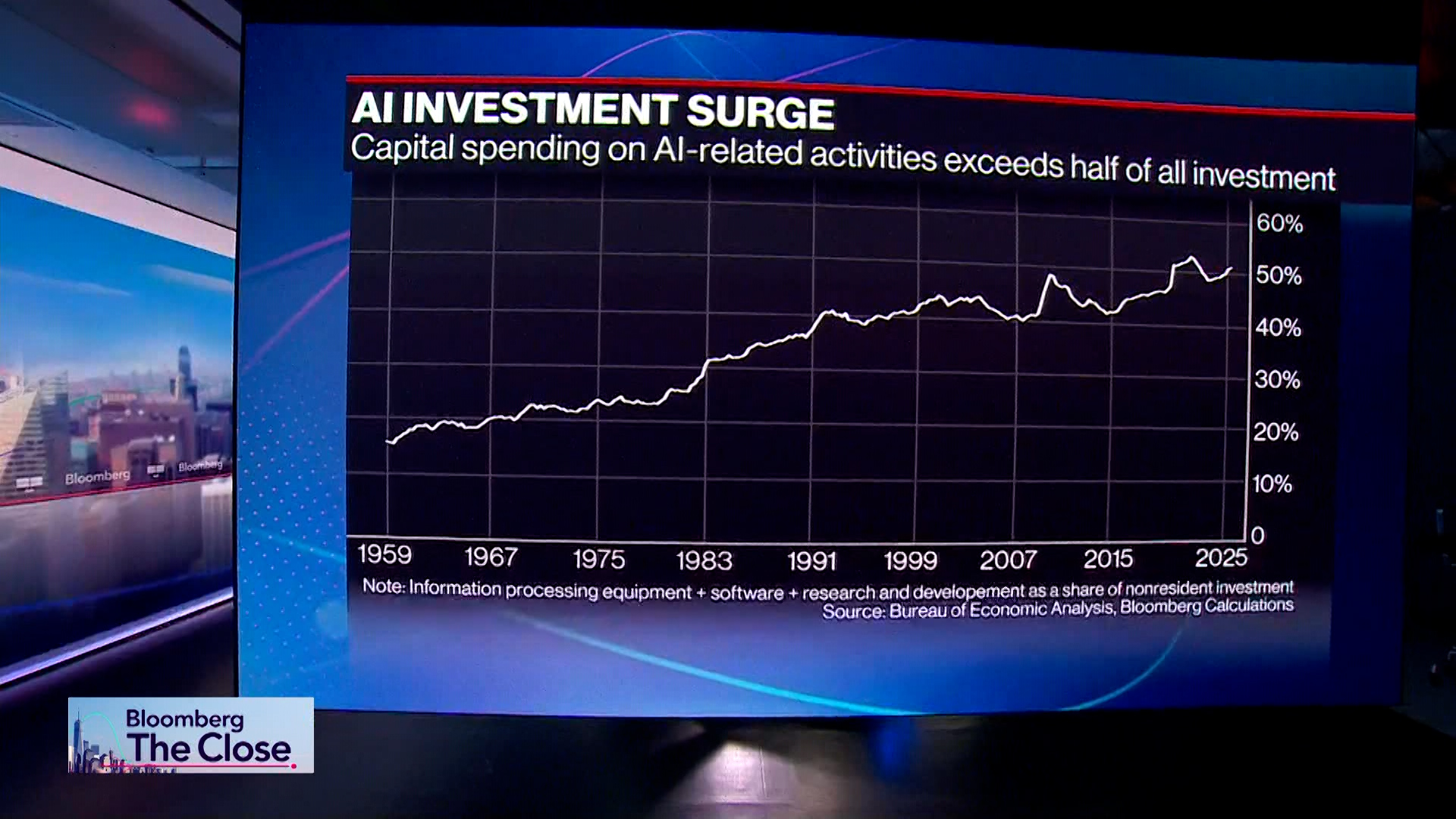
Credit markets are showing resilient fundamentals as most recent borrowing has been concentrated in high-quality borrowers (e.g., hyperscalers like Alphabet and Microsoft), keeping spreads tight for well-supported credits while more speculative issuers face significantly wider spreads. Through the year the S&P equal-weight is up ~10% versus roughly 8% total return for both high yield and investment-grade credit, and the view is that credit returns could be competitive with equities in 2026 as M&A and net new credit issuance pick up; by contrast private credit faces concentration and lower-quality risk (portfolios often >80% B‑/below and heavy tech exposure), suggesting less upside and higher downside risk versus public credit.
Market structure is bifurcating: hyperscalers (GOOGL, GOOG, MSFT) win as stable, high-quality borrowers able to fund data-center expansion at tight spreads, while standalone, lower-rated data center operators and private-credit-heavy borrowers lose pricing power and face >200–500bps higher funding costs. Supply-demand is shifting: expect net new corporate issuance to rise in 2026 driven by M&A and refinancing, which will temporarily widen spreads on lower-quality credits even as IG spreads remain compressed. Cross-asset: wider HY spreads would lift CDS and option implied vols, favoring long-vol strategies; a risk-off move could strengthen USD and pressure rate-sensitive commodities and REITs.
Tail risks include a Fed surprise (rate hikes or rapid cuts) that re-prices credit, a tech capex pullback from hyperscalers, or a liquidity shock in private credit; any could blow out B-/CCC segments by 300–600bps. Time horizons: immediate (days) — trim highly concentrated private-credit positions and hedge ORCL exposure; short-term (weeks–months) — deploy into public BB-heavy HY and IG on spread dislocations; long-term (quarters–years) — monitor covenant creep and refinancing cliffs as M&A issuance grows. Hidden dependencies: covenant quality, sponsor support from hyperscalers, and index composition (HY moving to BB) matter more than headline yields.
Trade implications: favor public high-grade and BB-heavy HY over private credit — volatility-adjusted returns look superior if HY yields stay in the high-6% to low-8% range; use LQD for IG exposure and HYG/JNK for HY, sizing to 2–4% tactical allocations. Pair trades: long MSFT/GOOGL equity or bonds (2% each) vs short ORCL (buy 3–6m puts) to express quality divergence. Options: buy puts on ORCL (10–15% OTM, 90–180d) and consider cheap put spreads on HY ETF (entry on +50bps spread widening).
Contrarian view: the market underestimates private credit downside — private portfolios concentrated >80% B- are likely to underperform public BB-heavy HY if volatility rises; consensus that credit will simply keep tightening is underdone. Historical parallel: post‑pandemic private-credit dislocation (2020–21) showed rapid convergence back to public markets once issuance reopened; unintended consequence — a M&A-driven surge in issuance can flatten IG spreads while amplifying tail risk in lower-quality tranches, creating asymmetric opportunities in public credit.
AI-powered research, real-time alerts, and portfolio analytics for institutional investors.
Request DemoOverall Sentiment
mildly positive
Sentiment Score
0.25
Ticker Sentiment
