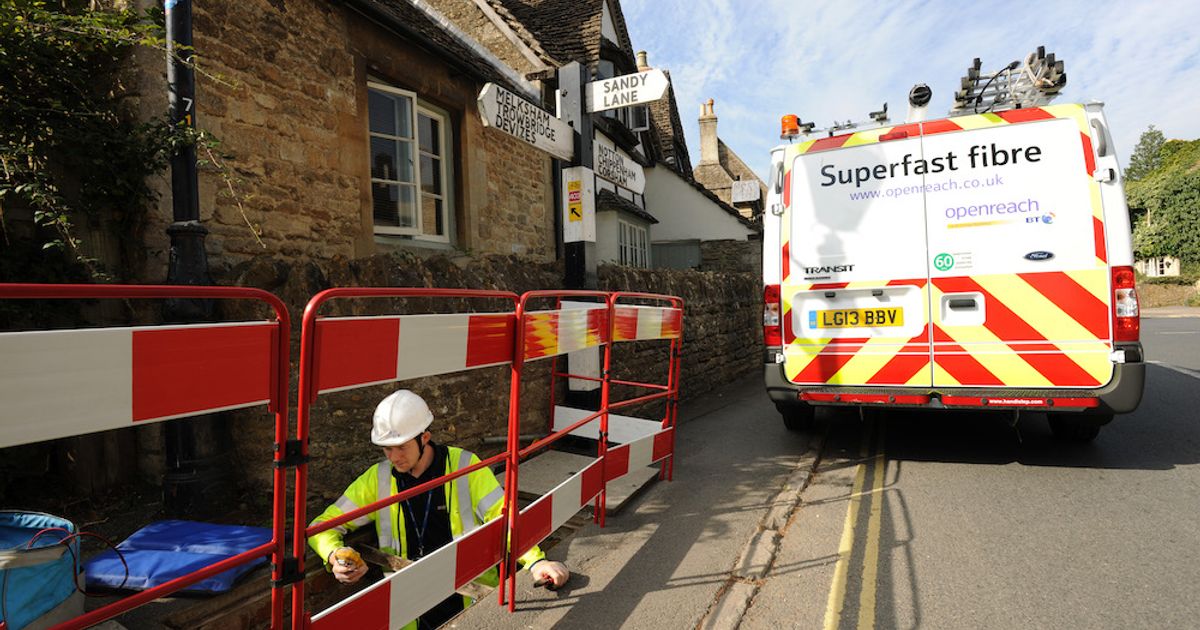
BT Group reported Q3 group revenue of £4.98bn, down 4% year-on-year and missing consensus and UBS's forecast of a 2% decline; EBITDA/earnings broadly met expectations primarily through cost savings. Openreach was the lone growth area (+0.5%) with improved broadband line loss guidance (850k versus 900k prior), while Consumer revenue fell 1.2% (ARPU down, though post-paid mobile net adds were +55k) and Business revenue dropped 8.3% due to disposals and weak trading. UBS called the quarter "very weak" on the top line, retains a sell stance and flagged doubts about BT hitting its £2bn free cash flow target by FY2027, leaving upside limited despite shares being +11% YTD.
Market structure: The quarter confirms structural share-shift toward alternative network operators (altnets) and mobile challengers—alternative networks now cover ~60% of UK premises and advertise prices 20–30% below incumbents, squeezing BT’s pricing power and ARPU (BT group revenue -4% q/q; Openreach only +0.5%). Winners: fibre builders (e.g., CityFibre CFB.L), tower/co-location owners and aggressive MVNOs; losers: legacy integrated operators with large fixed-cost bases (BT.L) and wholesale-dependent business lines. Expect sustained margin pressure unless incumbents materially change pricing or capex allocation over 12–36 months.
Risk assessment: Tail risks include an Ofcom intervention forcing deeper wholesale cuts or structural remedies (high-impact), a sharper-than-expected broadband line loss (>+50k q/q) causing cash-flow misses, or an operational capex shock on fibre roll-out. Near-term (days–weeks): Q4 trading update and any Ofcom commentary; short-term (1–6 months): guidance revisions and altnet rollout metrics; long-term (>1 year): market share transfer and FCF trajectory to the £2bn target. Hidden dependency: Openreach’s healthier performance hides group-level revenue dilution from disposals and mobile commoditization.
Trade implications: Primary tactical idea is short BT.L into Q4 while being long UK fibre builders. Use size-limited exposures: equity short or 3-month put spread on BT.L (see specifics below) and a 6–12 month long in CFB.L or tower plays; consider pair trade long CFB.L/short BT.L to isolate UK fibre upside vs incumbent risk. Credit angle: prefer CDS protection on BT if 5y spreads move >100bps wider vs current levels. Rebalance on Q4 print and Ofcom moves.
Contrarian angles: Consensus focuses on headline weakness but underprices monetization options—Openreach could be carved out or monetized (accelerating deleverage) which would be a binary upside catalyst. Reaction may be partly overdone if BT converts cost savings into stable FCF—so keep shorts size-constrained and use defined-loss option structures. Historical parallel: earlier BT restructurings produced short-term volatility but long-term consolidation in valuation once FCF proved stable; downside remains if top-line erosion continues.
AI-powered research, real-time alerts, and portfolio analytics for institutional investors.
Request DemoOverall Sentiment
moderately negative
Sentiment Score
-0.45
Ticker Sentiment
