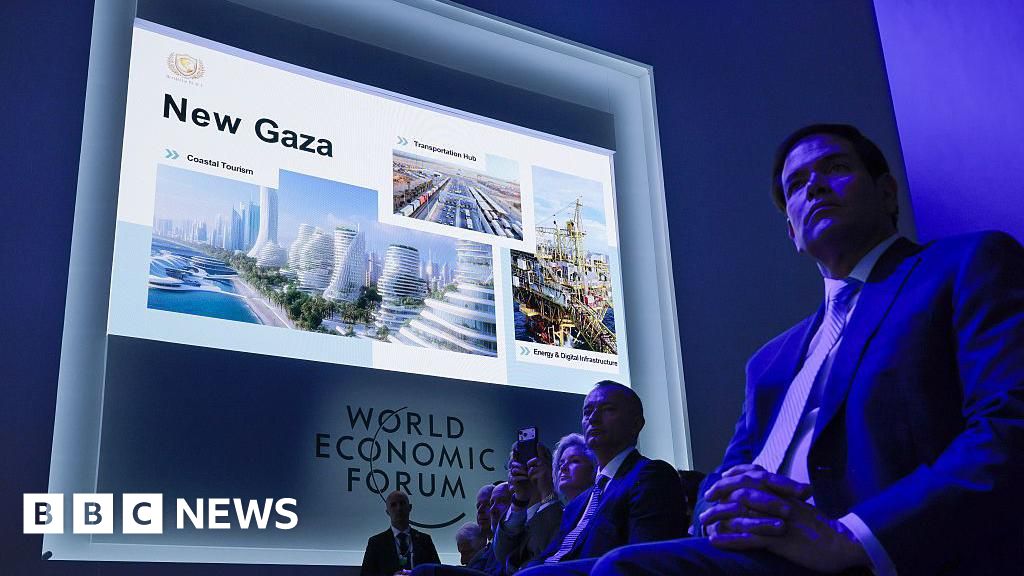
At the World Economic Forum in Davos the US unveiled a 'New Gaza' master plan tied to President Trump’s Board of Peace that envisions rebuilding Gaza for its 2.1 million residents with coastal skyscrapers (180 tower-blocks), a new seaport and airport, and phased redevelopment beginning in Rafah. Slides and remarks from Jared Kushner projected clearing 60 million tonnes of rubble, 90,000 tonnes of munitions removed, and targets for New Rafah of >100,000 permanent housing units, 200 education centres and 75 medical facilities with a two-to-three year build aspiration; the plan conditions reconstruction on Gaza demilitarisation and a security perimeter. The proposal signals potentially large reconstruction and private-investment opportunities but remains exposed to major political and security risk given the fragile ceasefire, ongoing casualties, humanitarian shortfalls (about 1m without adequate shelter, 1.6m facing acute food insecurity) and contested governance between Israel, Hamas and Palestinian authorities.
Market structure: Reconstruction is a large, multi-year capex story that mechanically benefits materials (cement/aggregates), heavy equipment, engineering contractors and data‑centre/infrastructure owners while depressing local consumer-facing sectors and EM sovereign credit near-term. Expect a persistent premium to bulk commodities (steel, copper, cement) and equipment (CAT, PC) if donor funding >$5bn is confirmed; conversely travel/leisure exposure to the region sees near-term demand destruction and credit stress.
Risk assessment: Key tail risks are renewed conflict (we assign ~25% probability in next 12 months), donor fatigue/conditionality and sovereign legal disputes that can stop private contracting. Immediate volatility (days) will spike around the Washington donor conference (weeks), short-term (3–12 months) outcomes hinge on demilitarisation progress, and long-term (1–5 years) returns require secured land rights and sustained capital flows. Hidden dependencies include border openings, Egyptian/Israeli security guarantees and global supply‑chain constraints for cement/steel that could inflate input costs by +10–30%.
Trade implications: Lean into materials/heavy-equipment and select data-center REITs while hedging geopolitical tail risk; favor liquid, large-cap names (VMC, MLM, CAT, EQIX, DLR, LMT) and avoid direct EM frontier exposure. Use event-driven sizing around the donor conference: initial small positions now, scale on concrete funding (> $5–10bn) announcements, and deploy options to cap downside during binary security outcomes.
Contrarian: Consensus assumes rapid privatized redevelopment; history (Balkans, Iraq) shows reconstruction often becomes multiyear, grant-heavy with low IRR to private equity until security is indisputable. If donor money is primarily grant/NGO-driven, pricing power and margins for private builders will be compressed—favor suppliers of inputs (cement/steel) and defensive hedges over speculative luxury tourism plays.
AI-powered research, real-time alerts, and portfolio analytics for institutional investors.
Request DemoOverall Sentiment
mixed
Sentiment Score
0.00
