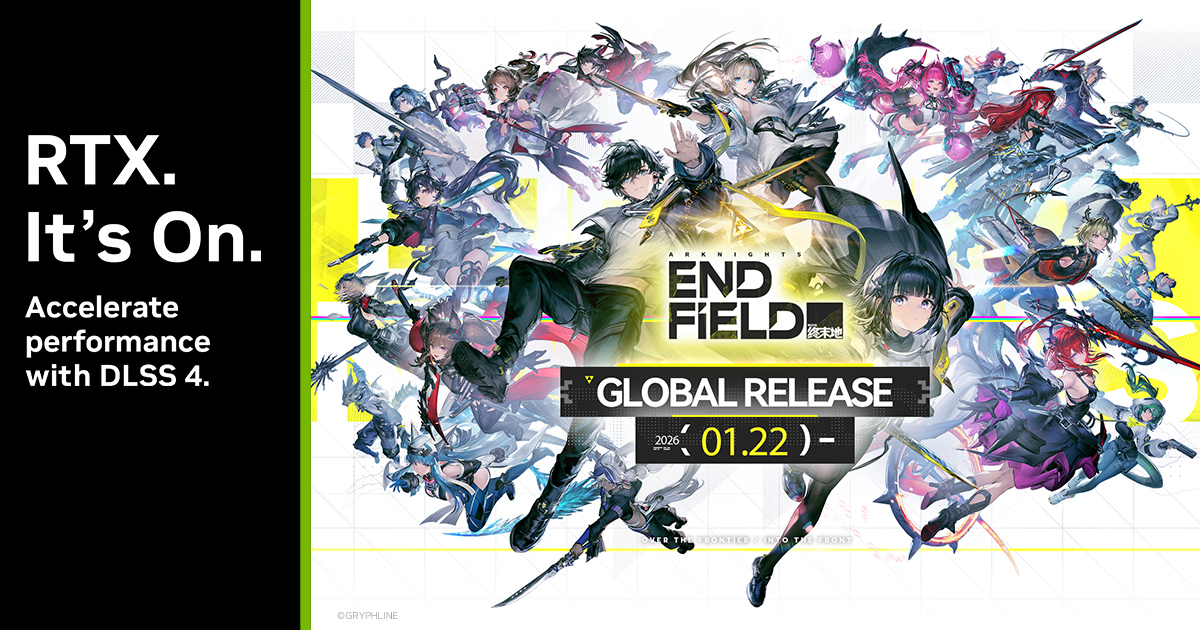
NVIDIA’s RTX ecosystem expansion continues with more than 800 RTX-enabled games and several near-term launches integrating DLSS and Reflex: Arknights: Endfield launches with day-one DLSS 4 (Multi Frame Generation) and DLSS Super Resolution—NVIDIA cites ~3x average 4K frame-rate uplift on GeForce RTX 50 Series and the ability for many GPUs to hit a 480 fps in‑game cap—while Styx: Blades of Greed demo (DLSS 4/MFG), No Rest for the Wicked’s four-player co-op update (Jan 22), and The Gold River Project (Jan 23) all add DLSS/Reflex support and app-based DLSS 4.5 upgrades. The releases reinforce NVIDIA’s platform advantages for PC gaming, likely supporting ongoing RTX GPU demand and user engagement but represent incremental, sector-specific upside rather than broad market-moving events.
Market structure: NVIDIA (NVDA) is the clear direct winner—DLSS 4/4.5 and app-level overrides increase stickiness of GeForce RTX, supporting ASPs and attach rates for high-end GPUs. Competitors in discrete graphics (AMD, INTC efforts) are relative losers for PC gaming share; expect NVDA to sustain a 2–5ppt share gain in high-end PC gaming GPUs over 12 months if integrations continue weekly. Game devs and engine vendors that quickly adopt RTX gain UX differentiation and potential price premia for premium PC editions.
Risk assessment: Key tail risks include expanded US/CHINA export controls on AI/GPU tech, a competitive leap from AMD/FSR or Microsoft/console-driven parity, or software that makes frame-generation redundant—each could reverse demand within 3–12 months. Short-term (days–weeks) impacts are headline-driven and muted; medium-term (3–12 months) are revenue/ASP drivers, and long-term (1–3 years) hinge on software lock-in vs. hardware upgrade-cycle compression. Hidden dependency: real demand depends on developer uptake across AAA titles and engine (Unreal/Unity) native integrations; slow adoption caps the uplift.
Trade implications: Direct play is NVDA long via staged sizing: buy equity now and use 3–6 month call spreads to leverage catalyst windows (game launches, earnings). Relative play: long NVDA vs short AMD to express DLSS exclusivity; expect 10–25% relative outperformance over 6–12 months if trend persists. Cross-asset: stronger NVDA narrative supports higher equity risk premia for semis, slightly tighter corporate spreads for high-quality tech names; monitor implied vol spikes around earnings for options entry.
Contrarian angles: Consensus overweights pure demand upside—software frame-generation could lengthen upgrade cycles, reducing unit growth by an upside-mitigating 5–15% over 2 years. Also, app-level DLSS overrides concentrate power in NVIDIA’s control plane—this increases platform risk (regulatory and developer pushback) that the market underprices. Historical parallel: NVIDIA’s software boosts (CUDA) locked datacenter revenue; gaming may mimic but at a smaller TAM—don’t assume linear scaling.
AI-powered research, real-time alerts, and portfolio analytics for institutional investors.
Request DemoOverall Sentiment
moderately positive
Sentiment Score
0.45
Ticker Sentiment
