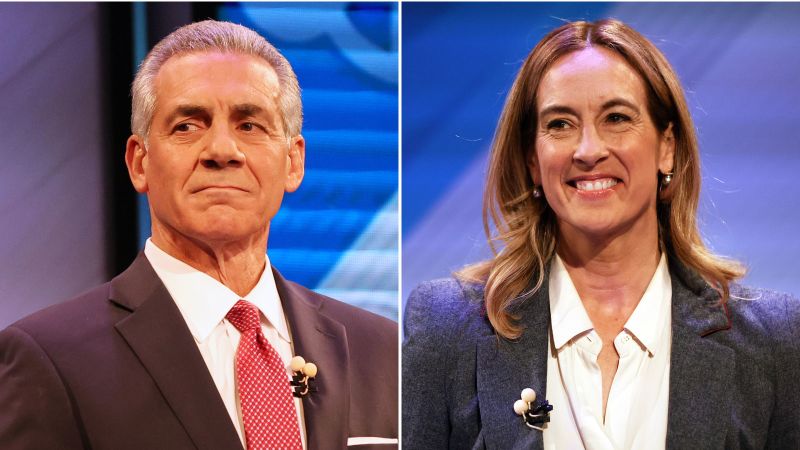
In a New Jersey gubernatorial debate, candidates Jack Ciattarelli and Mikie Sherrill outlined contrasting energy policies to address rising electricity costs, signaling potential shifts in the state's energy sector. Sherrill proposed declaring a state of emergency on utility costs, freezing rate hikes, and investing in a diversified energy portfolio including solar, battery storage, gas generation, and nuclear power. Ciattarelli, conversely, criticized overinvestment in renewables, suggesting an exit from the Regional Greenhouse Gas Initiative and advocating for a mix of fossil fuels, solar, and nuclear energy, which could impact utility companies and energy infrastructure investments in the state.
The sharp divides between New Jersey’s candidates for governor in Wednesday night’s second debate were crystallized by the grades each gave President Donald Trump. Republican nominee Jack Ciattarelli said Trump deserved an A. US Rep. Mikie Sherrill, the Democratic nominee, gave him an F. Ciattarelli and Sherrill had a more contentious meeting than their first debate, one that focused as much on Trump and personal controversies as it did local concerns about affordability. The heated attacks presaged a contentious last month of campaigning heading into the November 4 election. Here are the highlights from Wednesday night’s debate. Ciattarelli embraces Trump repeatedly Throughout the evening, Ciattarelli took multiple opportunities to praise the administration’s policies, touting tax reforms in the “One Big Beautiful Bill Act” and saying that he supported Trump’s immigration crackdown. He argued that it would help New Jersey to have a governor who gets along with the president. Trump improved his margin of defeat in New Jersey by 10 points between his 2020 and 2024 White House campaigns, losing last year by just 6 points. Ciattarelli at times sought to thread the needle. Asked if he was part of Trump’s “Make America Great Again movement,” Ciattarelli demurred. “I’m part of a New Jersey movement,” he answered. “We need change in New Jersey. We’ve got various crises that are raging across this state that are punishing the middle class.” Sherrill, meanwhile, accused her opponent of being “100% MAGA” and said, “He’s shown zero signs of standing up to this president.” “You see at every single level, costs are going up on New Jerseyans,” she said, citing Trump’s aggressive tariffs. Sherrill defends her college record Sherrill, who often cites her military service while campaigning, defended her service record and explained why she did not participate in her graduation ceremony in the 1990s. It comes as the National Archives admitted it wrongly released her unredacted military record, including her Social Security number, to an individual who filed a Freedom of Information Act request. “Look, I didn’t turn in some of my classmates, so I didn’t walk at graduation,” Sherrill said, referring to a cheating scandal during her time there. She blamed Ciattarelli’s campaign for culpability in the records release, linking the episode to what she said were abuses of power by the Trump administration. Ciattarelli pushed back, laying the blame with the National Archives and demanding Sherrill release more records about what happened. “I think the people in New Jersey deserve an answer as to why she was punished at the Naval Academy, and she’s trying to create a giant smoke screen for something the National Archives has taken complete responsibility for and apologized for,” Ciattarelli said, calling the records request “perfectly legal.” A barbed and personal back-and-forth Responding to a question over job creation in the state, Sherrill attacked Ciattarelli over a past report by NJ.com that a medical publishing company he once owned was paid millions of dollars in grants from the pharmaceutical industry to create continuing educational materials saying there was a low risk of Opioid abuse among patients with chronic pain. The issue arose in his last gubernatorial campaign against Democratic Gov. Phil Murphy in 2021. “My opponent likes to talk a lot about being a businessman, but I think what New Jersey doesn’t know as much about - his business, how he made his millions by working with some of the worst offenders and saying that opioids were safe, putting out propaganda, publishing their propaganda, while tens of thousands of New Jerseyans died,” said Sherrill. “Shame on you,” Ciattarelli said in response before arguing the flow of fentanyl into the US increased due to Democratic border policies under former President Joe Biden. “Shame on you, sir,” Sherrill fired back. “With regard to everything she just said about my professional career, which provided my family, it’s a lie. I’m proud of my career,” Ciattarelli said. “I think the people you got addicted and died deserve better than you,” she said. Ciattarelli then cut in to say, “I got to walk in my college graduation.” Both address the shutdown Ciattarelli accused Sherrill, who was first elected to Congress in 2018, of hypocrisy over the ongoing government shutdown. “When there were shutdowns during the Biden era, she voted every time for the continuing resolution to keep government, get it, open again. This time around with Trump in the White House, she’s voted no on the resolutions to keep government open,” Ciattarelli said. Sherrill defended congressional Democrats’ push to restore health care funding in Medicaid that was cut earlier this year and provide for Obamacare subsidies that could lead to premium hikes. “They’ve taken away health care in the “One Big Beautiful Bill” for millions of people, and they now want to cut health care support for people who still have it with the markets, the Affordable Care Act markets, that’s what we’re fighting for,” Sherrill said. “And so right now, with the president, with the Senate and the House, all in GOP hands, the fact is, they’ve got to work to reopen government so workers can get back to work.” How both would address affordability Both repeatedly raised the issue of surging electricity bills, offering contrasting approaches to the emerging challenge. Sherrill touted her plan “to declare a state of emergency and utility costs and free rate hikes,” and vowed to “drive in an energy arsenal of power as we drive costs down over time, making sure we build out our solar, our battery storage, improve our gas generation in the state, and then develop nuclear power.” Ciattarelli, on the other hand, blamed overinvestment in renewable energy projects, saying he would exit the Regional Greenhouse Gas Initiative and promote a mix of fossil fuel, solar and nuclear energy. Unity over not pumping your own gas The end of the debate featured a light-hearted round of questions on a topic near and dear to the hearts of New Jerseyans, something that can confuse the uninitiated out-of-state driver. New Jersey is the only state in the country where it is illegal for customers to fill their own tanks. Drivers can stay in their cars while an attendant fills gas. “I’ve come into New Jersey on fumes from Delaware, especially when my kids were little and in the rain,” Sherrill said. “So I think a lot of people really love our state laws as they are.” In a rare moment of unity, Ciattarelli agreed with Sherrill. “We have too many dubious distinctions, and I’ll fix great many of those. But one of our special, special differences here in New Jersey, we don’t have to pump our own gas. Jersey girls don’t like to pump their own gas. We’ll continue to have full service,” he said. The New Jersey gubernatorial debate highlighted significant policy divergences between candidates Jack Ciattarelli and Mikie Sherrill regarding the state's energy future and rising electricity costs. Sherrill proposes declaring a state of emergency on utility costs, freezing rate hikes, and diversifying energy investment across solar, battery storage, gas generation, and nuclear power. This approach suggests a more interventionist stance on energy pricing and a broad push for varied generation sources. Conversely, Ciattarelli criticizes overinvestment in renewable projects and advocates for exiting the Regional Greenhouse Gas Initiative (RGGI). His plan emphasizes a different energy mix, including fossil fuels alongside solar and nuclear, indicating a potential shift towards deregulation and a reassessment of current renewable energy mandates. These contrasting platforms present distinct potential regulatory and investment environments for energy companies operating within New Jersey. Sherrill's proposals could impact utility profitability through price controls, while Ciattarelli's stance might alter the trajectory of renewable energy development and carbon pricing mechanisms. While the immediate market impact of this political debate is assessed as neutral with a very low market impact score (0.05), the outcome of the November 4 election will be crucial in determining the state's energy policy direction, influencing infrastructure development and investment attractiveness for various energy sub-sectors.
AI-powered research, real-time alerts, and portfolio analytics for institutional investors.
Request DemoOverall Sentiment
neutral
Sentiment Score
0.00
