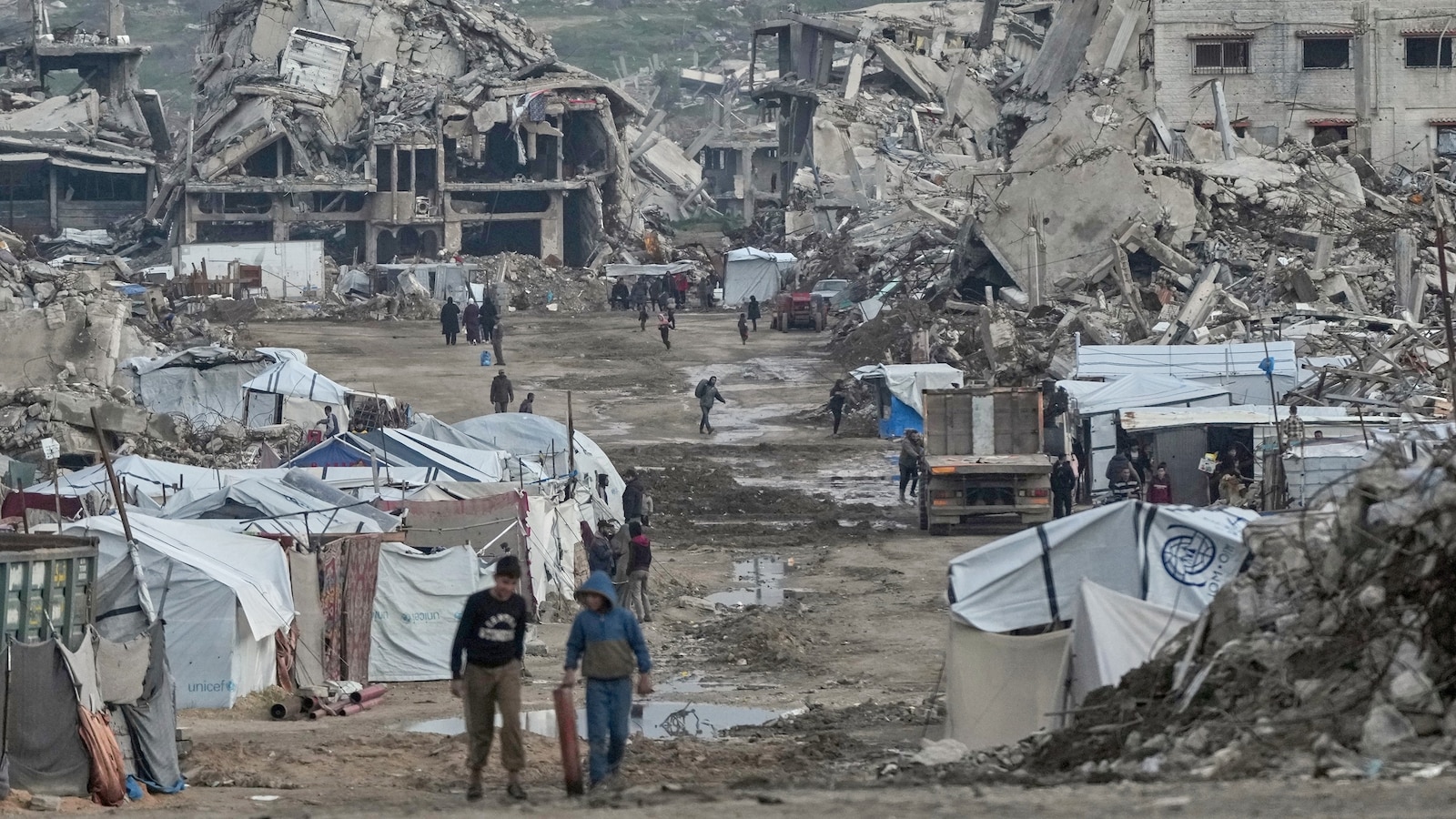
President Trump plans a formal signing to constitute a Gaza 'Board of Peace' reportedly while at Davos, but a circulated charter omits explicit reference to Gaza and leaves details vague. Multiple countries — including Argentina, Canada, Australia, Egypt, Turkey, Israel, India and reportedly Russia — received invitations but appear reluctant to publicly endorse membership, creating diplomatic and credibility headwinds for the initiative. The ambiguity around mandate and participation raises political and operational uncertainty for any future reconstruction effort and suggests limited near-term market impact.
Market structure: The board’s ambiguity reduces near-term certainty around coordinated multilateral reconstruction flows; winners in a protracted, underfunded scenario are global defense (RTX, LMT, GD) and private security/logistics firms that win contracts for stabilization rather than local contractors. If the board successfully aggregates $10B+ in pledges within 90 days, large-cap global EPC and heavy-equipment names (KBR, FLR, CAT) gain durable backlog and pricing power over 12–36 months; failure to do so keeps demand fragmented and drives risk premia in insurers and reinsurers.
Risk assessment: Tail risks include rapid regional escalation (low probability, high impact) that spikes oil >10% in 1–2 weeks and pushes equities down 5–10%, or conversely a rapid, well-funded reconstruction agreement (> $20B within 6 months) that re-rates construction and industrials. Near-term (days) volatility centers on Davos announcements and member list; short-term (weeks–months) depends on pledge cadence and legal/aid channels; long-term (quarters–years) depends on implementation, security, and contractor award pipelines. Hidden dependencies: insurance/legal restrictions, sanctions, and on-the-ground security will constrain effective spending and favor firms with sovereign-backed contract experience.
Trade implications: Tactical: overweight defense (RTX, LMT) by 2–3% AUM each and size a 1–2% core position in KBR for reconstruction optionality, with a 3–6 month horizon; hedge with 3-month put protection if geopolitical escalation triggers >5% downside. Use options: buy 3-month 12–15% OTM call spreads on RTX/LMT sized to 0.5–1% AUM to cap cost; buy 1–2% AUM long GLD as insurance if oil/geopolitics spike.
Contrarian angles: Consensus expects big donor pooling; markets underprice fragmentation and execution risk—this favors contractors with defense/logistics adjacency and strong balance sheets over pure-play local builders. The market may overpay small-cap reconstruction hopefuls; short or avoid EM construction names lacking sovereign guarantees. Monitor two triggers: public pledge sum crossing $10B and inclusion of IMF/World Bank mechanisms—these should be explicit buy signals within 30–90 days.
AI-powered research, real-time alerts, and portfolio analytics for institutional investors.
Request DemoOverall Sentiment
mildly negative
Sentiment Score
-0.25
