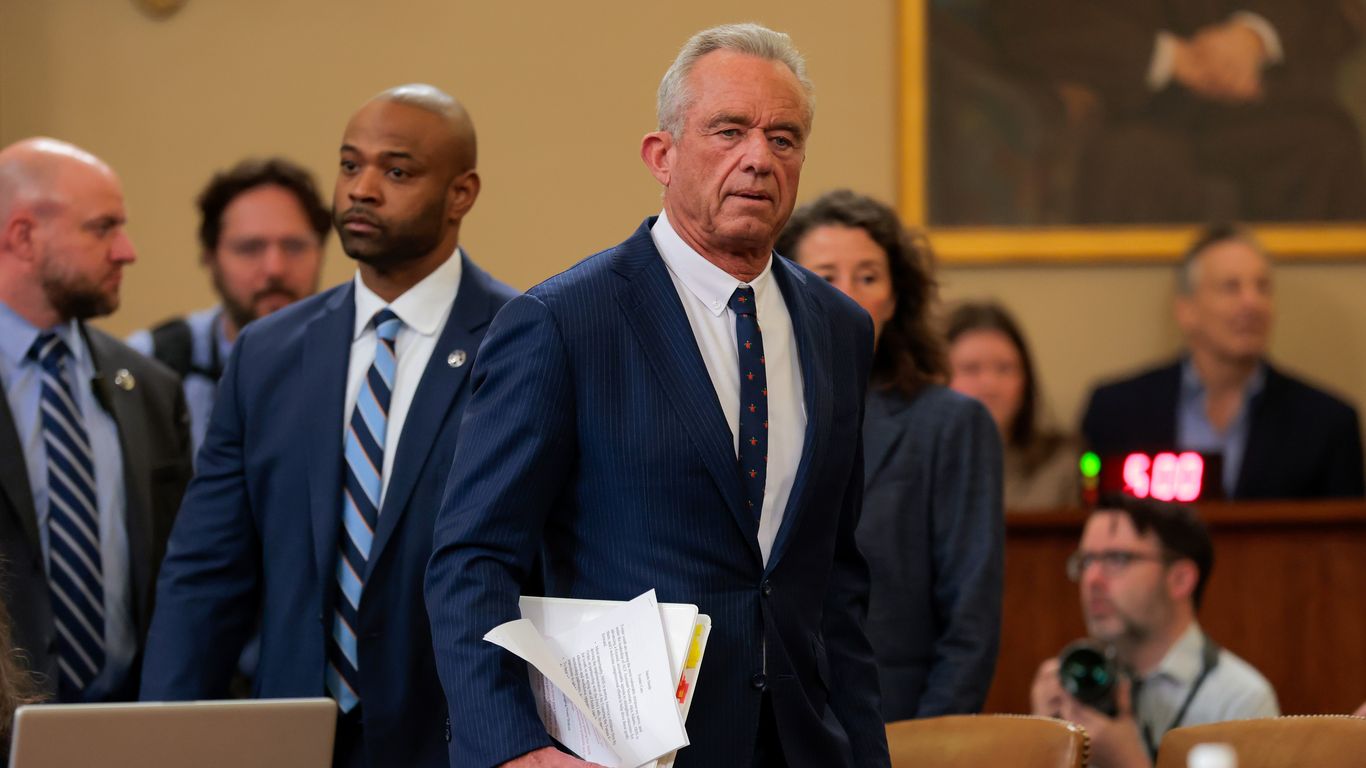
Health Secretary Robert F. Kennedy Jr. faced sharp congressional scrutiny over vaccine policy, measles outbreaks, and deep staffing cuts at federal health agencies. He acknowledged the measles vaccine could have saved the life of a child who died in the Texas outbreak and said it is "safe for most people," while defending CDC and FDA policy changes and plans to overhaul the U.S. Preventive Services Task Force. The article also highlights HHS staffing recovery from 62,000 to 72,000 employees, with plans to add 12,000 more.
The market implication is less about any single vaccine headline and more about the rising probability of policy drift inside HHS: if preventive guidance becomes more ideologically driven and less evidence-based, the first-order effect is noise, but the second-order effect is a slower, more fragmented reimbursement backdrop for biotech and diagnostics. That tends to benefit incumbents with diversified payer exposure and multiple labeling pathways, while penalizing smaller names that depend on clean guideline adoption to unlock utilization. The task force overhaul is particularly important because even modest changes in recommended screening can move commercial coverage decisions over a 12-24 month window.
The bigger hidden risk is operational, not rhetorical. Deep staffing churn at FDA/CDC raises variance around approval timelines, advisory committee cadence, and post-marketing enforcement; in practice, that widens the dispersion between companies with active late-stage catalysts and those whose valuation depends on predictable review clocks. If leadership is trying to prove it can speed reviews, the near-term winner is management teams willing to lean into filing cadence and supplemental indications; the loser is the basket of small-cap biotech names that trade on binary timing and financing windows.
Contrarian takeaway: the market may be underpricing the reputational and legal counterforce. Once preventive-care recommendations or immunization guidance are seen as unstable, insurers, large health systems, and state health departments will increasingly substitute their own protocols, which dilutes federal influence but also creates a patchwork that favors providers and payers with the most negotiating power. That suggests the policy risk is not a clean sector-wide selloff; it is a dispersion event, with insurers and large cap managed care more insulated than single-asset biotech or pure-play diagnostic adoption stories.
For the broad market, the direct tradable impact is likely modest unless litigation or staffing issues cause a measurable spike in review delays over the next 1-3 quarters. The cleaner expression is relative-value: long healthcare cash-flow defensives that benefit from coverage certainty, short high-beta biotech names that need regulatory momentum to sustain multiples. Watch for a reversal if HHS walks back personnel cuts, keeps preventive guidance unchanged, or if FDA review times begin to normalize on published metrics over the next 60-90 days.
AI-powered research, real-time alerts, and portfolio analytics for institutional investors.
Request TrialOverall Sentiment
mildly negative
Sentiment Score
-0.15
