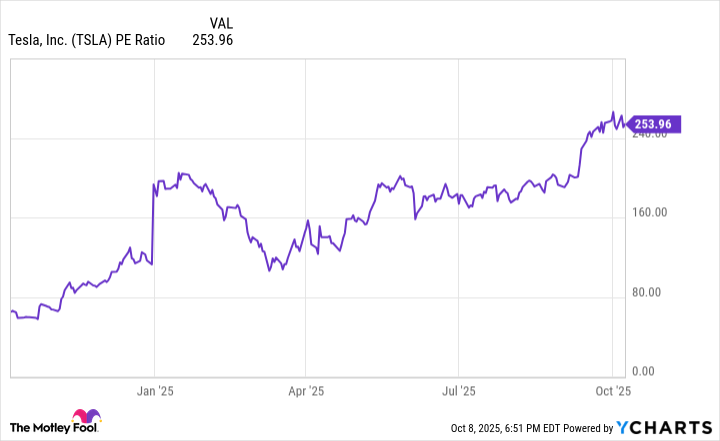
Tesla reported record Q3 vehicle deliveries exceeding 497,000, significantly beating Wall Street expectations and marking a rebound from a challenging Q2 that saw a 12% year-over-year sales decline. However, this delivery surge may be attributed to consumers rushing to utilize a $7,500 federal tax credit expiring at year-end, potentially leading to a demand drop in 2026. Given Tesla's current elevated price-to-earnings ratio, which is at a yearly high, and an uncertain broader EV market outlook, the article advises caution for investors despite the strong delivery performance.
Tesla reported record Q3 vehicle deliveries exceeding 497,000 units, significantly surpassing Wall Street expectations and marking a strong rebound from a challenging Q2 where sales dropped 12% year-over-year to $22.5 billion and deliveries fell 13% to 384,000. This performance suggests a potential recovery in operational execution following earlier macroeconomic headwinds and internal issues.
However, this surge in Q3 deliveries may be partially attributed to consumers accelerating purchases to capitalize on a $7,500 federal tax credit set to expire at the end of 2025. This raises concerns about a potential demand plummet in 2026, which could impact future sales volumes.
Furthermore, Tesla's stock currently exhibits an elevated valuation, with its price-to-earnings (P/E) ratio in October reaching its highest point all year, indicating the shares are quite pricey. Coupled with an uncertain broader electric vehicle (EV) market environment lacking clear growth visibility, the combination of high valuation and potential future demand volatility presents a risky investment landscape.
AI-powered research, real-time alerts, and portfolio analytics for institutional investors.
Overall Sentiment
mixed
Sentiment Score
-0.20
Ticker Sentiment
