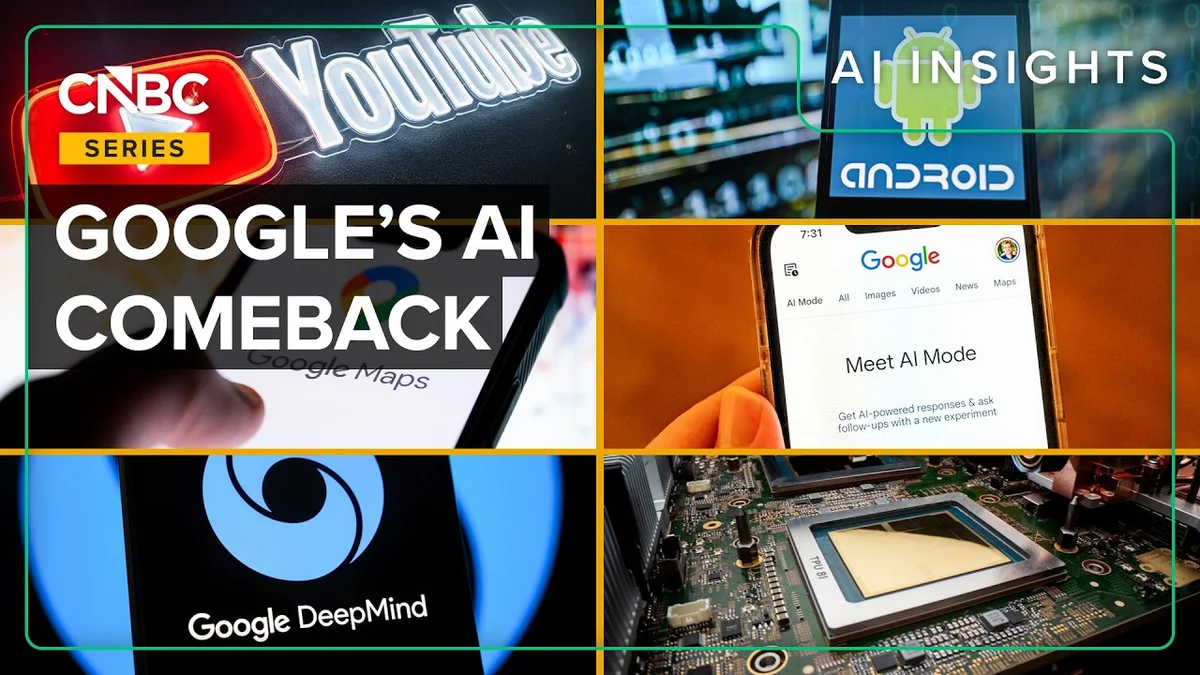
Google is being re-rated as an AI leader after a perceived lag in the generative AI race, helped by heavy investment in custom hardware, Gemini, and product-wide AI integration. The article highlights a notable shift in market perception and investor confidence rather than a specific financial metric. The impact is positive for Google and could modestly support sentiment toward large-cap AI infrastructure and software names.
GOOGL is increasingly looking less like a follower in AI and more like the default monetization layer for enterprise and consumer AI usage. The important second-order effect is not model quality alone, but distribution: if AI becomes embedded inside search, workspace, cloud, and devices, Google can turn AI from a cost center into a retention engine that hardens share across multiple revenue pools. That reduces the odds of a durable winner-take-all outcome for standalone model vendors and raises the barrier for smaller software firms that depend on search traffic or generic cloud differentiation.
The market is still underestimating how much custom silicon and vertical integration matter over a 12-24 month horizon. If inference costs keep falling, Google can defend margins while scaling AI features more aggressively than peers tied to third-party compute, which is a structural advantage in a world where AI usage is high-volume and price-sensitive. The supply-chain winner here is not only semiconductor capacity, but also networking, memory, and advanced packaging; the loser set includes firms exposed to search disintermediation, because even modest click-through compression can hit ad pricing before it shows up in headline traffic.
The key risk is that investor enthusiasm outruns monetization proof. If AI features lift usage but fail to translate into incremental revenue per query or meaningful cloud acceleration within the next 2-3 quarters, the stock can de-rate on “expensive optionality” concerns. A second-order bear case is that stronger AI in search cannibalizes high-margin ads faster than it creates new AI-native ad inventory, creating a temporary margin trough even while the strategic story improves.
Consensus appears to be late in recognizing Google’s strategic position, but may still be too early on the earnings payoff. The more interesting trade is not a generic long-beta AI basket, but a relative-value expression where Google’s integrated monetization is paired against higher-multiple AI beneficiaries that need external funding or perpetual top-line acceleration. That setup offers better downside protection if the market rotates away from pure AI narrative names toward cash-generating platforms.
AI-powered research, real-time alerts, and portfolio analytics for institutional investors.
Request DemoOverall Sentiment
moderately positive
Sentiment Score
0.55
Ticker Sentiment
