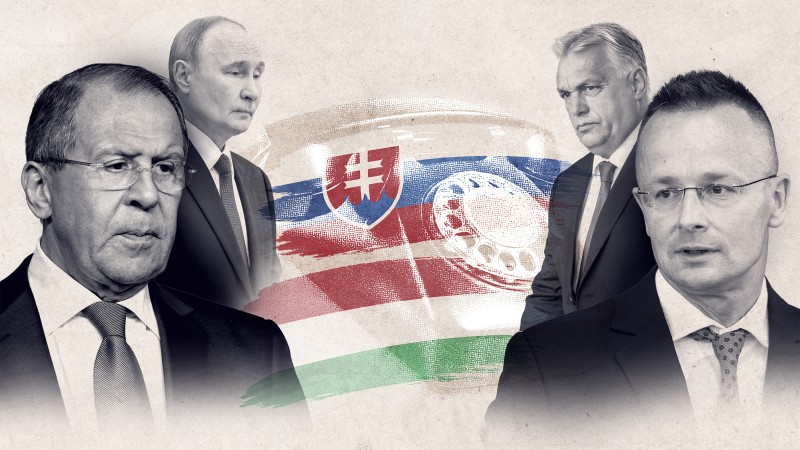
Audio recordings show Hungarian FM Péter Szijjártó coordinating with Russian officials to press for delisting Kremlin-linked individuals, resulting in the removal of Gulbahor Ismailova seven months after an August 30, 2024 call. Szijjártó claimed to have removed 72 entities from a proposed 128, and Hungary/Slovakia repeatedly delayed EU renewals for a sanctions list that covers ~2,700 Russian citizens/entities, weakening enforcement and potentially boosting Russian energy revenue via shadow-fleet channels like 2Rivers (later sanctioned). The disclosures raise geopolitical risk ahead of Hungary's April 12 parliamentary election, signal Kremlin influence over EU decision-making, and are sector-moving for energy and sanctions-sensitive assets.
The leak-driven breakdown in sanctions cohesion is creating two measurable market frictions: (1) reduced political certainty around future sanction renewals, which compresses the effective discount that buyers assign to Russian-origin energy and raises basis volatility across oil benchmarks; and (2) asymmetric enforcement risk for intermediaries (shadow-fleet operators, commodity traders, correspondent banks) that magnifies counterparty premia. Mechanically, uncertainty about member-state vetoes makes buyers hold a higher inventory cushion and pay up for non-Russian-clean barrels and vetted shipping capacity, a dynamic that typically manifests as 20–50% spikes in short-term freight and storage rates when enforcement tightens.
Second-order winners are firms owning flexible tanker tonnage and Western defense contractors that can supply accelerated procurements; losers are boutique commodity traders, boutique tanker operators with sanctionable counterparties, and smaller CEE banks whose reputational exposure raises their sovereign risk premium. The political feedback loop—where domestic electoral cycles and covert influence operations are used to extract EU-level concessions—lengthens the timeline for a full restoration of sanctions discipline from quarters into years, keeping a risk premium on European strategic goods and services for multiple policy cycles.
Key catalysts to watch are procedural EU mechanics (next renewal/consensus windows), credible evidence of further leak or influence operations that prompts information-sharing restrictions, and immediate shipping-rate prints tied to sanction listings or de-listings. Reversals are possible if (a) an external shock (energy supply disruption or major legal ruling) suddenly re-centralizes EU resolve, or (b) enforcement becomes binary (large asset seizures) that forces market participants to reset counterparty risk within weeks rather than months.
AI-powered research, real-time alerts, and portfolio analytics for institutional investors.
Request DemoOverall Sentiment
moderately negative
Sentiment Score
-0.65
