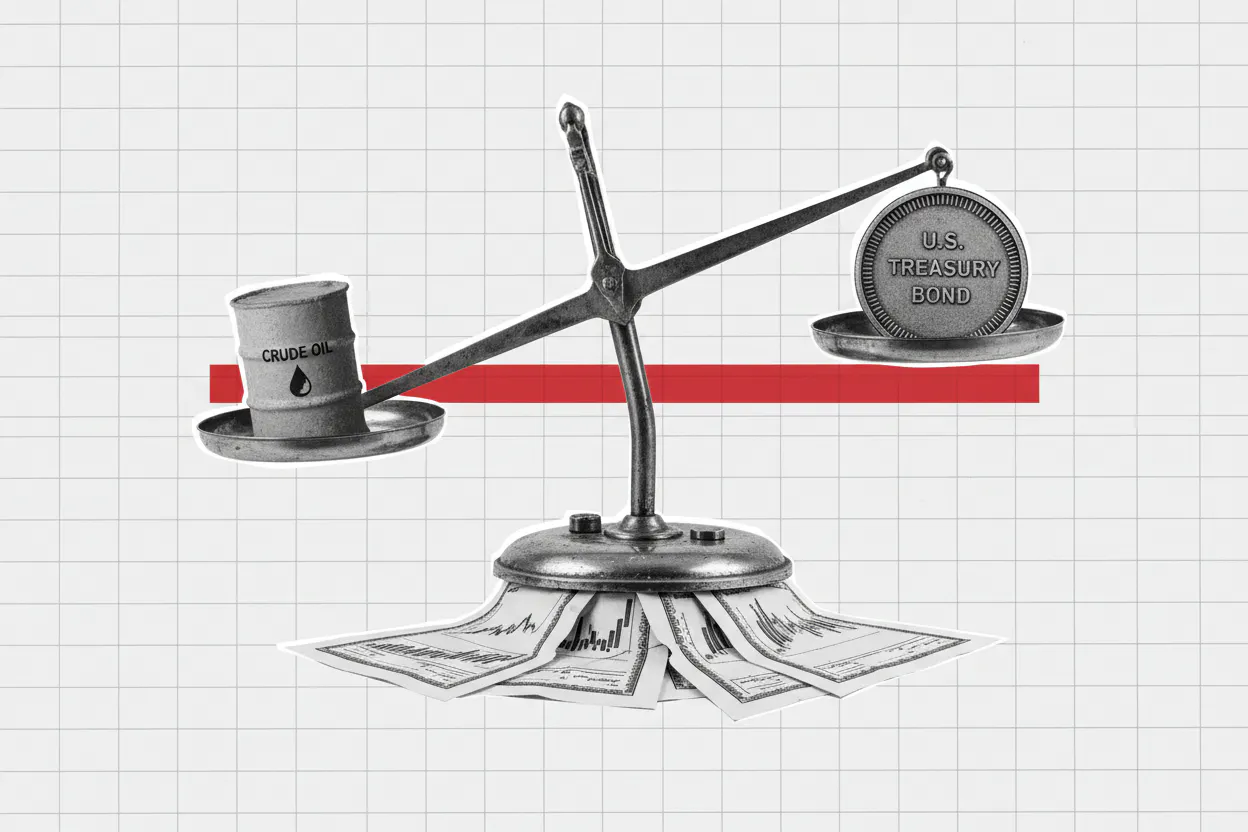
US stocks opened the week under pressure as the Strait of Hormuz remained closed, lifting WTI crude to about $102.45 a barrel and pushing the 10-year Treasury yield to roughly 4.61%, its highest since early 2024. The backdrop is risk-off ahead of Nvidia earnings on Wednesday, Fed minutes the same day, and May PMI data on Thursday. Higher oil and borrowing costs raise valuation pressure on equities, especially growth stocks and AI names.
The immediate beneficiary set is narrower than the headlines imply: upstream energy and select utility names with constructive rate-sensitive narratives can outperform, while the real pain sits in duration-heavy growth and capital-intensive cyclicals. A sustained move in 10-year yields above the mid-4%s is mechanically more damaging than a single Fed pause because it compresses equity multiples even if short rates stay unchanged; that makes index-level downside skew worse for NVDA than for the market as a whole. The combination of geopolitical oil risk and tighter discount rates is also toxic for margin-compression stories in software, semis, and unprofitable tech, where the market is already paying for future cash flows.
Nvidia is the key catalyst because the stock is no longer being judged only on beats and guidance, but on whether AI capex remains insulated from a broader tightening in financial conditions. If management signals any moderation in order pacing or hyperscaler digestion, the reaction could be disproportionate: the market is positioned for perfection and the macro backdrop increases the odds of a de-rating, not just a post-earnings pullback. Conversely, a clean guide could temporarily overpower rates, but the follow-through may fade unless yields stabilize; in this tape, “good earnings” is less important than “good earnings plus easing yields.”
The utilities setup is subtler: names with visible project pipelines and financing access can absorb higher rates better than the average defensive, so NEE has a relative edge over the broader rate-sensitive universe. D is more about downside protection than upside, as utilities can benefit from flight-to-quality flows, but their valuation support weakens if the 10-year keeps rising. The more interesting second-order trade is that higher oil can pressure consumer demand and transport margins, creating a relative bid for regulated cash flows even if absolute multiples stay capped.
The consensus may be underestimating how much of the current move is a rates story disguised as a geopolitics story. If the Strait remains shut for only a short window and crude retraces, equity relief may still be limited unless the 10-year also backs down; the bond market is now the cleaner risk-off indicator. That argues for tactical positioning around yield sensitivity rather than outright direction on oil alone.
AI-powered research, real-time alerts, and portfolio analytics for institutional investors.
Request DemoOverall Sentiment
mildly negative
Sentiment Score
-0.35
Ticker Sentiment
