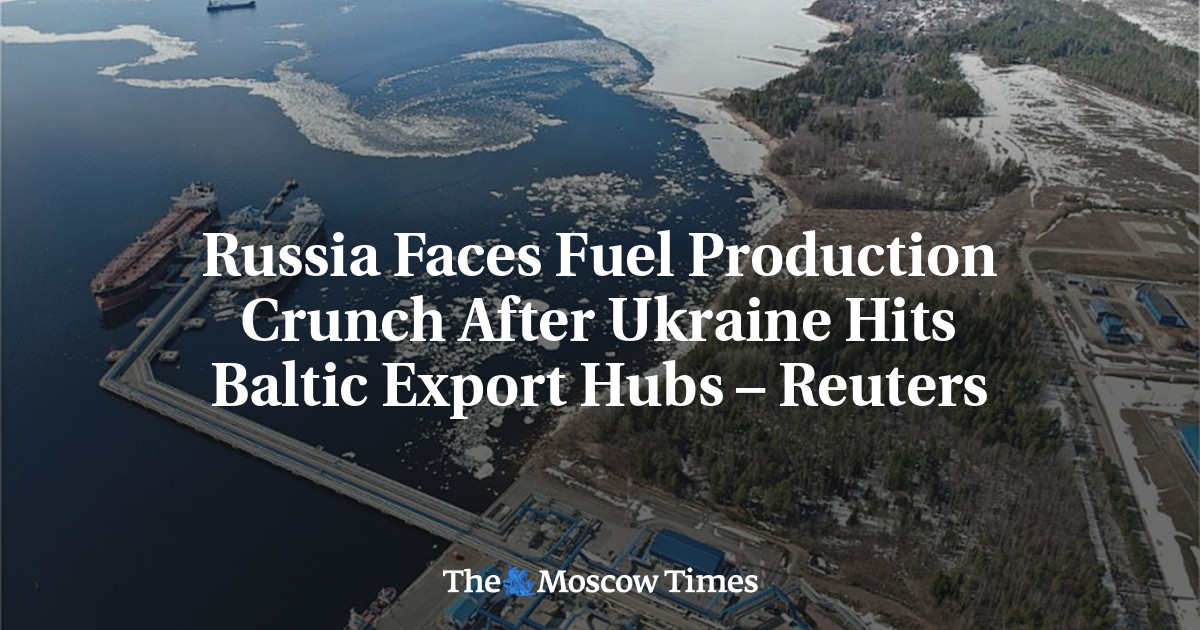
Ust-Luga terminal (capacity ~30 mtpa, ~19 mtpa dark products) halted operations on March 25 after drone damage, disrupting roughly 18 mt of fuel oil shipments in 2025 (over 14 mt from KINEF, YANOS, Moscow and Ryazan). Combined crude runs at those four refineries are ~55 mtpa; fuel oil accounts for ~18–35% of their output, so inability to export fuel oil could force cuts to minimum runs or temporary shutdowns, reducing gasoline output as seasonal demand rises. Options to redirect fuel oil are limited due to NW Russia port capacity and longer rail turnarounds; KINEF was also hit on March 26, adding further near-term uncertainty.
The tactical impact is a logistics-driven crude demand haircut concentrated in northwest Russia that transmits to global markets primarily through two channels: immediate reduction in refinery crude throughput and an outsized rise in required product tanker/rail logistics miles. Back-of-envelope: the four refineries cited account for roughly 1.1 mbpd of crude runs; even a 15–45% mechanical cut (plausible in the first 2–8 weeks before rerouting and tank car mobilisation) implies a 160–500 kbpd spot demand gap that disproportionately pressures front-month Urals/Brent and regional product balances.
Second-order winners will not be majors that benefit from sustained $/bbl moves but asset-light transport and defence suppliers — product tanker owners (MRs) and short-sea barge operators see voyage lengths and days-at-sea spike, while counter‑UAS and port security vendors face near-term procurement cycles. Conversely, refiners with limited ability to reroute heavy fuel streams, tank car owners in Russia, and local insurers face both operational and underwriting stress; fuel oil scarcity also elevates bunker/IFO prices, squeezing refiners’ dark-margin management choices.
Time horizon and catalysts: expect most dislocations to crystallise in days–weeks with logistics solutions (additional tank cars, longer voyages, temporary storage) restoring most flows over 4–12 weeks; a sustained multi-month disruption requires either escalating campaign scope or spot constraints in alternative ports. Reversal drivers include rapid rail/terminal repairs, diplomatic de‑escalation, or a seasonal product demand swing; upside tail risks include escalation widening to broader chokepoints or sanctions-driven export realignments that remove recovery paths.
Consensus blind spot: markets are primed to trade crude price headlines, yet the more persistent and higher-P&L opportunity is in freight and security-capex, not a simple long crude call. Positioning that leans into higher freight rates and defense procurement captures asymmetric returns with clearer mean‑reversion windows (4–12 weeks) than directional crude exposure tied to uncertain geopolitical escalation.
AI-powered research, real-time alerts, and portfolio analytics for institutional investors.
Request DemoOverall Sentiment
moderately negative
Sentiment Score
-0.45
