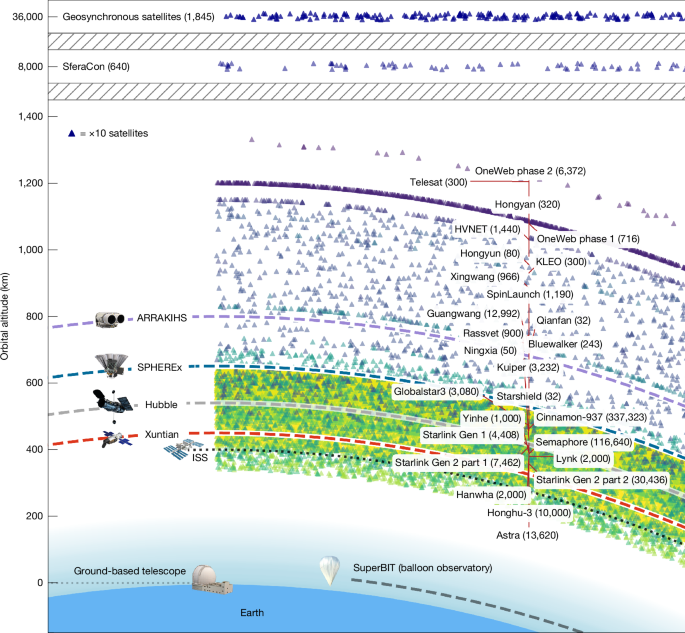
A simulation study warns that if current telecommunications megaconstellation proposals (~560,000 satellites) are completed, space telescopes would face severe contamination: average satellite trails per exposure would be ~2.14 (Hubble), ~5.64 (SPHEREx), ~69 (ARRAKIHS) and ~92 (Xuntian), with >96% of exposures affected for SPHEREx/ARRAKIHS/Xuntian and ~39.6% of Hubble images contaminated. Detected trail surface brightness is estimated at µ≈18–23 mag arcsec−2 (Sun-illuminated trails ~18–19), making them readily detectable, and simulations are validated against Hubble observations; the authors call for regulatory/operational mitigations including tighter orbital-data precision (cm-level) and limits on orbital layers. For investors, the findings imply potential regulatory, engineering and reputational risks for satellite operators (design/attitude changes, lower-orbit trade-offs, and possible operational constraints), which could drive costs, impact deployment plans and influence valuation assumptions for LEO-focused companies.
Market structure: The paper creates a clear winners/losers bifurcation — winners are companies and sectors selling space‑traffic management (SSA), debris removal, optical mitigation and defense space systems (large primes that supply SSA sensors, command/control and hardened optics). Losers are pure consumer LEO broadband rollouts and low‑margin launch/service providers if regulatory caps or stricter orbital allocation are imposed; expect pricing power to shift toward specialized SSA providers and incumbents able to deliver compliance (higher ASPs, +10–30% vs commoditized launches). Supply/demand: if regulators cap usable LEO slots or require new mitigation tech, effective supply of commercial slots could fall 30–70%, raising value of compliant capacity and landing recurring government contracts.
Risk assessment: Tail risks include a regulatory moratorium or mandated altitude limits within 6–24 months that could reduce projected launches by >50%, and a Kessler‑cascade event causing temporary halt to launches and multi‑bn$ insurance losses. Immediate (days–weeks): political/regulatory scrutiny and hearings; short (3–12 months): FCC/ITU rulings, insurance repricing; long (1–5 years): mission redesigns, concentrated winners. Hidden dependencies: insurance market capacity, launch backlog, satellite orientation/BRDF disclosure; a single high‑profile collision or scientific backlash could accelerate regulation.
Trade implications: Constructive trade is to go long SSA/defense primes (Lockheed LMT, Northrop NOC, L3Harris LHX) and Earth‑observation/space imaging (Maxar MAXR) while hedging legacy LEO comms exposure (Iridium IRDM). Tactically buy 6–12 month call spreads on LMT/NOC (e.g., 1–2% NAV each) and buy 3–9 month put spreads on IRDM (size 0.5–1% NAV) to express asymmetric risk/reward. Pair idea: long MAXR vs short IRDM for 3–12 months — data demand rises while legacy comm pricing compresses if constellations stall.
Contrarian angles: Consensus exaggerates uniform “death” of all space business; missed point — stricter rules raise barriers and create oligopolistic, higher‑margin opportunities for regulated, defense‑grade suppliers. Historical parallel: telecom spectrum auctions redistributed value to incumbents after initial overbuild; similar consolidation could boost LMT/NOC margins by +200–500bps over 2–4 years. Unintended consequence: heavy regulation could increase sovereign demand for national SSA and defense procurement, accelerating revenue cadence for primes.
AI-powered research, real-time alerts, and portfolio analytics for institutional investors.
Request DemoOverall Sentiment
moderately negative
Sentiment Score
-0.45
