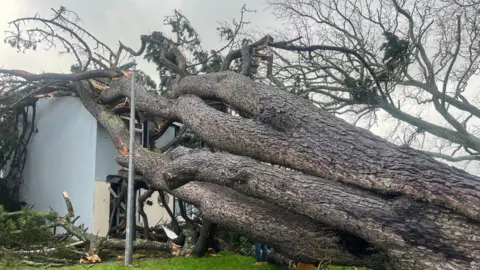
Storm Goretti brought a rare red wind warning to Cornwall with gusts recorded to 99mph, leaving more than 42,000 homes without power in Cornwall and 998 in Devon and causing widespread property damage, fallen trees and transport disruption. Great Western Railway suspended all Cornwall services until safety checks are complete (not expected to resume before 16:00 Friday), dozens of schools closed or opening late, and localised incidents included a gas-service governor damaged in Grampound (no wider gas-supply impact reported). The event is causing significant regional infrastructure and operational disruption but appears contained geographically, implying limited broader market implications beyond localized economic and service interruptions.
Market structure: Immediate winners are local network contractors, generator/temporary power suppliers and emergency services contractors; losers are regional transport operators (GWR), small businesses in affected areas and property insurers. 42,000+ homes without power and 99mph gusts imply concentrated repair demand, likely raising short-term opex for distribution network operators (DNOs) and localized upward pressure on day-ahead power prices over the next 7–14 days.
Risk assessment: Tail risks include a prolonged multi-day outage (>7 days) that triggers regulatory investigations, emergency capex mandates or reputational fines for operators—this could move regulatory ROE/pricing discussions for 6–18 months. Hidden dependencies: blocked roads delaying crews and global supply-chain lag for transformers/poles could stretch repairs from weeks to months; catalysts that would amplify risk include another storm within 30 days or large insurance loss aggregation announcements.
Trade implications: Tactical plays favor short-dated energy/volatility trades and selective utility buys: expect UK power forwards to spike 10–30% intraday if outages persist; regulated utilities (NGG, SSE) are buyable on >5% dip given stable RAV-backed cash flows, while regional rail operators and short-term insurers (AV., DLG.L) face near-term P&L pressure. Options: buy 2-week call spreads on UK day-ahead power (strikes +15%/+30%) and protective put spreads on small-cap regional transport names.
Contrarian angle: Market will likely overreact to localized damage—systemic impact is limited; historical UK storms show equity mean reversion within 4–12 weeks. If NGG or SSE gap down >7% on headlines, that represents a high-confidence re-entry (target 1–3% portfolio tilt) because regulatory revenues dampen long-term downside.
AI-powered research, real-time alerts, and portfolio analytics for institutional investors.
Request DemoOverall Sentiment
moderately negative
Sentiment Score
-0.40
Ticker Sentiment
