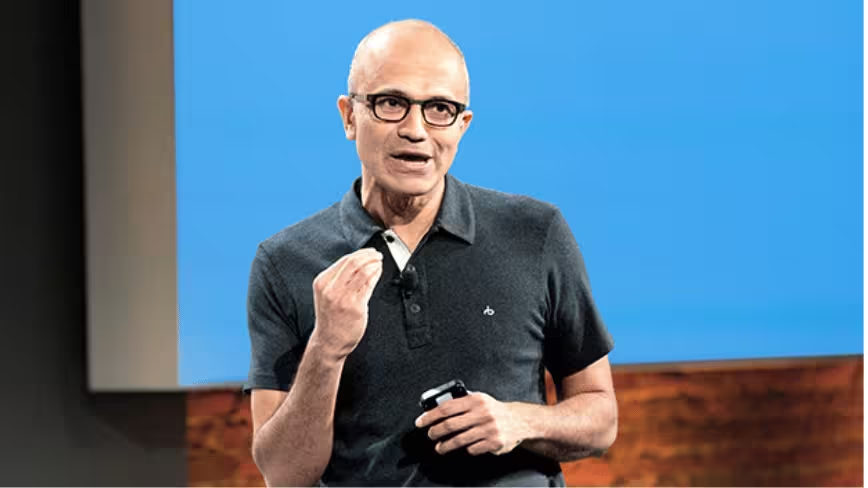
Microsoft is offering voluntary retirement to about 7% of its U.S. workforce, or roughly 8,750 employees, using a Rule of 70 formula that targets senior director level and below with a 30-day decision window. The move comes after more than 15,000 layoffs in 2025 and alongside a March 2026 hiring freeze outside AI teams, as Microsoft redirects spending toward more than $80 billion of AI infrastructure and $37.5 billion of quarterly capex. Despite strong fiscal Q2 results of $81.3 billion revenue and $38.5 billion net income, the workforce reduction underscores restructuring pressure tied to the AI shift.
This is less a cost-cutting headline than a labor-capital reallocation signal. Microsoft is effectively using a low-friction exit mechanism to prune the highest-cost, highest-tenure layer of the organization while protecting AI buildout from any internal budget competition; that should improve near-term margin optics and free cash flow flexibility, but it also raises execution risk if too much institutional memory leaves before AI tooling is actually embedded into workflows. The second-order winner is not just Azure capacity suppliers — it is the remaining AI talent, whose bargaining power rises when legacy layers are thinned and compensation is increasingly tied to stock performance.
The market is likely underestimating the signaling effect on the rest of Big Tech HR. Once one platform company normalizes tenure-based exits, peers can replicate the structure without the reputational hit of involuntary layoffs, which increases the probability of a broader, slower workforce reset over the next 2-4 quarters. That argues for continued pressure on traditional enterprise software names with slower AI monetization paths, while AI-native infrastructure beneficiaries keep the pricing power. The risk to the trade is that if Microsoft’s operating leverage improves faster than expected, investors will treat this as proof the company can fund AI capex without sacrificing earnings, supporting the multiple.
The contrarian read is that this may be a maturity signal rather than an AI super-bullish one: when a dominant platform starts paying experienced employees to leave, it can reflect organizational brittleness, not just efficiency. In the next 30-90 days, the key catalyst is uptake rate and severance cost disclosure — a high acceptance rate would confirm management’s desire to accelerate restructuring, but a low one would imply Microsoft may need harsher measures later, which would be a negative overhang. The bigger medium-term question is whether AI actually offsets the loss of senior operators, or whether the company is quietly trading away product reliability and internal coordination for a cleaner margin story.
AI-powered research, real-time alerts, and portfolio analytics for institutional investors.
Request TrialOverall Sentiment
mildly negative
Sentiment Score
-0.15
Ticker Sentiment
