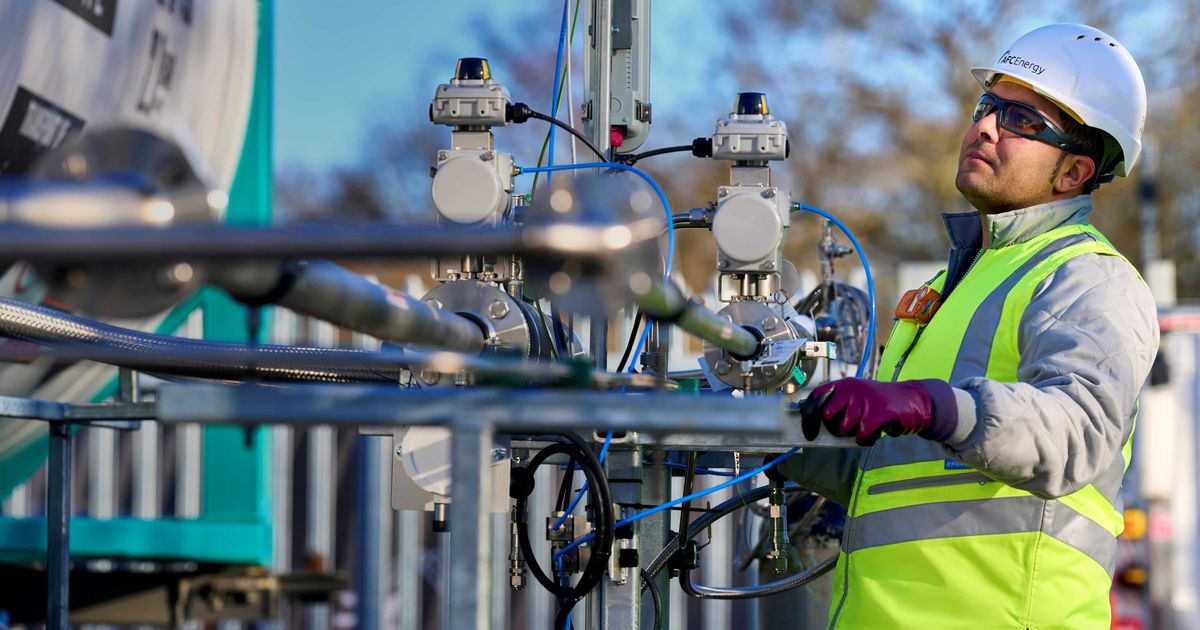
AFC Energy reported a widening loss after tax of £22.2m for the year to 31 Oct 2025 (prior £17.4m) driven by higher R&D (£11.7m) and non-cash write-offs, but raised £27.5m in July 2025 and held £25.3m in cash and short-term investments at year-end (cash £20.4m at Jan 2026). The company launched the lower-cost LC30 30kW fuel cell generator post-period (cited ~85% lower costs, up to 20% better efficiency) and is targeting a Hy-5 ammonia cracker (500kg/day, £10/kg target) for delivery by end-2026; commercial traction includes a ~$2m JDA with Komatsu, other partnerships and an Environment Agency permit that accelerates pilot revenue. Management has reorganized operations, cut headcount and made three senior commercial appointments, positioning AFC to convert pipeline opportunities into orders in 2026 while still facing near-term dilution and cash runway risk.
Market structure: AFC's LC30 (30kW) and Hy-5 (500kg/day → ~182,500kg/yr) create a credible decentralised hydrogen product set that directly benefits industrial contractors (Komatsu JV) and onsite fuel‑cell integrators (Speedy/Volex). If Hy-5 achieves the £10/kg price point, each unit implies up to ~£1.8m/yr topline per cracker, shifting some demand from central electrolyser projects to modular ammonia‑to‑hydrogen solutions and pressuring pure electrolyser pricing for small-scale use cases. Cross-assets: short-term risk‑on into small‑cap hydrogen names, moderate upward pressure on ammonia feedstock and capex‑sensitive commodities, and widening credit spreads for cash‑hungry hydrogen developers if commercial traction falters.
Risk assessment: cash was £20.4m end‑Jan and FY cash outflow implied ~£13.8m (adjusted non‑cash), suggesting a ~15–20 month runway at current burn (~£1.1–1.4m/mo) absent material revenue — a realistic fundraising trigger if no ≥£5–10m contracts appear by H2‑2026. Tail risks: permit or safety incidents for ammonia cracking, Volex manufacturing failure, or major partner (Komatsu/S&P500) walking away; each could force dilutive raises or write‑downs. Catalysts: signed commercial orders, production ramp at Volex, and published performance/O&M metrics for Hy‑5.
Trade implications: tactically consider a small, event‑driven long in AFC (AIM:AFC / OTC:AFGYF) sized 1–2% with defined stop and a 6–12 month horizon to capture order flow; hedge with short positions in large electrolyser peers (e.g., NEL.OL, ITM.L) if rotation into ammonia solutions accelerates. Options: prefer long‑dated call spreads or equity plus protective puts to limit downside; avoid capital‑intensive outright long in large incumbents until visibility on commercial conversions. Sector: rotate modestly from central electrolyser developers to modular hydrogen solutions and select industrial equipment OEMs exposed to ammonia cracking.
Contrarian angles: the market may underprice the execution risk — £10/kg excludes scale O&M and ammonia feedstock volatility, so conversion risk is binary and valuation should reflect optionality not linear revenue. Historical parallels (Ballard/Bloom) show hype cycles with multi‑year disappointments; unintended consequences include partner IP capture or quality issues from rapid scale‑up. Use hard binary triggers: upgrade to overweight only after ≥£10–15m cumulative contracted orders or consistent monthly production output from Volex over two consecutive quarters.
AI-powered research, real-time alerts, and portfolio analytics for institutional investors.
Request DemoOverall Sentiment
mildly positive
Sentiment Score
0.25
