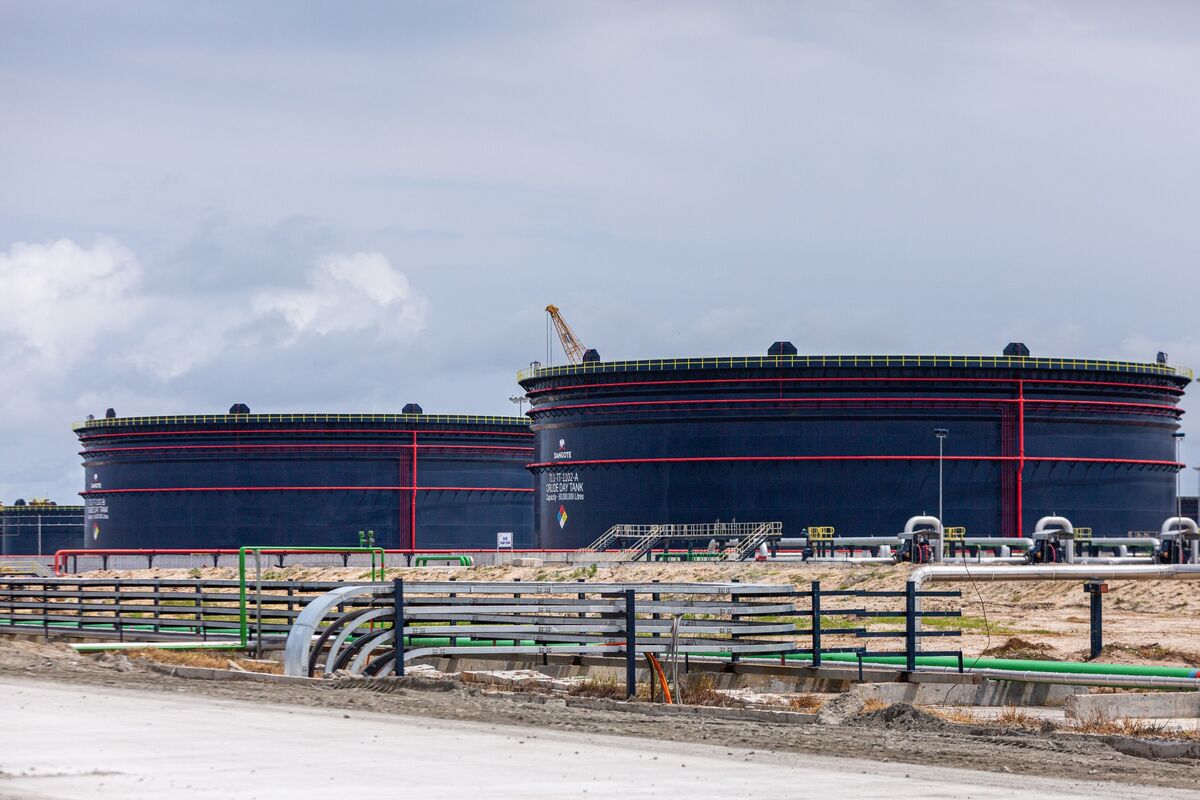
Nigeria doubled crude supply to Dangote Refinery in March, delivering up to 10 cargoes from state-owned NNPC to the plant. The boost was implemented to shore up fuel availability after the Iran war disrupted Middle East shipments, supporting throughput at Africa’s largest refinery and regional fuel supply.
Re-routing Nigeria’s barrels to a domestic mega-refinery materially reconfigures short-haul seaborne flows across the Atlantic basin: a 0.5–0.8 mb/d local crude drawdown (roughly one large refinery at near-full run-rate) shifts crude cargoes away from export terminals and compresses the pool available for European/Asian refiners within 1–3 months. That rebalancing preferentially tightens dated Atlantic grades and lifts freight demand for shorter crude voyages (Aframax/Suezmax trunking) while simultaneously reducing LR/MR product shipment volumes into West Africa, creating a divergence between crude tanker and product tanker earnings.
Downstream, improved local product availability reduces import-dependence and removes an immediate layer of margin capture by traders and distant refiners; the beneficiary cohort is domestic distributors/retailers and inland logistics (storage, trucking, pipeline operators) who will see higher throughput and working-capital churn within 3–12 months. Fiscal and FX second-order effects are ambiguous: upfront subsidy relief and lower import bill can support NGN and sovereign cashflows, but sustained upstream allocation by the state oil company risks lower export receipts and pressure on FX if production or lifting problems emerge over the medium term.
Key risks are operational (ramp reliability, crude quality mismatches, storage capacity) that can manifest within days–weeks as cargo cancellations or forced exports, and political/financial (NNPC balance sheet limits, subsidy politics) that play out over months. A resolution of Iran-related disruptions or a restoration of pre-crisis shipping patterns would reverse seaborne tightness quickly; conversely, repeated regional disruptions would entrench the new intra-African crude-product loop and favor owners of short-haul crude tonnage and local downstream infrastructure.
AI-powered research, real-time alerts, and portfolio analytics for institutional investors.
Overall Sentiment
mildly positive
Sentiment Score
0.20
