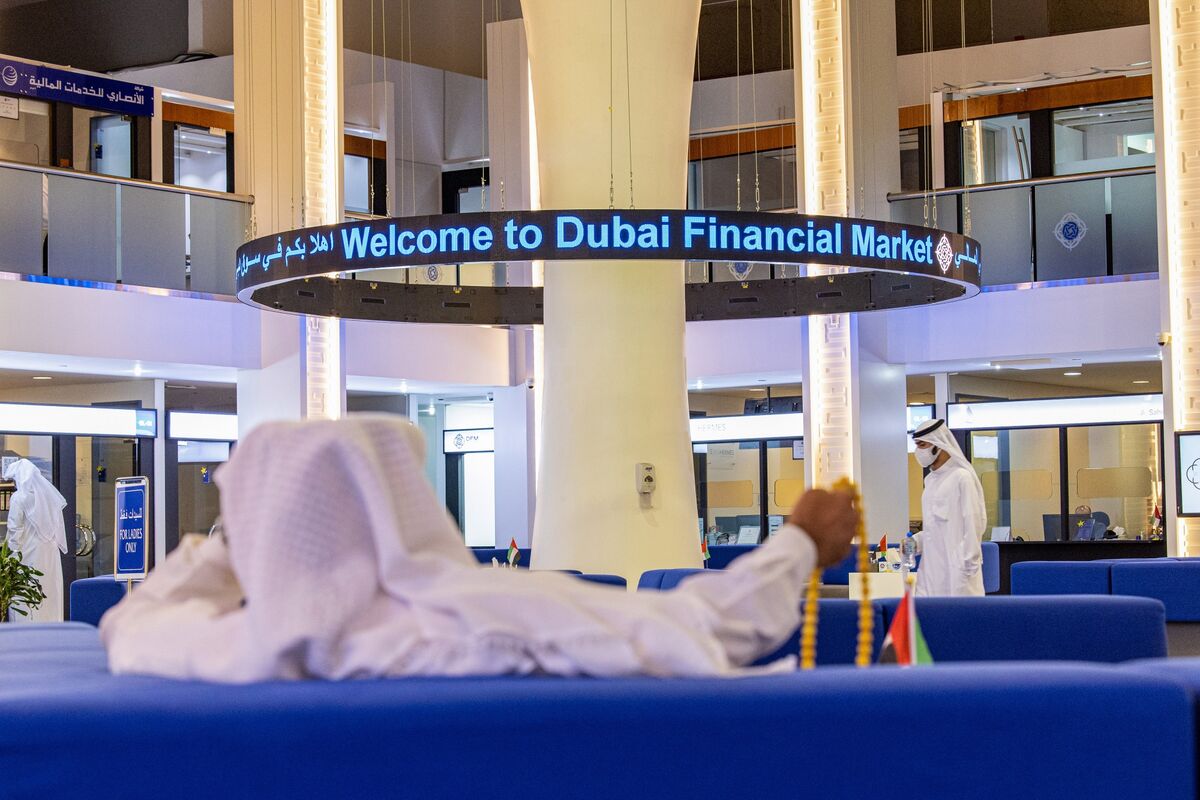
Dubai Financial Market General Index surged as much as 8.5%, the biggest intraday gain since December 2014, after the US and Iran agreed to a two-week ceasefire. Investors rotated into real estate and bank shares after weeks of war-related volatility that had threatened Gulf energy infrastructure, signaling a broad risk-on rally that should ease regional risk premia and boost Gulf equity performance.
The ceasefire decompression is a classic volatility-to-confidence snap: assets with high geopolitical beta (Dubai real estate developers, locally focused retail banks, hotel operators) get an outsized repricing because perceived tail risk — and the associated risk premia embedded in financing spreads and insurance costs — collapses faster than underlying fundamentals can change. Expect credit spreads on Dubai-centric corporates to tighten by 150–300bps in the first 2–8 weeks as banks reprice lending lines and marginal buyers re-enter; that mechanically supports highly levered developers with near-term refinancing needs.
Second-order winners are businesses whose cashflows are fixed but sold at a volatile discount during the conflict: airport concessionaires, tour operators, and hospitality REITs. A 10–20% lift in tourist arrivals over the next 3–6 months (from pent-up demand and re-routed Gulf travel flows) would translate into 1–2 turns of EBITDA multiple expansion for airport/hotel assets given low free-float and high operating leverage. Conversely, oil & gas firms face a modest negative impulse — the risk premium that propped prices is smaller, so expect a 2–6% near-term headwind for Brent if flows persist.
Tail risks and catalysts: the main reversal vectors are (1) ceasefire breakdown or asymmetric strikes that reintroduce insurance and shipping risk within days, (2) a global liquidity shock (US rates surprise) that drains EM flows over weeks, and (3) realization that Dubai property fundamentals (supply pipeline, occupancy) need 6–12 months to normalize, which would cap any sustained rally. Monitor CDS moves, ship insurance (P&I) premia, and FX inflows into local banks as early warning indicators.
Contrarian read: the intraday surge likely contains a large component of short-covering and momentum-chasing rather than fresh fundamental allocation; prices may overshoot in the 1–4 week window. If you believe fundamentals (excess residential supply, developer leverage) still matter, the optimal horizon to lock gains is 1–3 months — not buy-and-hold for a multi-year real estate bull without confirmation of sustained credit loosening and foreign direct investment recovery.
AI-powered research, real-time alerts, and portfolio analytics for institutional investors.
Request DemoOverall Sentiment
strongly positive
Sentiment Score
0.75
