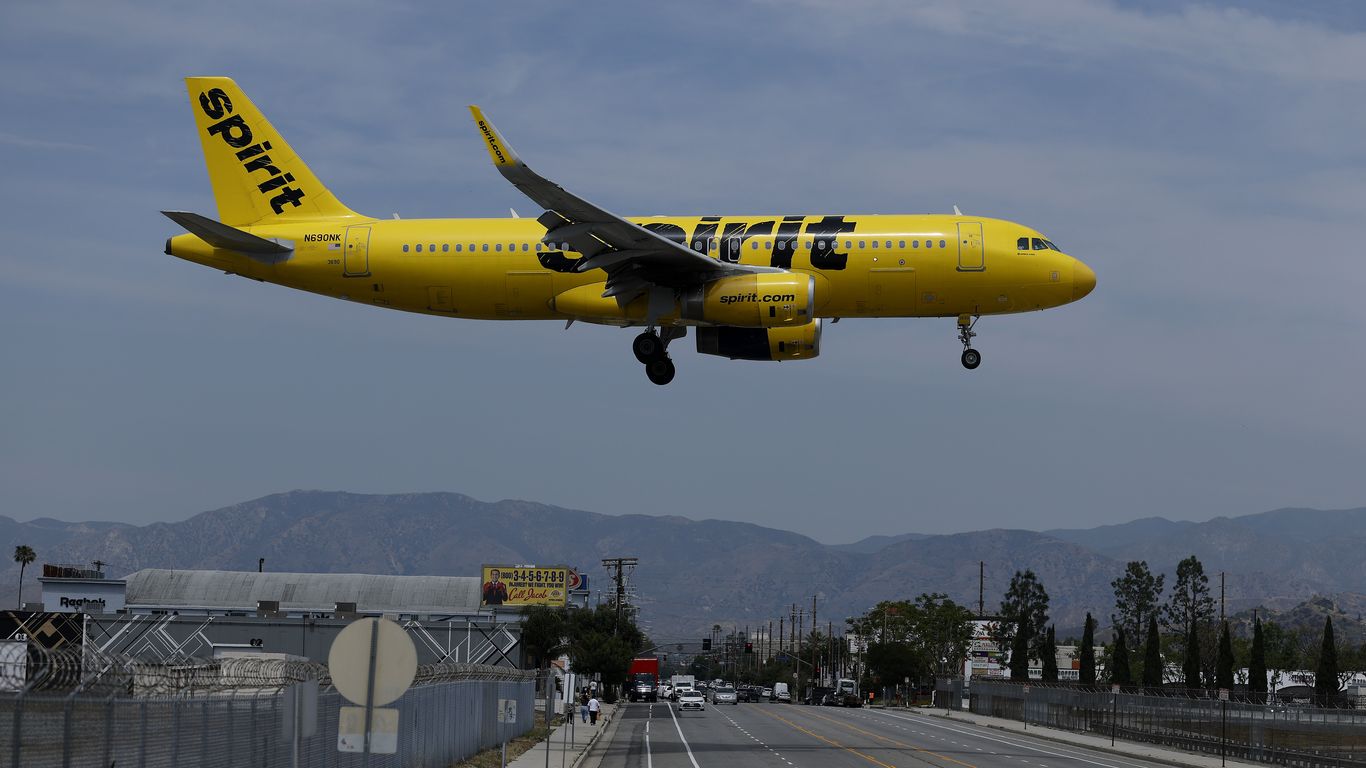
The Trump administration is reportedly discussing emergency financing for Spirit Airlines, potentially including a loan of up to $500 million plus government equity warrants, as the carrier seeks to avoid liquidation after filing for bankruptcy protection in August for the second time in less than a year. Spirit remains under severe financial strain from higher fuel and labor costs, and Transportation Secretary Sean Duffy signaled skepticism about using federal funds to support a company that may still lack a viable path to profitability. The situation could affect Spirit shares and the broader budget airline sector, but the market impact is likely company-specific rather than broad.
A federal backstop for a distressed carrier would be a clear signal that airline credit risk is no longer purely idiosyncratic; it becomes partially policy-priced. That matters most for lower-quality travel names and lessors, where the market will start assigning a nonzero probability to government intervention whenever liquidation risk becomes politically visible. The immediate beneficiary is not the equity of the rescued company so much as the rest of the industry: a bailout lowers the odds of an abrupt capacity hole, which should reduce near-term fare spikes and limit any dislocation premium in competing networks.
The second-order effect is on competitors’ pricing power. If the rescue extends runway, excess seats stay in the system longer, which keeps domestic leisure yields from repricing as aggressively as a bankruptcy exit or liquidation would. That is a hidden negative for the stronger legacy carriers and the ULCC complex if investors had been positioning for a capacity reset; the better trade may be against the assumption of a fast rebound in industry unit revenues rather than against a single name.
The market is likely underestimating policy asymmetry: the government can discuss a loan, but it is much harder to justify repeated support if there is no credible path to solvency. That makes the key catalyst not the headline announcement but the terms—warrants, covenants, maturity, and whether capital is senior enough to truly bridge liquidity. If the package is too dilutive or too punitive, the equity remains a zero-probability call option on a restructuring outcome; if it is too soft, it increases moral-hazard scrutiny and raises the odds of political reversal in weeks rather than months.
Contrarian read: the bailout talk may be more useful for bondholders and aircraft lessors than for the common. Equity can rally on survival optionality, but if the business model still cannot earn its cost of capital, a government loan simply delays the reset. The better risk/reward is to fade any sharp relief rally in the distressed airline equity while staying alert to a broader repricing in credit and travel volatility.
AI-powered research, real-time alerts, and portfolio analytics for institutional investors.
Request TrialOverall Sentiment
strongly negative
Sentiment Score
-0.60
