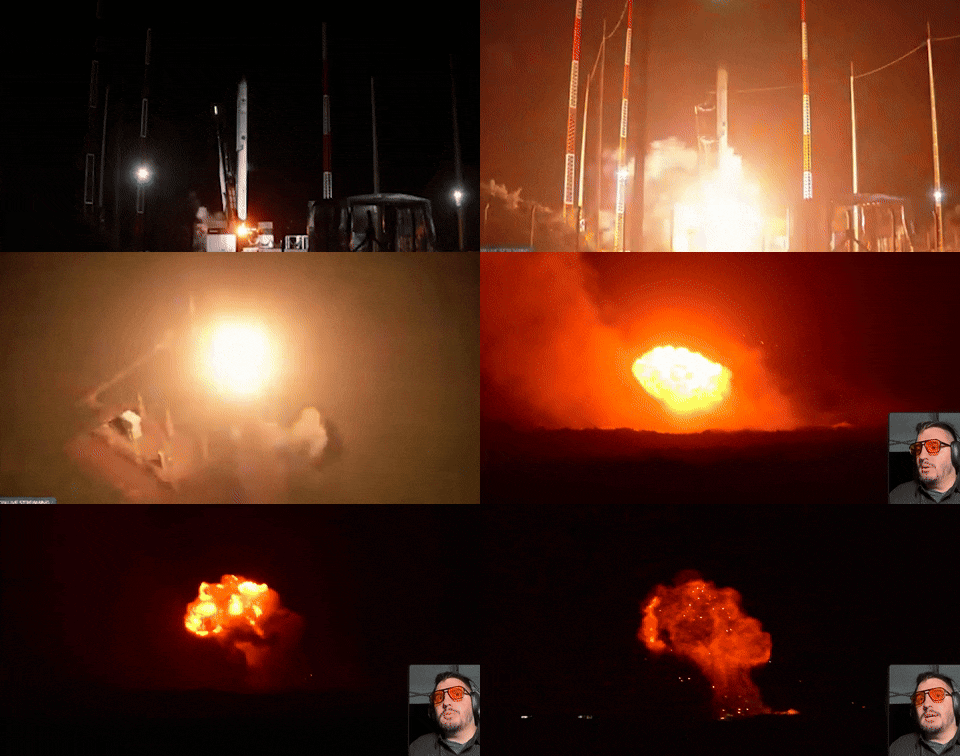
The Hanbit-Nano launch vehicle experienced a mission failure and crashed approximately 30 seconds after liftoff, resulting in the loss of the vehicle and any onboard payloads. The mishap creates near-term operational, reputational and financial risk for the operator and manufacturer—likely prompting insurance and regulatory reviews, potential contract delays or penalties, and downward pressure on investor sentiment until the cause is established and corrective measures are announced.
Market structure: A failed Hanbit-Nano launch immediately re-routes demand toward incumbent, flight-proven primes and integrators (Lockheed/Northrop/Boeing) while damaging small launch pure-plays and suppliers. Expect short-term funding stress for sub-$1bn launchers and tier-2 suppliers; pricing power shifts to large defense primes and government-backed launch services over the next 3–12 months. Cross-assets: expect a modest spike in aerospace equity implied vols (+20–50% vs pre-event), small widening in high-yield spreads (+10–30bp), and safe-haven FX/USD strength if regional sentiment (e.g., KRW) is affected within 48–72 hours.
Risk assessment: Tail risks include a multi-vehicle grounding/regulatory probe (low-probability, high-impact) that could wipe out 30–70% of affected small-cap market caps and force covenant breaches at suppliers within 60–120 days. Immediate risks (days) are sentiment-driven equity hits; short-term (weeks–months) are inspections, contract delays and insurance claims; long-term (quarters) is potential consolidation or government re-contracting. Hidden dependencies: insurance P&L, engine/component single-source suppliers, and sovereign procurement reallocation are second-order levers.
Trade implications: Short small-launch equities and suppliers; rotate into large defense primes and select aerospace services with backlog visibility. Options: buy 30–90 day puts on most exposed small-cap launchers and use vertical call structures on LMT/NOC for leveraged, time-bound exposure. Sector rotation: reduce small-cap space exposure, increase US large-cap defense and aerospace services by 2–5% of portfolio within 1–4 weeks.
Contrarian: Consensus may oversell all small launchers — historical analog: early SpaceX/Electron failures led to consolidation then outsized returns for survivors; a 40%+ drawdown on a fundamentally solvent launcher can be a buy within 6–12 months. Risk: if failure triggers wide regulatory action, recovery may take years; only back survivors with demonstrable technical fixes and cash runway >12 months.
AI-powered research, real-time alerts, and portfolio analytics for institutional investors.
Request DemoOverall Sentiment
strongly negative
Sentiment Score
-0.50
