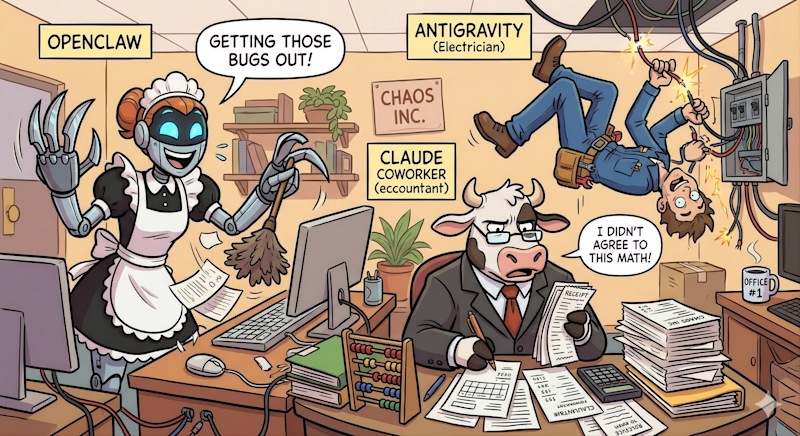
OpenClaw surpassed 150,000 GitHub stars in days and is being deployed with deep local system access, while Anthropic's Claude Cowork (legal-domain agents) and Google's Antigravity coding agent are accelerating agentic AI adoption. Claude Cowork already triggered a sharp sell-off in legal-tech and SaaS (the “SaaSpocalypse”), highlighting tangible sector risk even as these agents promise large productivity gains if properly governed. Key risks include data leakage, wrongful actions with elevated privileges, and legal/ethical exposure; the article stresses guardrails—accountability, logging, shared ontologies, and distributed identity—as critical mitigants.
Agentic AI is a structural demand shock that reallocates value from repeatable workflow SaaS toward platforms that provide safe, auditable execution environments, identity/trust, and edge/local inference. Over 12–24 months expect cloud providers and chipmakers to capture the lion’s share of incremental spend as enterprises pay for both compute and integrated safety tooling; conversely, single-function automation vendors face margin compression unless they embed verifiable controls.
Security, observability, and distributed identity are second‑order beneficiaries: enterprises will pay a premium for telemetry and human-in-the-loop gates that convert autonomous actions into auditable events. That expands the TAM for next‑gen SIEM, runtime attestation, and policy-enforcement by a meaningful multiple — think +30–50% addressable spend over 2–5 years — because every production agent needs plumbing to prove what it did.
Regulatory and operational tail risks are asymmetric and short-dated: a high‑profile data leakage or rogue-agent incident could trigger immediate enforcement (days–weeks) and materially slow enterprise deployments, resetting multiples for exposed software vendors. Offsetting catalysts that would sustain growth include standardized agent ontologies, distributed identity frameworks, and operator certifications — milestones that would re‑rate platform owners within 6–18 months.
Strategically, expect accelerated M&A as large cloud/AI incumbents buy trust and control layers rather than building them in-house; that favors public acquirers with big balance sheets and pressures pure-play automation vendors to consolidate or pivot to embedded safety offerings within 6–18 months.
AI-powered research, real-time alerts, and portfolio analytics for institutional investors.
Request DemoOverall Sentiment
mixed
Sentiment Score
0.05
Ticker Sentiment
