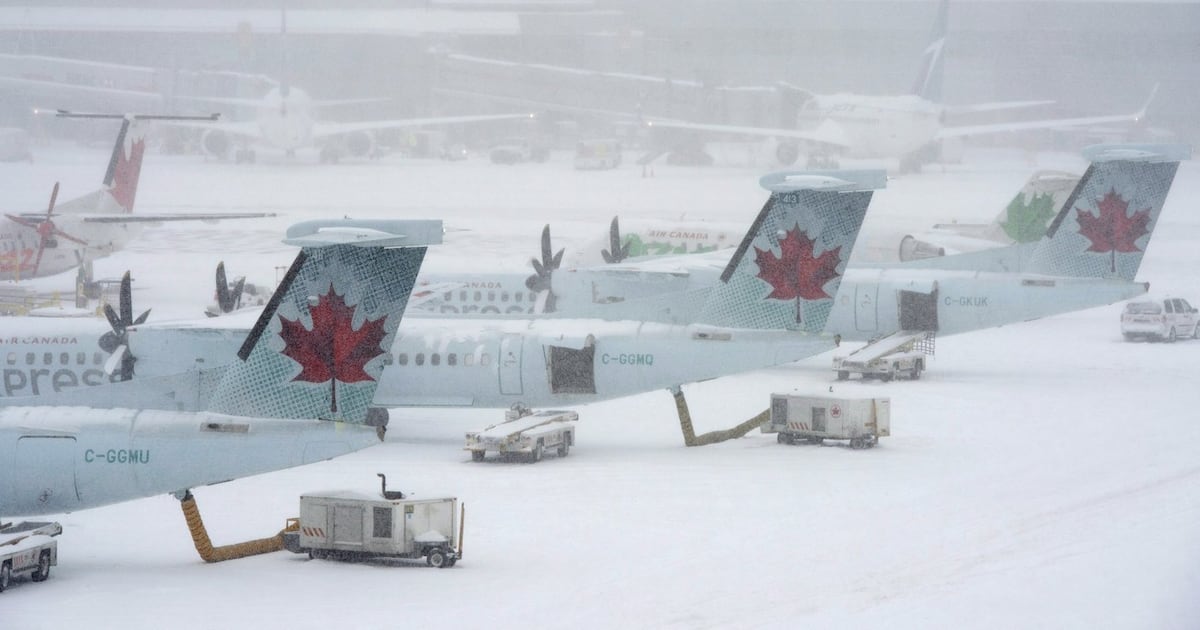
A large snowstorm has affected most of Canada, forcing widespread flight cancellations and school closures and bringing normal travel and commuting to a halt. The immediate disruption is likely to cause short-term operational and revenue pressures for airlines and ground-transport operators and create logistical complications for commuters and businesses reliant on in-person activity, though broader market impacts are likely limited and transitory.
Market-structure: Immediate winners are snow-removal & heavy-equipment OEMs and services (higher short-term revenue for maintenance, rental & parts) and utilities/nat-gas suppliers from heating demand; losers are passenger airlines and perishable/logistics-dependent retail (direct ticket refunds, rebooking costs). Rail and long-haul trucking can capture some displaced freight but face capacity limits, so pricing power for freight providers should rise modestly (est. +1–3% freight yields over 2–8 weeks).
Risk assessment: Tail risk includes a prolonged freeze/thaw that damages port/rail infrastructure or creates multi-week labour shortages, creating >$50–200m aggregate regional economic hit and forcing government intervention. Timewise: days—airlines/travel hit and volatility spike; weeks—logistics backlog and freight rate normalization; quarters—retail inventory miss into holiday season. Hidden dependencies: holiday-season inventory turns, driver/crew availability and insurance claims flow (which can lag 30–90 days).
Trade implications: Short-term tactical pain for airlines (Air Canada AC.TO; U.S. names DAL/AAL) calls for short or put exposure for 1–4 weeks; medium-term beneficiaries are CNR (CNR.TO/CNI) and CP (CP) for 1–3 months as freight diverts; equipment names (FTT.TO, TIH.TO) should see order upticks 1–6 months out. Cross-assets: CAD very short-term underperformance vs. USD (~0.5–1%) if growth data softens; natural gas prices likely to tick up 5–15% if cold persists >7–10 days.
Contrarian angles: Consensus underestimates pricing upside for freight — constrained truck/rail capacity can lift yields and operating profit for CNI/CP by several percentage points; airline revenue shocks are transitory if cancellations normalize in 2–4 weeks, so short-dated options on airlines may be mispriced to the downside. Unintended consequence: sudden capex/municipal spending on de-icing & grid resilience could boost construction/industrial suppliers into FY+1.
AI-powered research, real-time alerts, and portfolio analytics for institutional investors.
Request DemoOverall Sentiment
mildly negative
Sentiment Score
-0.25
