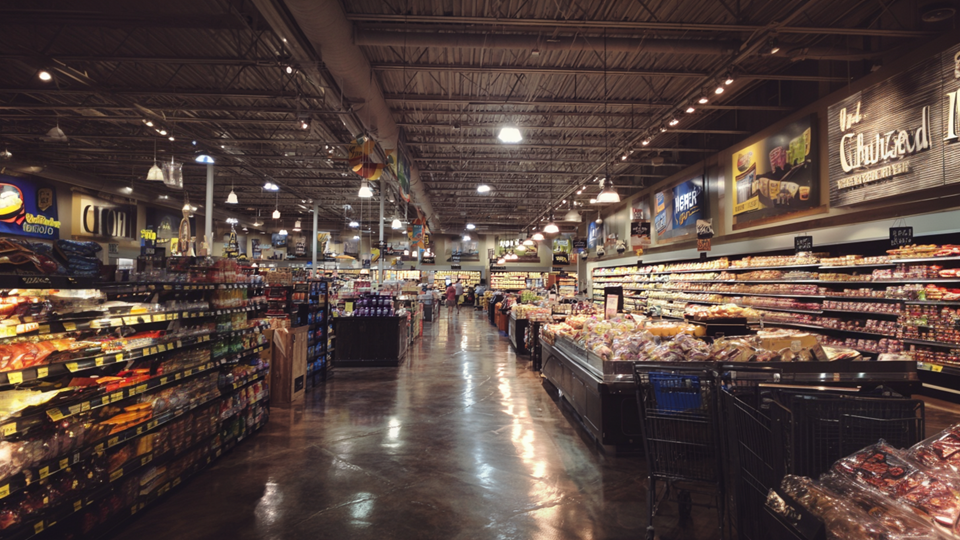
Kroger reported earnings that beat expectations driven by cost cuts (including plant closures and layoffs) but lowered its full-year sales forecast as shoppers—notably low-income households reliant on SNAP—pull back; SNAP disruptions account for roughly 6% of Kroger sales. In response to weaker sales and aggressive price moves from Walmart and Target, Kroger has expanded permanent price cuts to more than 3,500 items (up from ~2,000 earlier in 2025) and is leaning into its Simple Truth and Private Selection private-label brands (over $32 billion in sales last year) to defend market share, a strategy that may protect volume but pressure margins.
Market structure: Large-format discounters (WMT, TGT) are net beneficiaries—their scale lets them match or exceed Kroger’s 3,500-item cuts without as much margin stress, pressuring market share of mid‑tier grocers. Kroger (KR) will defend with private labels (Simple Truth/Private Selection: ~$32bn sales) which can expand gross margin if penetration rises by 200–400bp over 12–24 months; dollar stores and value channels will gain from SNAP pressure. Targeted cuts in fresh meat/produce signal demand elasticity at the margin and put downward pressure on spot agricultural and meat prices over quarters, modestly negative for protein commodities but supportive for CPI food core components.
Risk assessment: Tail risk centers on policy (another SNAP lapse or benefit cut) which can swing ~6% of Kroger’s revenues and could produce a 3–6% EPS hit depending on operating leverage; second‑order risks include accelerated price wars among top 3 grocers and higher last‑mile costs if delivery mix rises. Immediate (days) risk: post‑earnings knee‑jerk vol in KR/DASH; short term (weeks–months): margin compression and share shifts; long term (quarters–years): private‑label scale and cost cuts may restore EPS. Key catalysts: next 90 days of competitor price moves, Q3 comps, and any SNAP policy headlines.
Trade implications: Tactical pair: establish a 2–3% long in WMT and a 1.5–2% short in KR (or buy KR 6–9% OTM 3‑month put spread) to capture relative pricing power while limiting downside. Consider a 6–12 week bearish option on DASH (buy 3‑4% notional in 2–4 month puts) if Instacart volumes fail to monetize higher margins; sell covered calls on WMT to finance. Rotate 4–6% from discretionary into staples/consumer defensive ETFs over next 1–3 months; rebalance if KR outperforms WMT by >10%.
Contrarian angles: The market may underappreciate KR’s private‑label leverage—if private brands grow 5–8ppt penetration over 12 months, KR can recoup 50–150bp of gross margin, making deep shorts risky. A disciplined dip-buy: if KR trades down >15% post‑earnings, consider establishing a 2–3% recovery long with a 6–12 month horizon. Watch supplier consolidation: prolonged price pressure could force supplier M&A, accelerating private‑label adoption and structural share shifts over 2+ years.
AI-powered research, real-time alerts, and portfolio analytics for institutional investors.
Request DemoOverall Sentiment
mildly negative
Sentiment Score
-0.25
Ticker Sentiment
